Frontera Sur
There is no better place for a desert road trip than Baja California, Mexico
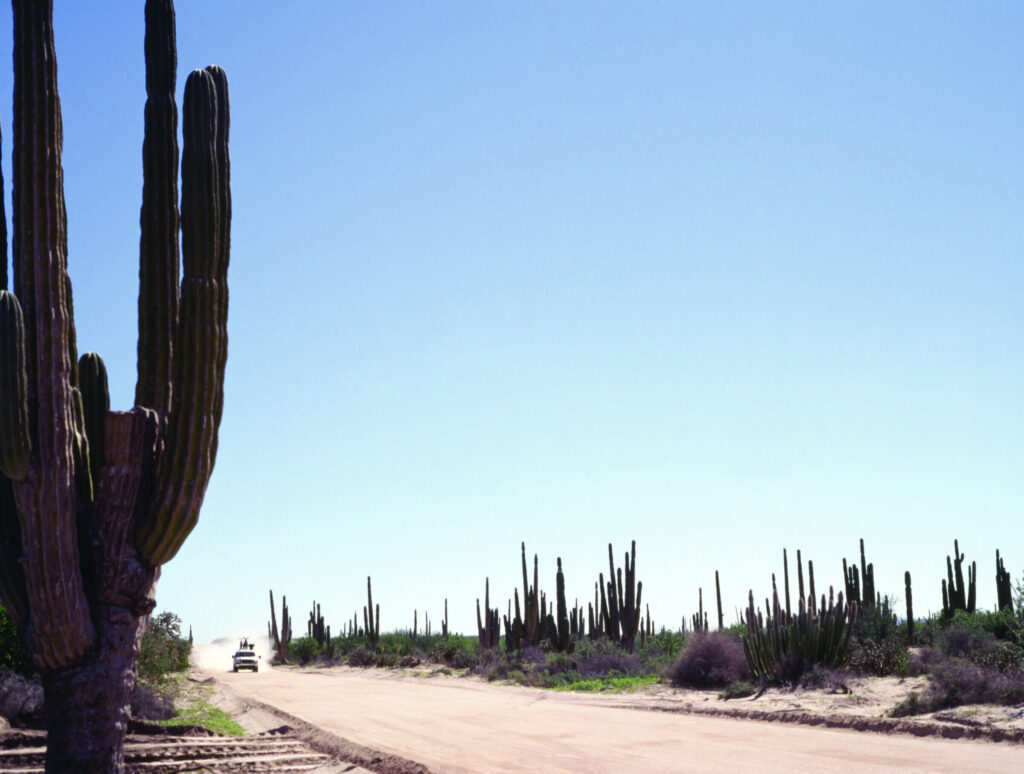
We’re driving south over a bad road. We’re driving south over a bad road because in Baja California even the good roads are bad. As for the bad roads themselves, well, they’re another whole level of bad. But each bad road in Baja California is bad in its own way, and if you spend enough time driving south of the border you become a connoisseur of them, a sort of bad-road snob, and you grow to appreciate, even respect, the many fine and subtle ways a road can be bad.
In Tijuana, for example, Mexico 1 features curves that tighten too sharply or drop away off-camber, exits requiring lane changes across speeding traffic, and grades more suited to a mountain pass—all typically experienced amidst a turbid mix of American SUVs, overloaded local jalopies, and ancient delivery trucks.
In Bahía de Los Ángeles, one encounters a moonscape of potholes; in Maneadero, unmarked speed bumps the size of redwood logs. In those cases “bad” means a certain, almost charming unpredictability, a piquant rebuke to our north-of-the-border notion that highway driving involves a degree of monotony.
Then there are the obstacles: black cows crossing in the middle of the night, pedestrians on the road surface, and (rumor has it) banditos that could steal your vehicle. There are stories of police who will stop you for nonexistent traffic offenses and relent only when you pay a “fine” on the spot. Indeed, the last occurrence even has its own name, mordida (literally, “bite”), and travelers often set aside cash just in case. As for me, I’ve driven in Baja so many times and never encountered mordida—much less banditos—that I feel a little cheated.
There are three of us, driving south in a big truck. The idea was mine—a dash through some of my favorite wild country—and I’d talked two of my more spontaneous friends into joining me. One is Sinuhe Xavier, a photographer, all-around outdoor athlete, and frequent traveling companion. The other is David Craig, a New York-based journalist and one of my dearest friends from high school. It’s his first Baja road trip, his first time camping in years, and I’m thrilled he’s here.
As we leave the border traffic behind, we’re committed to a road trip whose promise is limited only by the laws of time and space. I could spend months in a Kerouacian ramble, or set up camp and never come back. But we have jobs, commitments, schedules—and less than two weeks to get back to them. So we’ve given ourselves twelve days to drive two thousand-plus miles to Cabo San Lucas and back, to see how much of Baja we can grab for ourselves. With luck, we’ll swim at Land’s End, dive with giant mantas, ride desert singletrack, dip our paddles in mirrored water, and see waves from inside their curling tubes. Six jugs of gasoline are strapped to the roof, insurance against the sometimes unreliable filling station network. We have three mountain bikes, two surfboards, one body board, five boxes of Pop-Tarts, two pounds of Turkish-grind coffee, a case and a half of Red Bull, a telescope bought at Costco for about a hundred bucks, two packs of Immodium-D, and one extra-large bottle of Hershey’s chocolate syrup. We have music, an atlas, and all of Baja laid out before us. We’re driving south, driving south over a bad road that’s guaranteed to get worse, and we couldn’t be happier about it.


Mexico 1 zigzags back and forth across the peninsula, connecting the biggest communities like a lace on a boot, occasionally running straight along a coast but mostly just aiming diagonally from town to town. There are a few other highways up near the border, a few spurs, and a loop at the end, but the Transpeninsular Highway is basically it, a lone ribbon of scabrous asphalt connecting north to south.
The road’s completion in 1973 brought a measure of predictability and tameness to the journey, but not much: In most places, the peninsula is just as primal as when Spanish sailors first landed in 1533, thinking they’d arrived on the island of Califia, home to a tribe of giant warrior women and their troves of precious metals. Oh, to be sure, the two ends—the border strip and Los Cabos—teem with people and commerce. Cabo’s tourism growth has been shocking, with a seemingly endless string of luxury resorts guarding its beaches, villages of golf courses, and a consumer culture that supports everything from high-end jewelry stores to bars owned by rock stars, but that’s due more to the arrival of shining 737s than a thousand-mile run of pavement. Despite the growth, despite the road, the vast stretches between Tijuana and Cabo are still empty, rugged, traditionally Mexican, and somewhat lawless. If you’re self-reliant, this can be liberating, but there’s little in the way of safety nets. Credit cards are often pointless, and throughout much of the land a cell phone is about as useful as a feather boa. It’s no accident that the Baja license plate says “frontera“—frontier; whether that’s a boast, apology, or warning, I don’t know.
A day into our trip we find ourselves in a long, flat stretch of desert. Joshua trees guard the road and lean toward the south, as if they, too, want to know what’s at Land’s End. Up ahead we see a gaggle of soldiers and a military barracks. Unlike the checkpoints we’ve already encountered—forlorn little bunkers manned by post-adolescent Army recruits—this is a permanent facility, and the policia are serious and tough-looking. The commander is stone-faced, at least until the men searching our truck open the cooler.
“Tienes Red Bull?” he asks, a grin on his face. You have Red Bull?
“Le gusta, señor?” You like?
“Sí sí sí. Me gusta mucho.“
I dig around in the ice, pull a cold, dripping can out of the cooler.
Sinuhe psssts at me. “Dude! What are you doing? That stuff is precious. We’re gonna run out.”
“It’s okay, man. Share the wealth. Think of it as karma.”
The captain cracks open the Red Bull and waves his men away from the truck. He gestures toward the open road. “Adios, amigos.“

Our first camp is on an empty white sand beach on the shore of Bahía de Los Ángeles in the Gulf of California, reached deep in the night after fifteen hours of driving and a hustle to get far south of the border fast. Sinuhe pulls out his sleeping bag and crashes on the sand, but the stars are luminous and razor sharp and I’m too road-wired to sleep. David and I set up the telescope and dial in the spiral Andromeda Galaxy, the Orion nebula, the sparkling Pleiades star cluster, Saturn and its rings. When he finally slides into his bag, he is still in awe.
Alone now, and still abuzz, I motor the scope over to Jupiter and take in the storms raging on its surface. If I could avoid sleep altogether, I would. No matter how much time you have in Baja, it never seems enough. I putter with the telescope until two and then I wake up from excitement before first light in time to see Venus rise. Still in my bag, I fumble for the camp stove and portable espresso maker.
I roust the boys with a pan of chilaquiles and my standard road-warrior wakeup—four shots of espresso, two shots of Hershey’s. In short order, we’re in a nearby village buying gas from someone’s backyard tank (the only fuel source for a hundred miles) and then we’re headed back into the interior. The Gulf of California shrinks in the wide mirrors of the truck as we push deeper into the desert, farther from liquid and life. I wonder if this is how the Apollo astronauts felt as earth receded and the moon approached. The water behind us is deep, deep blue, but we’re entering a world where the colors are pale, dusty, and bleached. The sky is a thin pastel wash, and even the pavement is light gray, as if it lacks the energy to fight the sun.
We turn off the highway onto dirt and head across mountains. When the road isn’t washboarded, it’s broken with stair-step drops, reducing the average speed to about six miles an hour. Here is a whole new level of bad, a kind of enforced, unpaved intimacy with the underlying geology. Bedrock, erosion, sedimentation—it’s all right under our wheels.

Being from the United States, where beach camping is almost universally forbidden, I still get a subversive thrill out of being able to roll out a sleeping bag on virtually any beach you see. On this night it is Punta Chivato, on the gulf. David plays it safe and drops his bag well up in the dunes, but Sinuhe and I sleep close to the high-water mark, drawn by the lullaby of wavelets. In the morning, the tide has drawn to just a couple paces from our feet, and there, in the shallows, a giant squid is basking. It hangs out, squirts water, lounges, and then drifts away, as unhurried, for the moment, as we are.
Time shifts, expands, stretches in odd road-trip ways. Days become a blur of shimmering heat mirages, wind-swept waters, fresh fish tacos bought on the side of the road, ninety dollar fill-ups, vultures sunning their wings. We swim in the jewel of Baja, Bahía Concepción, and linger on a narrow isthmus. We hike through vast stands of cardón cacti sprung green by the rains of a hurricane and we scramble up the peaks of Sierra de la Giganta, named for the tribe of legendary women, not for the mountains’ stature.


David is on a pilgrimage from city boy to Mexican desert rat: He has backed into a cholla cactus and had it break off in his rear, but his early nervousness over a police shakedown or bandito holdup is receding, and every day he makes and breaks his camp faster. Sinuhe isn’t new to any of this, but unlike David, he is bumming. It’s a running joke between us that at any given time you are either a magnate or a victim. When things are going well, you are a magnate and you’re gleaming. When things go poorly, you are a victim and you’re bumming. Sinuhe, unfortunately, has lost a filling in his tooth, and with every passing moment the throbbing gets worse. Sinuhe is a victim.
“Magnate?”
“Yes, victim.”
“I need a dentist.”
It’s Sinuhe’s good luck that we’re pulling into La Paz, a city of several hundred thousand on the Gulf of California and the capital of the southern state of Baja California Sur. Within an hour he’s prone in a dentist’s chair beneath a TV playing Mexican music videos. Around him, the walls are decorated with photographs of seafood, the kind you might see in a diner on a Massachusetts wharf, but a few hours later the tooth is gone, Sinuhe’s jacked on painkillers and antibiotics, and victimhood is drifting away in a Vicodan haze.
La Paz in the evening is like a soft summer dream: a gentle breeze, a lovely waterfront causeway, families strolling with ice cream cones, live music. We should linger, we should send for our families and live here forever, but instead we hire a boat and turn our backs on the mainland. Isla Espíritu Santo, the island of the Holy Spirit, adrift in the Bahía de La Paz, greets us with open arms, and we slide between them into calm and sheltered bays, each empty but for cactus sentinels and silent rocks.
Although we see only a handful of others, people travel from all over the globe to paddle the changing waters of Espíritu Santo. Indeed, the Sea of Cortez’s lustrous blue, La Paz’s bustling community, the nearby international airport, and a well-developed outfitting infrastructure make the region one of Mexico’s premier adventure-travel destinations. For me, and maybe for the majority who come, it’s worth the journey just to sit in an outfitter’s camp under starlight and eat ceviche made from octopus taken right off the reef, but the kayaking is something else, too. We float on molten glass, slip through keyhole caves, and drift past soaring cliffs as we circumnavigate Isla Partida, Espíritu Santo’s northern satellite.


I pronounce the kayaking our high point so far, but that doesn’t last long. We paddle to Los Islotes, a trio of rocky islets where the southernmost population of California sea lions raises its young. Donning snorkeling gear, we slip out of the boats into the cool shadowed water. It’s dark, moody, and a little freaky as sea lions zoom by us on reconnaissance, black missiles caught in the corner of the eye, but the more I see them the more comfortable I feel. By the time we stumble upon an underwater cave that serves as a sea-lion playground, I’ve lost my fear of being bit, bumped, or dragged under and held hostage for a bucket of fish.
The cave is thick with pups, most just three months old and about the size of small Labrador retrievers. When we first arrive, they are shy, black shapes peering out from the cave, but our guide Kim mirrors their movements, hanging upside down, keeping arms and legs close to her body, and soon they venture out and grow bolder.
A female, gray on top, brown underneath, swims to David. She is two hundred pounds and six feet long, and she gets right up to his face. I come in close, and she turns to me, her whiskers tickling my cheek, her nose almost touching mine. Her eyes, just inches away, are huge brown globes. Her fur is soft, sleek, her ears tiny. A wave carries our heads above water, and I feel her sniff my hair.
Her pups get jealous and snuffle between us, but she chases them away. We’re hers.
The puppies dive to the bottom twenty feet below. They wrestle each other like dogs, chew on each other’s flippers, and chase their own tails. They blow bubbles, then race them skyward and bite them before they reach the surface. They blow bubbles beneath us, too, and the feeling of puppy breath tickling my chest makes me shiver from something I can’t begin to describe. One little guy sends aloft a giant bubble, and as it rises toward me and I reach out my hand to catch it, I spy my own reflection in its curving mirror—the giant hand, the floating body, the silver surface—and past it, through the bubble, I see the sweet brown eyes of the sea lion looking up at me.
I never, ever want to leave.
Every day is clear and sunny, every day is hot. Leaving water, any water, for the interior requires a girding of psychological underpinnings that typically eludes us. If it’s ninety-five degrees here on the coast, inland it must be, what, a hundred and fifty? Throw in the fact that the only bike rides our research turned up were long, grueling climbs on dirt roads and it’s not surprising that days go by without the bikes ever moving off the roof.
“Sinuhe, why did we bring bikes?”
“Uh, because we’re victims?”
“Precisely.”
But even a blind pig finds a truffle every now and then, and we come into the possession of a crude, hand-drawn map of a network of singletrack on the coast of the gulf, just outside Los Barriles. It leads us to a ridge above shining waters, and we sweat and grunt our way along the top.
The trail is magnetic, the distant mountains alluring. David is more trail runner than mountain biker, and as day becomes evening he has the good sense to turn back. Sinuhe and I, though, chase each other to catch the sun, hammering to see as much as we can before the light is gone, and then we’re slaloming between twenty-foot cacti under pink, fish-scale clouds. In seconds, it seems, the clouds turn gray, then black, and then we’re without lights a long way from the truck and a longer way from home.
We turn downhill and ride fast, Sinuhe in the lead, me a bike length behind. Cardón cacti line the trail and lazy cholla branches droop at the apex of every turn. We blur in the thickening dark through a gauntlet of a million tiny needles, but we ride without fear because whoever built this trail knew what they were doing: It is absolutely simpatico with the unique rhythms of a fast-moving mountain bike.
But then Sinuhe shouts in pain, I do, too, both of us victims of a hanging cholla branch that rakes our right arms with spines. Moments later, a patch of a stinging plant known as caribe sets our shins on fire. The light is almost gone and there’s no time to stop, so we suck it up and keep rolling, even faster than before. More chollas slap me in the now-dark, but I’m flowing with swooping speed and catching glances of the sliver moon climbing out of the Gulf of California, alive with the knowledge that even with the pain and darkness—maybe because of the pain and darkness—I can’t possibly imagine this ride or moment being any better.

The next day, five of our six bike tires are flat and my index finger is swollen from a stubborn spine that will, in the end, leave a permanent bump on my knuckle. It’s funny: We’d crossed the border in fear of getting bit by the police, but it’s biological Baja that’s laying la mordida on us. I’ve been stung by jellyfish, poisoned by a plant, punctured by cactus. Sinuhe is covered with mosquito welts, has had a tooth yanked, and suffered broken blood vessels in both eyes from scuba diving. “You know, I really love the desert, but I am getting tired of being bitten, pricked, and stabbed,” he says.
Me too. On the other hand, I’ve been nuzzled by a wild sea lion. I’d say I’m still way ahead.
Like a tiny pebble in a sock, we eventually work our way down to the toe. Crossing the Tropic of Cancer, coming to Land’s End, it seems that there should be great ceremony in the symbolism, but there isn’t. The main intersection in Cabo San Lucas is bounded by a t-shirt stand, a strip club, and a Burger King, while the city itself is ringed by plush resorts. During breakfast at one of these, Sinuhe gestures at the manicured lawns, swimming pools, and golf courses. “This is beautiful,” he says, “but I can’t wait to get back to the real Mexico.”
So we go. And we surf on empty waves, sleep on more beaches, down Red Bulls, and drive at night. We keep moving because Baja is long and our days are short.
Then, after a long, flat stretch of desert where the Joshua trees lean south, we are waved to a stop at a military checkpoint. It’s late and it’s dark and the desert is getting chilly. The commander hunkers in his coat and scowls at us. He doesn’t like being out in the cold and he doesn’t like what he sees in us. He grills us in rapid-fire Spanish. Where have you been? Where are you going in the night? What’s in your truck?
Sinuhe interrupts him. “Hey, hombre, you’re the one who likes Red Bull! Hey, remember us? We gave you a Toro Rojo!“
Recognition breaks across his face. “Sí! Sí, sí! Mis tres amigos.” He smiles, pulls a hand out of his coat, and dismisses us. “Vamonos, amigos! Hasta!“
Sinuhe, the magnate, puts the truck in gear, and we pull away into the blackness. We’re driving north. We’re driving north through Baja California, and the road, it’s not bad at all.