Mojave Rattler
For half a century, Desert magazine was gritty and provocative and full of love for American drylands

Ed Abbey wasn’t the first grumpy dude from back east to fall in the love with the desert and then spend the rest of his life writing about it obsessively, not by a long shot. Randall Henderson was born in Iowa in 1888 and headed west in 1907, a year before Model T automobiles were sold to the public, to study at the University of Southern California. For vacation money, he became a “fruit tramp,” riding on top of boxcars to pick cantaloupes in the Imperial Valley, where he got his first real taste of the Mojave, a desert seemingly without vanity. A gig with the Los Angeles Times in his senior year diverted him to journalism, and he moved from desert town to desert town, banging out copy for local newspapers, finding time in the middle to fly planes for the Army air service in World War I.
After Armistice, Henderson cajoled a local real estate agent named Ralph Seely into paying five thousand dollars for a Curtis Jenny JN-4H two seater still in its crate, trading flying lessons for use of the craft, which he piloted all over the desert, becoming the first person to land an airplane in Las Vegas (from Blythe, California, on May 7, 1920, requiring two fuel stops). In World War II, his skills undiminished, he volunteered for service again, flying in Africa while in his fifties.
By mid-century, Randall Henderson of Shenandoah, Iowa, USC matriculating class of 1911, was well on his way to being the Most Interesting Man in the World.

In July 1936, Henderson and his friend and fellow newspaper scribe J. Wilson McKenney were sitting atop Santa Rosa Mountain, a short condor flight from Southern California’s Coachella Valley, lamenting the lack of a publication devoted to the wild arid lands they’d come to call home. As they would later write, “Nearly every creed and industry and locality has its journal—except the Desert. Here, within the boundaries of Arizona, California, Nevada, New Mexico, and Utah resides a great family of human beings—the highest type of American citizenship—with a common heritage of environment and interest and opportunity, yet residing for the most part in regions that are remote from the so-called cultural centers. This is the last great frontier of the United States.”
Alaskans might take issue with the last frontier stuff, but the two were correct in that the deserts of America were mostly considered wastelands, appreciated only by hard rock prospectors, Native Americans, and the handful of people who saw beauty and utility in that sere, forbidding landscape. Henderson and McKenney went deep into the Mojave, the Colorado, and the Sonora when cars barely existed, air conditioning was decades in the future, travel was by foot or horse from water source to water source, and survival depended on good judgment, hard-won knowledge, and luck. They appreciated having earned their bones the tough way and felt kinship with others who’d done the same, and it was for these folks that Desert magazine was launched in 1937 out of El Centro, California.
The first issue dropped in November and carried a cover price of twenty-five cents, or two-fifty for a year’s subscription. With Henderson as editor and McKenney as business manager, they printed seven thousand copies. Writing of “two deserts,” their inaugural editorial staked out a vision that still resonates. The first “is the desert seen by the stranger speeding along the highway, impatient to be out of ‘this damnable country.’ It is the desert visualized by those children of luxury to whom any environment is unbearable which does not provide all of the comforts and services of a pampering civilization.”
“The other Desert—the real Desert—is not for the eyes of the superficial observer, or the fearful soul or the cynic. It is a land, the character of which is hidden except to those who come with friendliness and understanding. To these the Desert offers rare gifts: health-giving sunshine—a sky that is studded with diamonds—a breeze that bears no poison—a landscape of pastel colors such as no artist can duplicate—thorn-covered plants which during countless ages have clung tenaciously to life through heat and drought and wind and the depredations of thirsty animals, and yet each season send forth blossoms of exquisite coloring as a symbol of courage that has triumphed over terrifying obstacles…This is the Desert that men and women learn to love.”

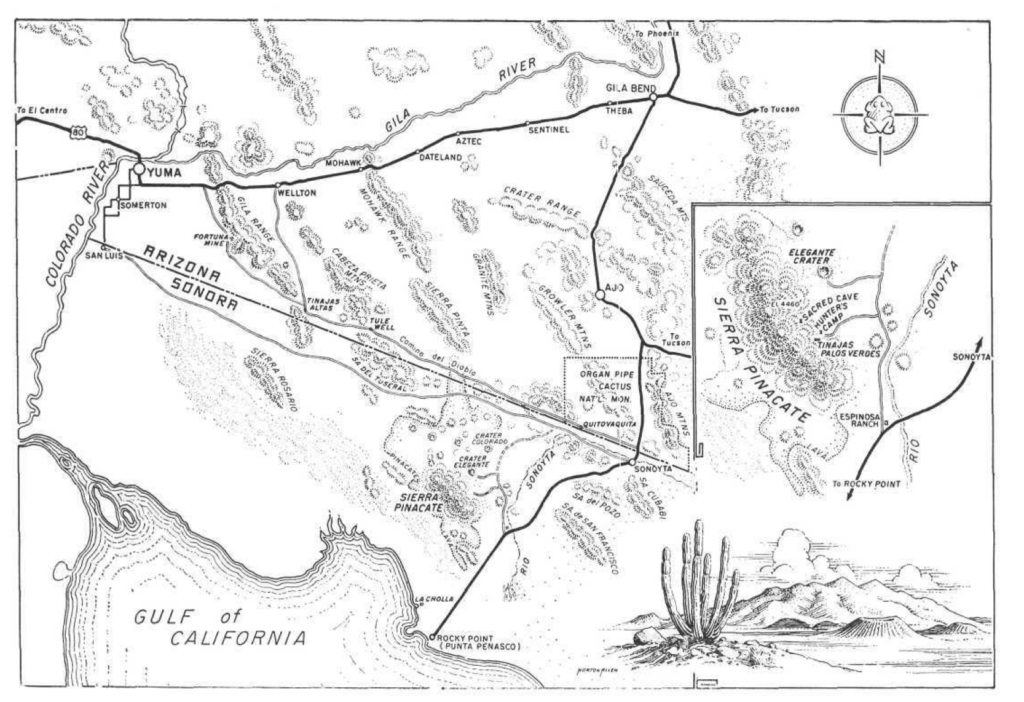
The magazine grew in circulation but struggled financially, and McKenney departed after a few years to earn enough to support his family. Henderson stayed at the helm, guiding an editorial philosophy that was consistent and uncompromising. From the get-go, he understood that the desert is fragile, and he called early and often for its protection, even as others viewed the drylands as a waste, or a dumping ground. He treasured local knowledge—the first story in the inaugural issue was an ode to greasewood, the second a profile of a Tucson plant scientist. Desert magazine covered rock art, geology, and climbing. It published poetry and the work of artists. Its maps, drawn by Mary Hall Atwood and Norton Allen, were ambitious and beautiful. Just two years after he disappeared in Utah’s canyonlands, it ran letters written by vagabond-poet Everett Ruess. It celebrated Native American culture, albeit sometimes with a patronizing manner.
It was a product of its time, for good and definitely sometimes bad, but also, thanks to Henderson, it was farsighted and wide-ranging within its scope. Even today, Desert is a compelling read (all five hundred thirty-four issues are available online for free), a window into a bygone world. Take its regional reports, missives sent back to Henderson by post and phone. From Blythe: “Lee Harden, farmer, killed and ate a young rabbit. Ten days later Harden developed symptoms of what he thought was influenza. His physician blamed the rabbit.” From the Henry Mountains: “Dr. Frederick J. Pack of Utah University recently declared that this is one of the most inaccessible regions in the country. Surveys are now underway to determine if any valuable mineral resources exist in this area.” From Yuma: “‘This is Hell.’ Lynn Jude, forty-nine, prospector, scrawled these three words in the desert sand before he died of hunger and thirst in the barren Gila Mountains sixteen miles southeast of Yuma. A searching party in May found Jude’s body, nearby an empty canteen, and the message.”
For all the respect its editorial garnered, Desert was never a roaring financial success. Henderson said its best years were when he was stationed in Africa and the magazine was run by his daughter and two other women. “Maybe I should have left earlier,” he said, “because under the direction of the girls the magazine showed a profit for the first time.”
In 1948, Henderson moved operations to Palm Desert in the Coachella Valley, adjacent to Palm Springs, hoping to open a museum of the American desert (lack of funds thwarted that idea). He co-founded the Desert Protective Council and was instrumental in the efforts to create the preserve that is now Joshua Tree National Park. But his dreams of keeping the magazine in the family were crushed by the death of his son, who was killed in the South Pacific during World War II. (It’s unknown why it didn’t pass to his daughter.) In 1958, at age seventy, Henderson sold the magazine, circulation thirty-two thousand, to Charles E. Shelton.

It didn’t take long before Shelton plastered a garish color box behind the iconic logo and introduced a subtitle, The Magazine of the Outdoor Southwest. Five years later, Shelton sold it to Jack and Choral Pepper, who splashed their covers with blurbs. They changed the subtitle to The Magazine of the Southwest and a year or two later tried their luck with The Magazine of the West. Without Henderson’s gruff and steady hand, Desert was morphing from a tightly focused book for hardcore desert enthusiasts to a softer, gentler, and clearly flailing lifestyle magazine. (Sunset magazine, published since 1898, was stiff competition.) It would not succeed: After a series of ownership changes and a fitful publication schedule, Desert went bankrupt in 1985 and ceased production.

Henderson didn’t live to see his journal die; he passed away in 1970 at age eight-two. But he was profiled by Jack Pepper in the March 1964 issue and seemed unruffled by the changes time had brought.
“The desert has lost none of its natural charm,” he told Pepper. “There are still thousands of little known canyons to be explored, trail less mountains to be climbed, rare species of plant life to be discovered, and lovely places where there is solitude for those who are aware of the tonic value of close communion with the natural world.”
“As one of the old-timers I do not resent the coming of golf carts and heated pools, cocktail parties and fabulous profits in real estate. I can live with these things. But I do object to the Chamber of Commerce fiction that they are a gauge of ‘progress’. For the desert has taught me that the professor in my philosophy class of long ago was right when he told me that true progress takes place only in the human heart and mind in the broadening of vision and understanding, the strengthening of the qualities of tolerance and generosity and humility.”