The Economics of Vanlife
What's the cost of living the dream?
I paid $32,500 for my Volkswagen van, which was nineteen years old at the time of purchase. When my wife told someone I’d paid “thirty-two five,” the person on the other end of the phone said, “You mean, thirty-two fifty,” to which my wife said, “No, thirty-two five,” and they repeated this cycle two more times until it became clear to them that I’d dropped three years’ worth of state university tuition on a vehicle known for its unreliability. Sorry, kids.
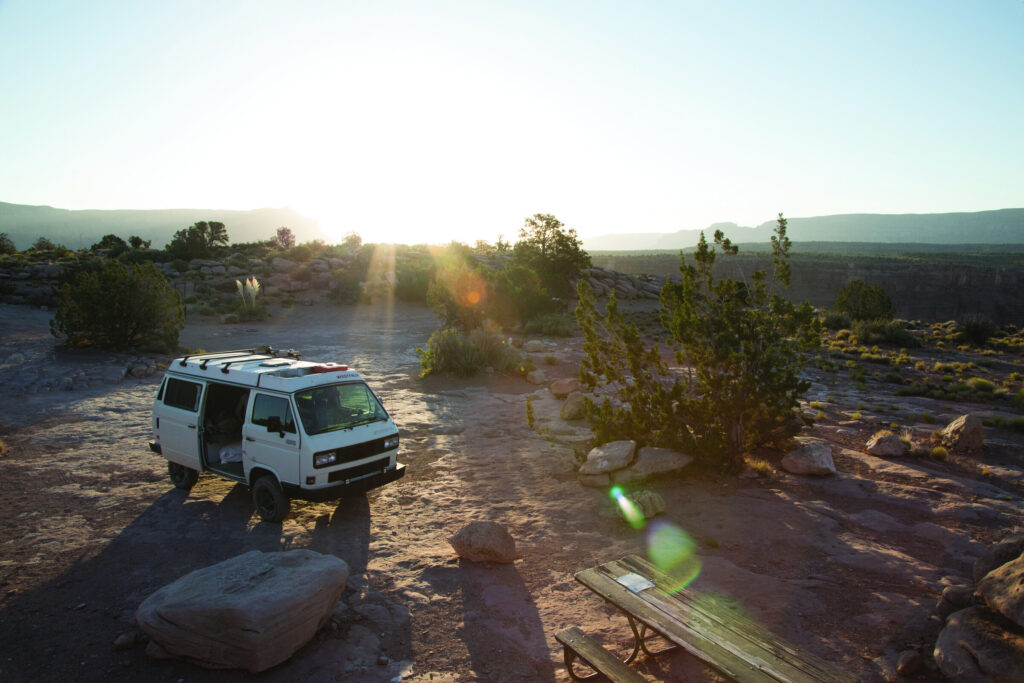
On the other hand, it was one heck of a sweet rig, and uncommon to boot. My new whip, soon to earn the name Vanzilla from my children, was a full Westfalia camper Vanagon Syncro four-wheel-drive. In Vanagon circles, they don’t come much sweeter. Between full campers, half camper Weekenders, and passenger vans, VW imported just fifteen hundred of these 4WD Syncros to North America between 1985 and 1991. Rare to begin with, they were rarer still after decades of crashes, engine fires, and all the other mishaps that can befall a small and cheaply made mini RV. Although there’s no comprehensive Syncro registry, certainly those with the full monty setup that I had—pop-top roof, sleeping for four, cabinets, sink, and two-burner stove—numbered in the hundreds.
The purchase was the culmination of more than a decade of dreaming, plotting and planning. In the 1990s, I discovered Sportsmobiles, the monster trucks of camper vans, which are righteously capable but also righteously expensive. I might as well have been kicking the tires on a lunar module. Then, in the early 2000s, staging out of Gooseberry Mesa for some Zion exploration, I met a couple from Palm Desert driving a root-beer brown Syncro. Mistaking its limitations for those of the old split window microbuses, I said, “What in the world are you doing out here in a VW van?” “Dude,” said the dude, “you don’t even know. This has four wheel drive. It’s lifted. It has Old Man Emu shocks. It’ll go anywhere.”
They popped the top, invited me in, and proudly showed off their rig. The rear seat folded down to a bed that slept two. Above, in the penthouse, another two could drift off while looking at the stars through a mesh window. There was a small sink and a fifteen-gallon water tank, a two-burner stove that sparked instantly from a propane tank below, a fridge large enough for the essentials, and cabinets for everything else.
A walk around the outside showed that their Vanagon looked like an oversized burrito, but it was one good-looking oversized burrito. The lines were flawless, the angles just so, the aesthetic both singular and timeless. It was a delightful combination of charm and nonchalance, a vehicle that made you smile even just catching a glimpse out of the corner of your eye. It spoke of summer, and road trips, and back roads, and surf wax, Mexican blankets, and meteor showers.
And the kicker, the thing that blew my mind: a four-wheel-drive system that had been developed for the German military, with locking differentials front and rear and a low gear that could climb Angel’s Landing. Who knew? I hadn’t.
The world as I knew it was over. There was no going back. I wouldn’t be complete without one.
It was five years before the pieces felt into place, but when they did it was like solving a Rubik’s cube. The van I bought had extremely low miles: just sixty-three thousand. It was from California, purchased from a dealer in Santa Barbara and garaged there, with only two previous owners. The body had a few small dings, and a slightly yellowed panel showed evidence of an accident even if Carfax didn’t, but there was zero rust and a flawless interior. Best of all, the first owner had already replaced the anemic original engine with a Subaru Legacy, the only motor California’s notoriously picky Air Resources Board had approved for a swap, saving me the ten thousand dollar trouble.
So, yeah. After that initial gulp when the cash changed hands, I felt that, if anything, I’d gotten a bargain.
“These things get rarer every year,” I told my wife. “I’ll probably make money on this.”
She just smiled. It wouldn’t be the first or last rationalization she ever heard from me.

Lots and lots of people would be satisfied with a camper van that ran great and was clean enough to sleep in from the very first night.
I’m not those people.
There are two basic approaches to Vanagon ownership—you buy it and accept the flaws, fixing parts only as they fail, or you buy it to upgrade, improve, and polish. The latter camp further divides into two categories. You either do much of the work yourself or you buy an already restored rig from a commercial operation like GoWesty. These typically sell—are you sitting down?—for $80,000 and up. GoWesty makes the argument that in the end you’ll spend at least as much restoring your van piecemeal, plus having to do all the work.
“Even if you already own a Vanagon—or if GoWesty were to give you one for free—the cost to go through it from end to end just mechanically is at least twenty five thousand dollars,” the Central California shop writes in its extensive online knowledge base. “Folks bring them to us all the time, from all over the country, and when we are done the bill is usually between $30K-$60K. This may seem like a lot of money, but compared to ‘fixing it up as you go along,’ it is actually a bargain.”
I don’t know about a bargain, but, yeah, either way, the costs add up. From the beginning, actually even before I bought it, I knew the van would be a project and that I would do much of the work myself and that it would cost a lot. Over the year or so I spent in the thicket of Vanagon and off-road forums and scouring the country for just the right rig, I drafted a transformation from stock van to overlandia rock star, with a spreadsheet filled with tasks, parts, prices, and links. I knew the path, I knew the tally. The question when I got the van, then, wasn’t so much what to do or who would do it, but where to start. With dark window tint for privacy during those stealthy urban camps? With steel GoWesty bumpers to add some butch protection to a tin can with no airbags or even three-point belts in the back? With a decoupler so I didn’t have to run in four-wheel all the time? With a lift and new suspension?
Actually, I started with something more anodyne: soundproofing. Although I’d driven Vanagons prior to buying mine, I’d never actually taken one on the freeway, and the closest thing I ever had to buyer’s remorse was during the three hours driving home from Santa Barbara, when the decibels inside were so loud I couldn’t hear myself think, let alone talk on the phone or listen to music. Not too surprising, I suppose, but to someone accustomed to a well-insulated SUV, it was a shock. One that I wasn’t willing to accept.
So, first up, I gutted the inside. Much like a kid taking apart a toaster or lawn mower, I dismantled with glee, except having learned from childhood miscapades, I stored the hardware in well-marked baggies and documented each step of the process so I could get everything back together. Then I spent the next few weeks wallpapering the interior with peel-and-stick vibration deadener and insulating sound absorber. It added about a hundred pounds to the van and set me back eight hundred dollars, but when every last screw was back into place (less, um, three or four), you were able to motor down the highway at seventy miles per hour and converse in a normal voice. I could do this.
That was the first tumble down the rabbit hole, and with every passing year, with every refilling of the discretionary fund, I fell deeper into the joy of van projecting. I ordered the South African Rhein rims from Van Cafe, which to my eye are the most beautiful of Vanagon wheels, but not wanting to look like every other van, I spent a few hundred bucks to have them powder-coated black. I had the windows tinted, installed the steel bumpers, and dropped in a subwoofer, inverter, and secondary fuse box. I bolted driving lights to the bumper, ditched the crappy stock fridge and turned that space into a cabinet, then spent a pile on a portable ARB unit.
Meanwhile, the van got a lot of use. My kids were little, and they played in it almost 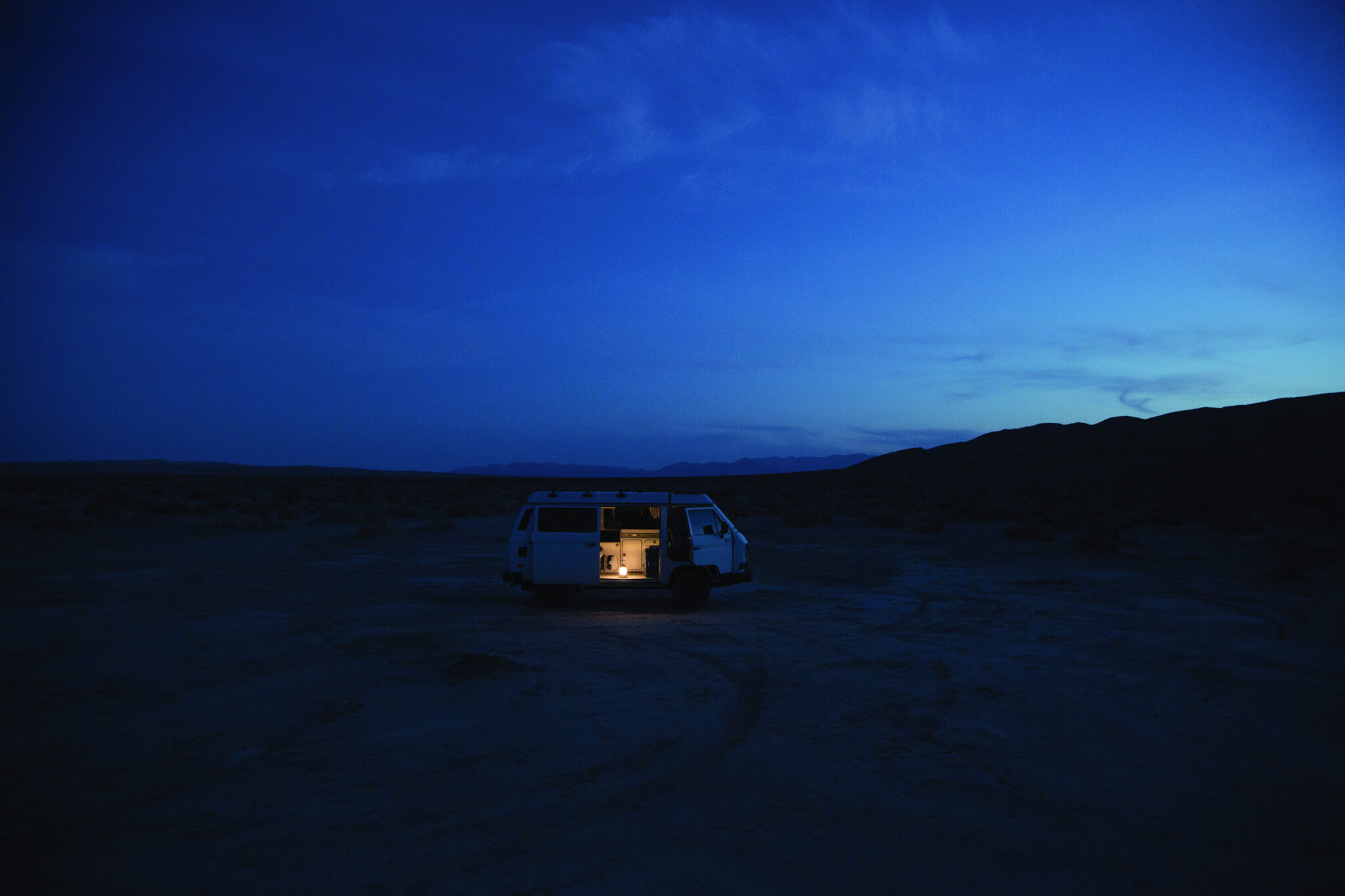
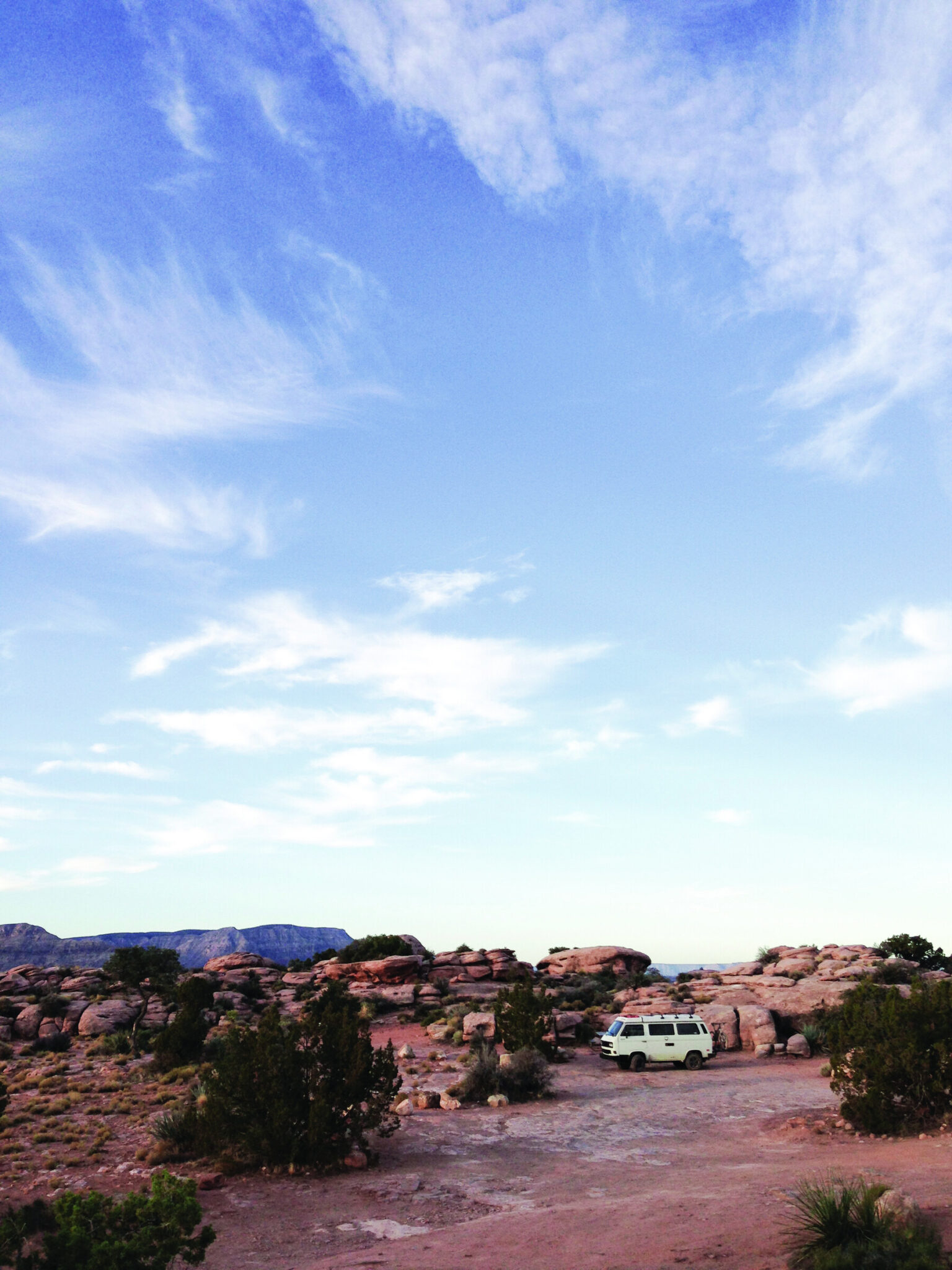
every day in front of the house. We went on weekend trips, we went on long trips. We drove to Oregon, we drove to BC. I took my seventy-something mom on a weeklong, all-dirt Utah road trip, then a few months later did the same thing with my seventy-something father-in-law. I spent a month working out of the van in Moab. I took my niece to the North Rim of the Grand Canyon, then my nephew.
Life in Vanzilla transformed my sense of capability, of potential, even of self. In a snowstorm on Teton Pass, I booted up in warmth and comfort—then returned after some laps high on powder for a warm cup of coffee and dry clothes. At Muley Point, with the wind howling outside, my mom and I shared tears over the news that her brother had passed. In Big Sur, I fell asleep to the giggles of my son and daughter in the bunk above. Back on Gooseberry, my amigo Sinuhe and I made dinner and shook off a post-ride chill while rain turned to snow. Vanzilla provided coziness, intimacy, and a sense of connection that no other vehicle could—it was home, it was home in some of the wildest landscapes in the West, and I’d made it mine.
I knew what I was getting into with my van, or at least I thought I did. I’d spent enough time in Vanagon forums to know people by their style of writing. I had a spirit guide who’d resto’d several Vanagons. The warnings were there, loud and clear, and my eyes were open to the quirks and foibles and nagging hassles of van ownership. These things were money pits. I knew that from the get-go.
But knowing something and living something are two very different things. Try feeling your clutch act up crossing the border into Canada, then watching the throwout bearing die when you’re still two miles from your crash pad in Whistler. Try watching the ignition give up the ghost, then the lights go out, when you’re working on a movie on Robber’s Roost, and you can only drive at night by pulling back and holding the stalk for the high beams, which miraculously still function. Or having those lights, too, die at ten o’clock on a Friday night in Kayenta, so that you have to find a place to camp instead of driving home, but it has to be on a hill because popping the clutch is the only way Vanzilla will start, and there’s only one hill in Kayenta and it’s in a neighborhood where you suspect the Navajo residents may be highly suspicious of a white dude in a California van angle-parked with nose pointing downhill to get a running start in the morning.
Such incidents come with vanlife. And if you travel in vanpacks, maybe that’s okay. But I don’t. Because of my schedule, and also inclination, a lot of my trips are solo, and I like to go deep. But over time, after about one major stranding a year, I became so nervous about the reliability of the van, I began to have a hard time enjoying myself. Yes, I learned to fix a lot of things, and that’s cool, but when the serpentine belt breaks halfway to Toroweap and the battery goes and you don’t have a spare belt because you just replaced it a week ago and didn’t yet get a new one, well, it’s a drag. Or when you’re driving across the Tushars and find an amazing aspen grove to have lunch and take a nap, but you don’t know if the van will start so you leave it running the whole time while you sleep, it’s just plain dumb. Perpetually, I suffered a low-grade anxiety stemming from lack of trust: What would Vanzilla do, or not do, next?
Between repairs, upgrades, and customizations, I’d hazard I spent at least two thousand dollars a year. It was in the budget, yes, but spending it got old. The mechanical stuff was easy enough to catch and repair, and rewarding, but the infuriating electrical demons made for a constant game of whack-a-mole. Between the shoddy VW power system and the Frankenrig modification of the Subi engine, it eventually became obvious that I would never, ever track down every last sparky bug. And if that was the case, I would never, ever be able to fully relax out there, no matter how much energy or money I spent on it.
The end came in late 2015. I was headed out for a couple nights in Southern California’s San Jacinto Mountains. Before leaving, my wife and I joked about “if I got there.” An hour later, I was stuck on the 60 with a dead engine. When I called her, she laughed at the irony, and I dropped a particularly spicy f-bomb in response, only to learn that I was on speakerphone and she was driving a carful of kids. AAA sent a flatbed—the first thing any Vanagon owner should do is purchase the extended AAA service, trust me on this—and five hours later I was back home, the van deposited outside the mechanic’s in Costa Mesa.
We got it working again. Well, Joe Schoening of Europro got it working again. He’s a freaking Vanagon whisperer, that guy. A few weeks later, I was able to get back out for that trip in the San Jacintos. I hiked the PCT along a spiny ridge for a few hours, then returned to the van, cooked up a feast, and had an amazing night at seven thousand feet. Around two a.m., it snowed, flakes caressing the fiberglass top and whispering in my dreams. I woke to a wonderland and then went down the hill to explore Whitewater Preserve, where post-storm puffies scudded across the sky and mountain lion tracks traced the banks of a rare, year-round desert river. What a trip!
But. But, on the freeway home, the van kept stalling. Whenever I’d push in the clutch, the engine would die. Restarting it in neutral while rolling, cars zooming past, killed the battery. I limped to within fifteen miles of home and then the whole thing shut down. Another flatbed ride, and back to Joe.
This time, Joe had the van for a long time. Among the issues he found, the wiring harness was shot. He tested a functioning harness from another customer’s van, and Vanzilla fried that one, too. Unfortunately, wiring harnesses for Legacies modified for Vanagons are neither cheap nor easy to come by. Joe had no idea where to source one. Neither did my spirit guide, nor the Samba forum. I finally found a shop in Berkeley that hired a dude in eastern Canada to scour junkyards for dead Subarus. By the time he found one, Berkeley modded it, and Joe installed it, the better part of a year was gone.
I was done. I was over it. I made the decision to sell, told some friends, and got a lot of exclamation point-filled texts back. For seven-plus years, Vanzilla had been the center of my adventure life. We’d created incredible family memories. That trip with my mom was the best time we’d ever spent together. Through the van, I got to know people in ways I never would otherwise, and the sensation of driving down a two-lane country road in canyon country in the fall with the windows down, moving from one adventure to the next, was as good as it got—right up there with face shots and tube rides.
But life is too short for things that let you down. I detailed the rig, photographed it, and put it back in the Samba classifieds where I’d found it. Four months later, I landed a buyer. He paid me fifty-two thousand five hundred dollars. Right about the time I had to cut my first college tuition check, too.
In the end, of course, it wasn’t about the money. It was never about the money. And if you added up all repairs and whatnot, what I spent after purchase probably came to somewhere between fifteen thousand and twenty thousand. So, yeah, I might have made a little. Not much. Barely enough to pay for coffee. But something.
Vanlife, if you’re wondering, isn’t out of my system. When it’s good, it’s damn good, and I suspect I never will shake it. Now that I know most of what breaks in a Vanagon and how to fix it, I find myself trolling the Samba about once a year looking for a restoration candidate. I dream about Sprinters. I still ogle Sportsmobiles. But for now, for the near and probably distant future, my demand is simple: I’m only driving something that I’m pretty sure will bring me home, and not on a flatbed.
So, in 2017, I dove back into projecting. It took four months to find what I was looking for, and when I did it was in Denver. I flew there and drove it home through the Sangre de Christos, along the Rio Grande, and across the Superstition Mountains. It’s a 2001 Toyota 4Runner. Had one hundred thirty thousand miles when I bought it, and no rust. It cost me nine thousand dollars. By my math, you can buy five and a half of these third generation 4Runners for the peak Vanagon price of one Syncro.
Sweet.