The Mountains Are Calling and I Must Break Out of Prison to Go
During World War II, three POWs plotted an audacious escape to climb Mount Kenya
Italian Felice Benuzzi was brought to Nanyuki, prisoner of war Camp 354, in early 1941, during Kenya’s rainy season, when clouds shrouded the equatorial landscape, but the gray pall that hung over the camp wouldn’t lift for him even when the sun came out. Born with itchy feet, Benuzzi as a boy had dreamed of a life at sea, but he was rejected by the Italian navy because of bad teeth, a loss somewhat tempered when he fell in love with climbing in the limestone archipelagos of the Dolomites. He eventually found his way to a career as an officer in Italy’s colonial government in Ethiopia, was captured by the British early in World War II, and ended up in Nanyuki, where the deprivations weren’t so much physical as spiritual. In a camp of ten thousand men, there was little to do except stare past the fences at the soft boundary of cloud and try not to speculate on past or future. For a man who’d envisioned the limitless ocean, who’d embraced the freedom of fighting gravity, it was a prison within a prison.
“Forced to endure the milieu, we seemed almost afraid of losing our individuality,” he wrote. “Sometimes one felt a childish urge to assert one’s personality in almost any manner, shouting nonsense, banging an empty tin, showing by every act that one was still able to do something other than to wait passively. I have seen normally calm people suddenly rise from their bunks and climb the roof poles of the barrack, barking like monkeys. I felt I understood them, and they had my full sympathy.”
The tedium was stultifying. He once came across a crowd of several hundred men gathered to watch a cat toy with a mouse. They would have watched for hours had the mouse cooperated. The few books were passed around like treasures. The prisoners’ main occupations were talking and walking laps on the inside of the perimeter. Benuzzi’s explorer soul died a little more each day.
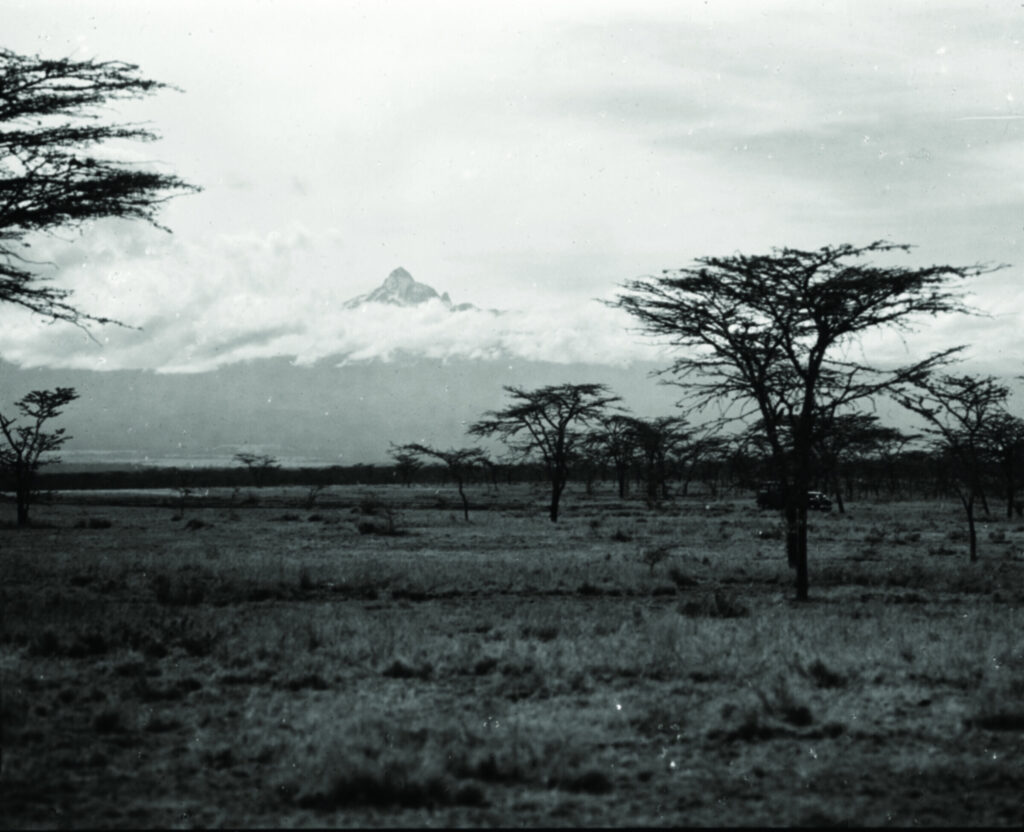
On the morning of May 13, that changed. A fellow prisoner roused Benuzzi from his sleep. “Quick. Get up. Come and look at Mount Kenya! Hurry up or the peak will be covered in clouds again!” There, in the southeast distance, was an apparition, a revelation.
“I emerged at last, stumbled a few steps in the mud and then I saw it. An ethereal mountain emerging from a tossing sea of clouds, framed between two dark barracks: a massive blue-black tooth of sheer rock, inlaid with azure glaciers; austere yet floating fairy-like on the near horizon. It was the first seventeen-thousand-foot peak I had ever seen. I stood gazing until the vision disappeared among the shifting cloud banks.
“For hours afterward I remained spellbound. I had definitely fallen in love.”
Even better, he had found a purpose. He would break out of camp. He would climb that mountain. He would fight a slow death from inaction with a bold and perilous quest.
Camp 354 offered a surprising degree of freedom. Prisoners’ families could send them clothes and rations. There was a robust black market and bunks weren’t usually searched, so contraband was rarely found and confiscated. The camp was ringed by barbed-wired fencing, not walls, and prisoners often worked on projects outside the fence. But still, how does one go about escaping from a prisoner of war camp without getting caught? How does one climb a seventeen-thousand-foot glaciated mountain without information, gear, or supplies? And what happens if one does escape and by some means get to the top? What next for a white escaped prisoner in rural East Africa, standing out like a full moon on a cloudless night?
Despite these practical issues, Benuzzi understood that logistics were secondary to finding the right men for his team, but he had to be cautious about whom he approached, so as not to get ratted out to the guards. One evening, as golden light was splashing across Mount Kenya, he strolled up to a man he knew was a mountaineer, with several first ascents in the Alps under his belt. Benuzzi gently floated the idea of climbing the peak, but the man deflected it with a long list of reasons why it was impossible. “It looks tantalizing, I agree,” the man said, “but it would be sheer madness to think of it seriously.”
“I broke off the conversation,” Benuzzi wrote. “We were speaking different languages. He was a realist and when all is said and done it was he who was right; I, an incurable idealist or possibly a madman, as he had it. I realized then that I would find companions only among ‘madmen’ like myself.”
It took him most of a year to recruit partners and to prepare. For months, he collaborated with a prisoner named Mario, who had no climbing experience but had grown up in the highest part of the Apennine Mountains. The two cadged hammers from a workshop and gathered scraps of metal from a trash pile and snippets of wire from the fences, which they used to cold-forge ice axes and crampons. When Mario was transferred to another camp, Benuzzi found a new partner, a doctor from Genoa named Giuàn Balleto, and later, Enzo Barsotti, a thirty-five-year-old from Tuscany with a wicked bridge game and no climbing experience. Benuzzi stopped smoking, using his ration of cigarettes instead to purchase supplies through the camp’s black market. Improbably, he acquired two sisal ropes, borrowed a waterproof sleeping bag, and found the material to craft a rudimentary tent.
He stashed some of his meager food rations and he squirreled away the label from a tin of meat, which had an illustration of Mount Kenya—a critically important guide to the topography, even though it was tremendously simplified. In a book written by missionary priests about a local tribe, he found a motherlode of information: The padres had climbed above sixteen thousand feet on Mount Kenya and left a cross on a secondary summit, Point Lenana. From the book, Benuzzi learned that he and his comrades would have to walk twenty miles from Camp 354 and climb eleven thousand feet, that following a river upstream would be their best course, and that January was the driest season. He set a date: January 24, 1943.
Escaping from the camp itself would be relatively straightforward, Benuzzi thought. Authorities weren’t too worried about a prison break, as Nanyuki was surrounded by hundreds of square miles of inhospitable terrain, and prisoners often worked outside the fence. Giuàn, for example, had been given permission to grow a garden outside the fence. The guards, drawn from local communities, were easily bribed, but Benuzzi had a moral code and didn’t want to expose them to punishment (or risk stumbling into an honest one). Instead, the men decided to use the garden as a springboard. They spent months copying the gate key Giuàn was allowed to borrow, making five iterations before crafting one that worked, and then secreted their gear beneath the rows of tomato plants.
On the second to last Sunday in January, at lunchtime when British officers were in the mess, Enzo, Giuàn, and Benuzzi strode out the gate, three prisoners simply going to work in the garden. After an hour, they slipped into a small shed to wait for dark. Benuzzi read a book, but Enzo seemed out of sorts and then feigned sleep. When confronted, he confessed to having had a fever for days and having taken so much quinine that he was hearing things that weren’t there.
“Do you realize that a trip to Mount Kenya in your condition might mean death?” Giuàn, the doctor, asked. “It’s alright. I have left my will in my barrack,” answered Enzo. Benuzzi thought they were joking, but they were not. Giuàn went on: “You are old enough to make up your own mind. It is up to you to decide; both as a friend and as a doctor I advise you not to come with us.” “I have already made up my mind,” Enzo said. “I am coming.”
Benuzzi wrote, “Our adventure had really begun.”
That first night, Sunday, the trio crossed a wide plain, farm fields, roads, a railroad track, and small clusters of houses, but as they gained elevation they left the signs of man behind and faced more elemental challenges. Sticking to their plan to travel by night until well clear of the camp and to follow the first river they found toward its source, by Tuesday night they were scrambling and slipping and fighting their way up a rocky streambed. “Only too soon we realized what it meant to ‘follow’ the river,” Benuzzi wrote, “and our mood of exultation suffered a beneficial cold shower. With the kind of rucksacks we had to carry it was not easy, in the fitful moonlight that filtered through the dense foliage, to keep our balance on the smooth, wet stones. Time and again, a splash and a muffled curse told of a false step…Our progress was exasperatingly slow and tiresome.”
It would take them a week before they could leave the watercourse and gain an upper plateau. Some time in the early morning hours on Wednesday, Enzo’s fever soared and an unseen beast stalked their camp, “snorting and grunting.” Benuzzi thought it was a leopard. Giuàn threw a burning branch from their fire, and Enzo banged on water bottles with an ice axe until it left. Later that day, they crossed paths with an elephant. Thursday and Friday brought more bushwhacking in the riverbed. On Saturday, a cold storm soaked them through. On Monday, they woke to frozen water bottles, and later that day they crossed the fourteen-thousand-foot contour, where Enzo faltered and collapsed from his fever and the effort. Giuàn rolled him over, opened his shirt, and listened to his heart, alarmed. “Enzo must not be allowed to climb a single foot higher,” he said.
They were still a long way from the real climbing, way too far from the summit for a base camp, but it would have to do. With Enzo confined to the tent, Benuzzi and Giuàn spent Tuesday, their ninth full day on the lam, reconnoitering the northeast slopes of Mount Kenya. They scoped the Hausburg and Mackinder valleys and the northern faces of the principal summit, 17,057-foot Batian, unaware of the route climbers took to the top; from where they stood, the northeast ridge looked best. They retreated and spent Wednesday resting and prepping for a summit attempt.
“Thursday, February 4. I do not know how I managed to wake at the agreed hour and rouse my companions. It was 2:00 a.m. when I got out of the tent and the sky was amazingly starry,” Benuzzi wrote.
Retracing their Tuesday steps, Benuzzi and Giuàn scrambled up a long scree slope, fought through winds at an exposed col, and first touched the rocks of the Batian formation as sunrise crested an eastern ridge. The rock was granite, reminding them of Mont Blanc and the Grandes Jorasses in Chamonix, France, and they moved quickly up a pitch or two, belaying with their sisal rope.

When they came to an off-width crack, Giuàn led thirty feet to a small terrace and Benuzzi followed, but twenty months of inactivity in prison had left him weak, and he started to slip. Shouting for slack in the rope, he leaped twelve feet to a flat spot. somehow landing without injury. Collecting himself, he tried again, pushing through the crack, and the two continued higher.
By eleven, they were on a formation called the Petit Gendarme. The rock was rotten and belays were impossible. They tiptoed across snow-covered slabs and stopped even trying to belay, as there was no place for anchors. At half past noon, nearing sixteen thousand feet and still more than a thousand below the summit, Benuzzi saw “rags of mists” coming from the south. Soon, wind, fog, snow, and hail were upon them, plastering their wool clothing and caking their eyelashes. With the deteriorating conditions, their improvised equipment, and the lack of anchors, they accepted the obvious: The summit would not be theirs. And they didn’t know if they could descend without falling or getting lost.
It took them eight hours to retreat. Every hold had to be cleared of snow. Route markers they’d left were covered in white. Exhausted from ten days of undernourished climbing, they stumbled deep in the dark. Benuzzi, hallucinating, heard bells, then voices. At nearly nine, they somehow found their tent and Enzo asleep in it.
“We consoled ourselves by thinking that at least we had stretched out our hands toward that magnificent goal, and though we deeply regretted having been defeated, we felt sure that in our condition we could not have done more.”
Before leaving Mount Kenya, Benuzzi and Giuàn rested a day, then spent a day climbing Point Lenana, where they left an Italian flag they’d sewn in camp, along with a note in a brandy bottle. Later, they found out that the northeast ridge had only been climbed once, in the summer, and only then by two of the world’s best alpinists. Even today, only fifty or so make it to the top of Batian each year—most of the fifteen thousand people who climb Mount Kenya aim for the easier Lenana.
When the three returned to camp and slipped unnoticed through the gate with a work crew, they were given the cold shoulder by fellow prisoners, who’d suffered the wrath of camp officials when the escape was discovered. After two days recovering, they presented themselves to the camp commandant, who sentenced them to twenty-eight days in restricted confinement. After seven days, he relented, telling them they deserved leniency for their “sporting effort.”
Benuzzi was imprisoned for another three years, during which he devoted himself to writing a book about his adventure, first in Italian and then in English, called No Picnic on Mount Kenya.
“Never perhaps have lovers of mountains approached the mountain of their dreams in conditions like ours,” Benuzzi wrote in No Picnic. “Materially, our ignorance meant that we were gravely, irredeemably inferior; from a purely spiritual side, however, which matters more to a true mountaineer, our ignorance was a genuine godsend. Every step was a discovery, a new beginning. We were back at the dawn of time, before places had names; everything we saw aroused thoughts of awe, gratitude and reverence. We were, as Pascoli said, like Adam.”
This story first appeared in Adventure Journal 16.