Archery at 1, Canoeing at 3, Cocktails at 5
Wandawega harkens back to camps of yore, reminding that even grown-ups need a summer getaway
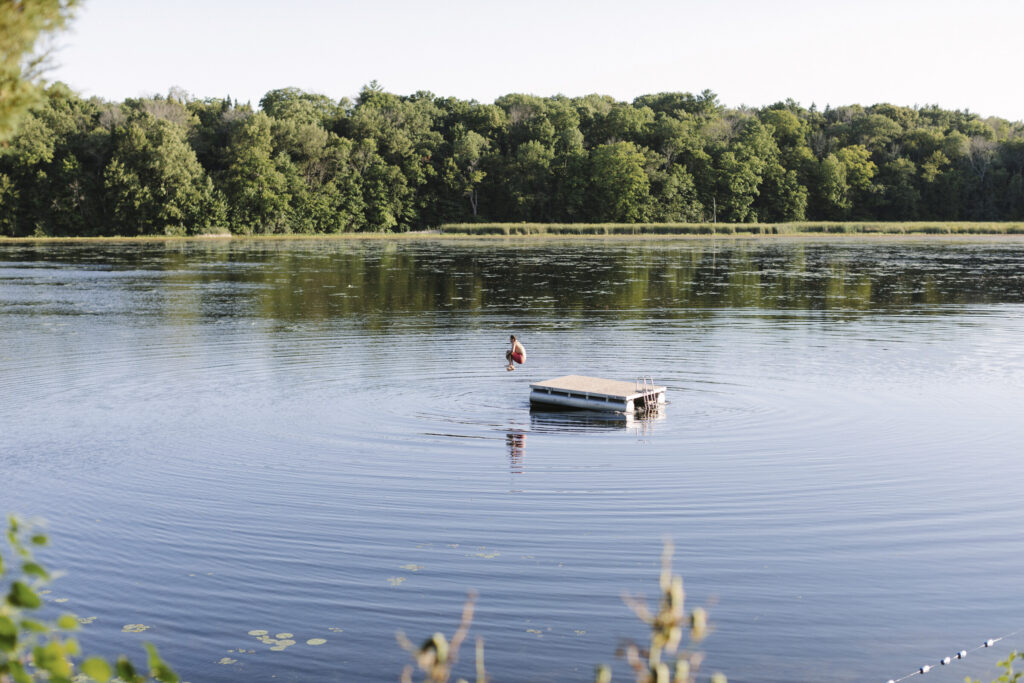
Other than “snow day,” there may be no sweeter words in a child’s lexicon than “summer camp.” No parents to reel you in. New friends for secret shenanigans. Pocket knives and an endless supply of wood to whittle. The mysteries of the forest: bugs, strange noises, trees to climb, lean-tos to build. Splash fights in the middle of a lake with dinged paddles and battered canoes. Badminton without rules, tennis with a droopy net.1 Squishy shore mud between your toes and pancakes for breakfast every single day.2 Oh, and did we mention no parents?
When David Hernandez was a boy, some of his happiest days were spent at a summer camp run by Latvian Catholic priests on the shore of Lake Wandawega, Wisconsin, about two hours north of Chicago. The Latvian fathers had fled Soviet oppression after World War II with support from the Vatican and landed in exile in Wisconsin; in 1961, the church bought the Wandawega Lake Resort as a retreat for the padres and, because there’s no W in Latvian,3 renamed it Vandavega.


Vandavega quickly became a cultural center for families of Latvian heritage like David’s, and by the late 1960s the informal gatherings were becoming more formal. The fathers still conducted Mass, married couples, and held retreats from their local parishes, but every year from May to September Vandavega became Camp Vandavega. Generations of families flocked there for swimming, hiking, fishing, campfires, cookouts, arts and crafts, and the daily raising of American and Latvian flags. For decades of summers, life along the hundred-and-twenty-acre lake4 was nothing short of idyllic.
But the priests grew aged, the kids from those families turned into adults, and Vandavega faltered into disrepair. Roofs leaked, then collapsed, and in the 1990s, thinking he might be able to prevent the place from falling into the hands of developers, David asked Vandavega’s leader, Reverend Boleslavs Baginskis, to alert him if the church ever wanted to sell it. In 2004, Father B called, and a few months later David and his soon-to-be wife Tereasa Surratt found themselves the owners of twenty-five acres of nearly condemned lakefront property.


What exactly had they bought? Vandavega certainly came with a colorful past. In its earliest days, beginning in the roaring twenties and through Prohibition, it was known as the Wandawega Lake Hotel and served as a brothel and speakeasy, with trap doors and hidden rooms for stashing bootleg whiskey. Anna “Orphan Annie” Beckford5 became infamous as the hotel’s proprietor and madame, and though she was arrested numerous times, including once for hiding illicit hootch in the hotel’s piano,6 a cozy relationship with local authorities kept her out of the big house until 1942, when she was finally sent to prison and the hotel was impounded. Later, purchased by Polish immigrants, it was operated as the Wandawega Lake Resort, its reputation rinsed and cleaned through old-fashioned family hospitality, and then in 1961 it passed to the Latvian fathers, who stewarded it for forty-two years.
Unlike David, Tereasa had no connection to the camp, and what she saw looked daunting. Roofs needed to be replaced and foundations rebuilt. Twenty-two trees blew down in one storm alone.7 The first event at the lake was their wedding, in August 2004, and it took eight months of hard work and leaning on the goodness of friends just to bring the camp up to “acceptable.” That day, it rained nonstop and she was married wearing rubber boots.8


Today, the renamed Camp Wandawega looks as exquisitely curated as a movie set (if you squint you might see hints of Moonrise Kingdom9), but in the beginning the couple just hoped to have a place where they could throw parties and entertain. “We were just fixing this place up, trying to save it from the wrecking ball,” she said. But both have creative jobs—David is chief creative officer at Allstate and Tereasa is creative director at Ogilvy & Mather agency10—and lots of artistic friends, who helped with the restoration, styling, and documentation of the process. Soon, Wandawega was hosting art, music, and other kinds of camps, and then renting its rooms, cabins, and platform tents to those who asked. Almost two decades after acquiring it, the couple have molded their rescue into a full-on destination that channels golden, nostalgic Americana while encouraging timeless pleasures and nurturing connection and the kind of creativity that fills their own lives.
Theirs is not an imitation retro camp, though. Wandawega remains a nearly hundred-year-old property, with creaks and squeaks and drafts. For all its transformative time machine magic, the place is rough around the edges, as campers are informed in Wandawega’s “Manifesto of Low Expectations.” “Expect ladybugs on your pillow, a cricket if you’re lucky. The errant chipmunk doing laps around your cabin…and then there are the camp showers…be prepared to share them with toads—they were there first.”11 The manifesto touts lumpy mattresses, wi-fi that barely functions, no room keys or air conditioning, and lodging that hasn’t been “updated since the Hoover administration.”12 David and Tereasa warn that Wandawega is “not for the meek, the squeamish, or any other synonym for folks who don’t like roughing it.”
It is, in other words, “summer camp”—blissful, rustic, evocative, and old school at its best, whether you bring your parents or not.


Notes
- 1. Badminton is, by projectile speed, the fastest racquet sport in the world; recorded smashes exceed 300 miles per hour. None of them have occurred at summer camp.
- 2. A claim no child has ever fact-checked and no adult has ever disputed.
- 3. Nor a Q, an X, or a Y. Latvian shed the W in the 1920s along with the rest of its German-influenced orthography, which had used it for the V sound. Wandawega to Vandavega isn’t a translation so much as a correction.
- 4. The lake. The camp holds twenty-five acres of its shoreline.
- 5. The nickname’s origin is unrecorded. Harold Gray’s comic strip debuted in 1924, so the timing lines up, though nothing about Beckford’s operation suggests plucky optimism.
- 6. Which raises the question of whether the piano was ever in tune, and whether anyone at the Wandawega Lake Hotel would have been in a condition to notice.
- 7. A figure that gets more impressive the longer you sit with what it costs to have twenty-two trees hauled off a property.
- 8. The correct call. Eight months of restoration and the ceremony still required footwear rated for mud.
- 9. Wes Anderson’s 1965-set Khaki Scout idyll, shot in Rhode Island in 2011. The resemblance is real, but the causality runs the wrong direction—Wandawega had been restored to this exact register for years before the movie existed.
- 10. Which explains a great deal, including the Manifesto of Low Expectations, arguably the best ad copy either of them has written on spec.
- 11. American toads, most likely, which favor exactly the cool damp concrete a camp shower provides. They have no interest in you and will leave when you do.
- 12. Hoover took office in March 1929 and was gone by March 1933, which places the last renovation squarely in Orphan Annie’s tenure. Interpret accordingly.