Who Owns the Copyright When a Monkey Takes a Selfie?
In the world of people and courts, the idea that nature has legal standing can be one slippery banana peel
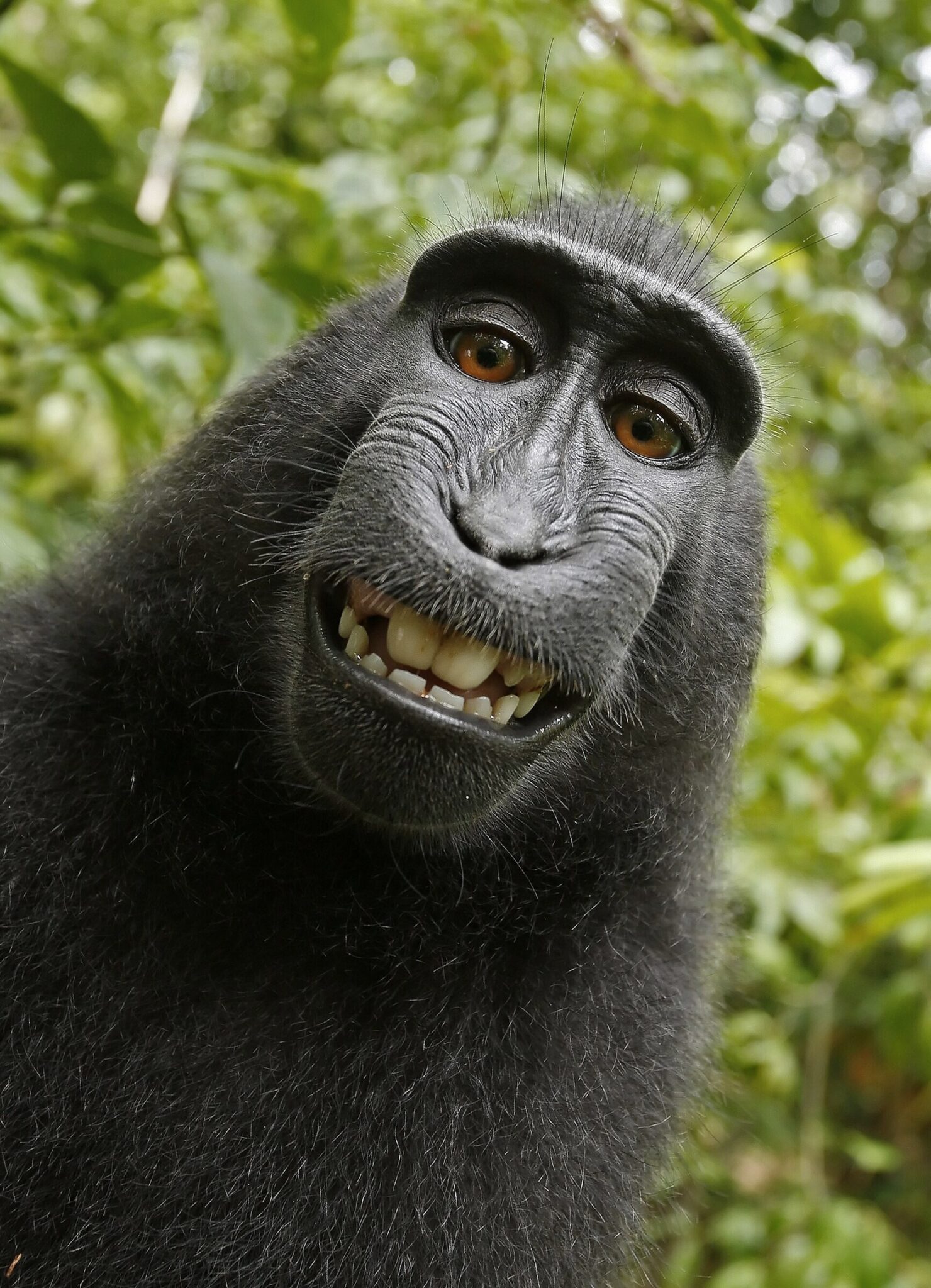
It was a case of monkey see, PETA sue.
In 2011, wildlife photographer David Slater licensed his “monkey selfies” of endangered Celebes crested macaques to a British news service, and the wry, whimsical shots charmed the world—at least, the world reached via the internet. Though the pictures went viral overnight, Slater had been traveling to Indonesia for years to shoot photos of the macaques, and these pics were made only after spending two days on the island of Sulawesi with a group of a small primates to gain their trust. At first he put the camera on a tripod with a self timer and stepped away so the creatures could investigate it, but it wasn’t until he attached a dangling cable release and the monkeys could trigger the shots themselves that he got the images he’d envisioned.
The photos and their capture had all the elements of a feel-good story, but things quickly turned sour. Wikimedia Commons posted the best-known image, one of a grinning macaque, under a Creative Commons license available for anyone to use for free, arguing that because an animal snapped the photo it could not be copyrighted. In 2014, Slater included the photos in a self-published book, and that’s when PETA got involved. It sued Slater on the monkey’s behalf, reasoning that because the macaque activated the shutter, it should be the copyright holder.
It was a novel argument. The U.S. Copyright Office had already issued an opinion that works created by nonhumans could not be protected, thus supporting Wikimedia’s point of view. To Slater, the notion that any transfer of rights could take place was absurd. “Many photographers now use remote cameras and GoPros, where an animal triggers the camera without the photographer even being present,” he told Vice. “Cameras are put on the backs of birds or on the collars of lions, and they shape the composition. The BBC and National Geographic use that type of footage all the time—Blue Planet and documentaries like it are full of these techniques.”
The courts agreed with the Copyright Office: Nonhumans can’t hold creative rights. PETA appealed, lost, and was criticized by the U.S. 9th District Court for seeming to pursue its own interests rather than those of the monkey. The case got messy and dragged on, and it wasn’t until August 2018, when the court refused to consider yet another appeal, that the conflict ended.
This won’t be the last example of critters coming before a court, however. In a 2004 case, the 9th Circuit itself said animals have standing in some cases, and in 2015 the first habeas corpus hearing on behalf of an animal was held. This idea—that nature and the creatures in it have legal rights—was once exotic, but today, all across the world, it’s gathering momentum. India granted legal rights to the Ganges and Yamuna rivers in 2017, while New Zealand did the same for the North Island’s Whanganui River. Colombia gave the Amazon rainforest rights and the Ojibwe people granted them to a wild rice known as manoomin. In February 2019, the citizens of the city of Toledo, Ohio, passed a legal bill of rights for the Lake Erie ecosystem (over intense opposition by agriculture interests), which opens the door to lawsuits against the polluters who make its water unsafe to drink.
The United States granted legal personhood to corporations in the 1880s, yet animals still have a long way to go, despite dramatic new evidence that all kinds of species are more intelligent and live more complex emotional lives than previously thought. In February 2019, a Connecticut court rejected a habeas appeal by the Nonhuman Rights Project on behalf of three elephants held captive in a traveling circus. Slater, despite his wrangling over copyright, testified before the 9th Circuit that animals too should have legal standing in cases of harm. How and where that will finally be adjudicated is yet to come, but it seems clear that it will, eventually.