
Andy Davis Rides a Happy Wave
The Southern California surf artist is tapping into the feminine spirit and bringing his beautiful friends with him
There’s a little bit of Shaggy in artist Andy Davis, a certain lankiness around the elbows and shoulders, and when he’s in profile on a longboard, black neoprene hugging his frame, he seems improbably slender. Often when he surfs, he’s preternaturally still, as if he isn’t moving but the background is, like in a Hanna-Barbera cartoon.
There’s some Scooby Doo in Davis, too. When his beard is full, it takes on the wide, curving shape of Scooby’s chin, and its color, a kind of ginger brown, will be familiar to any kid who’s zoned out to the hijinks of Mystery Inc. with a bowl of Cap’n Crunch on his lap.
Perhaps even more apparent is that Davis shares the sweetness of these two best friends, their soft hedonism and stoke and aloha. One doesn’t spent time with Davis or experience his art without feeling a little lighter, a little more hopeful–as if there’s a promise of Scooby Snacks or a quadruple decker sandwich waiting back at the gang’s clubhouse.
These character traits may have come by assimilation. They may be an accident. But they’re probably not a coincidence.
Kids had more time and room to roam when Davis was growing up in the 1970s and ’80s. Schools didn’t have the hyper-intense focus on achievement that they do now, and the homework load was light. TV was comprised of just three main channels, and the bulk of kids’ fare came in blocks on Saturday mornings. A boy could have hours of adventure between school and bed every day of the week and still get As.
“My mom and dad split when I was really young and it was me and my mom and my brother,” said Davis. “And we went to a new town, and this little neighborhood’s cool and this little suburb and over here it’s like gnarly ghetto, with gangs and shit. They were cool and I’d go to their neighborhood and it was cool. But certain times it wasn’t, and I’m just, like, whoa, this is kind of heavy.
“It wasn’t the type of parenting it is now. There was a ton of freedom. When we were kids, we were outdoors all the time, but still, wanted to come home and watch ‘Happy Days’ and ‘Mork & Mindy’ and cartoons on Saturday morning.
“That was part of it. And then there was, like, riding my bike all over town, you know, like miles away, just be home by when the street lights come on. And in that freedom, there was also being a little bit scared. And I tried to distract myself with things that made me happy and laugh, like color and abstract whimsy. And I was like, okay, if I think about this or do that, then I won’t worry that.”
His mom had been a painter since Andy was born, so the materials and creation and encouragement were always around, and he spent hours making art. “There was no pressure,” he said. “This was fun, and I wanted life to be fun, because I was afraid of how dark it could be.”
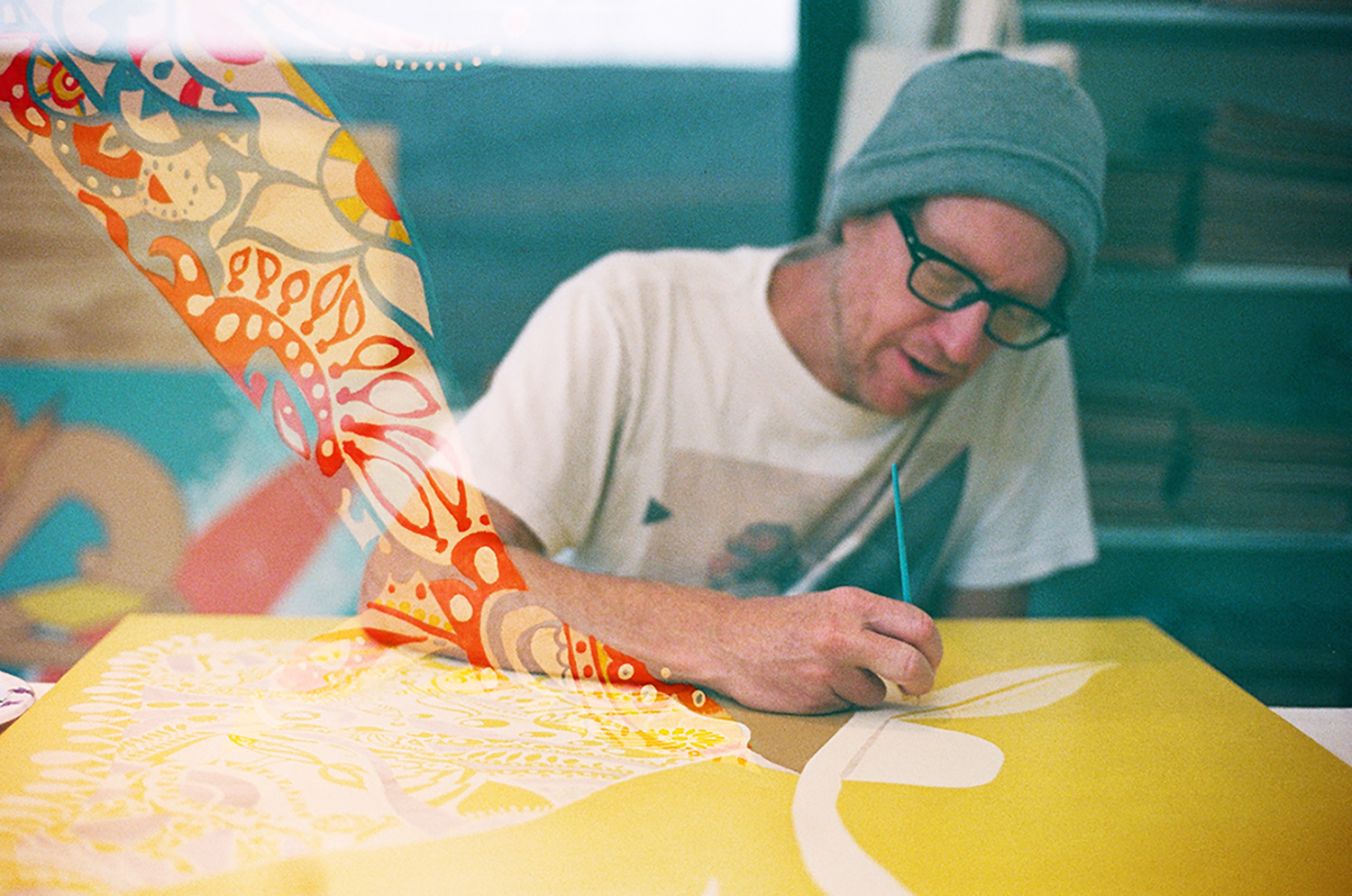
Surfing was a passion, an escape, but the 1980s were a grossly commercial time for a sport that considered itself a soul pursuit and way of life. Davis was left cold by what he saw as he flipped through surf magazines.
“I love simple, pure shots, but I would hate shots that looked like it was NASCAR with logos everywhere—I got bored of that really quick. Oh, that would have looked so much better if that was just a blue board with a green pair of trunks with that backdrop…it would have looked more like a painting. And I just started seeing surfing that way. What if I painted that person with no face and they were all blue?”
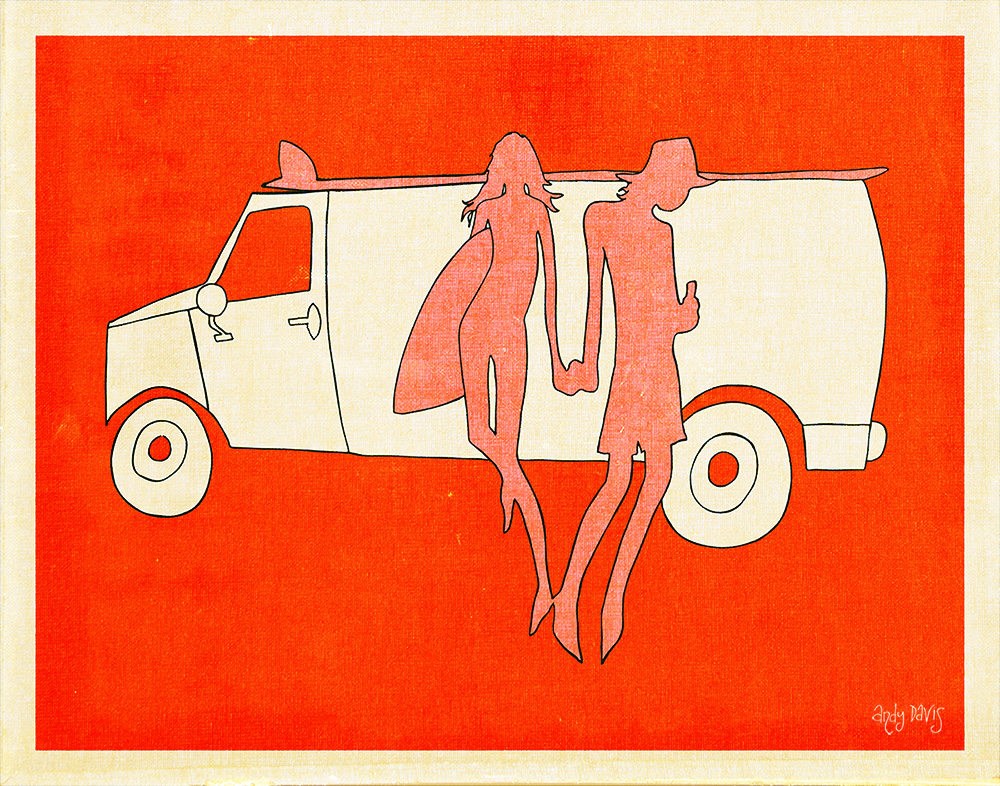
Davis began creating pieces whose vibrancy, color, and energy came straight from those Saturday mornings, when the world was simple and the outcome clear. His surfers have always been reduced to their essence and gently stretched like Silly Putty, exaggerating the sense of flow. Arms are impossibly long, the better to paddle and balance, perhaps even to take flight. On Davis’s waves, special care is devoted to the placement of feet and the angle of knees—his surfers are athletes, but they’ve thought about their style, too. The men have long hair or beards and sometimes slouch with carefree nonchalance. The women are twiggy, sexy without being sexual, and they wear floppy hats when they nose ride, skinny briefs clinging to tanned frames.
Davis was a voracious consumer of pop culture as a grom, and his work remains finely attuned to cross-cultural currents that are reflected and refracted, sometimes ironically, by mass communication entities—animation houses, record companies, sitcom producers. Formative artistic influences include John Severson, the filmmaker and founder of Surfer magazine, whose paintings and watercolors ranged from the beat to the romantic; Dr. Seuss, who spoke a universal language of love and idealism; and Wayne Thiebaud, whose elongated San Francisco streets and lush desserts pushed and pulled with distorted intensity. Davis’s muses are diverse, but what they share are themes of energy and joy.
“He does a lot with what appears to be very little—mostly just lines,” said surf historian Matt Warshaw. “But really, that’s the hardest thing, like hitting one perfect sustained guitar note to create a mood, instead of jamming out three dozen notes, which basically says nothing except, ‘Look at me and how fast I’m playing.’”
In Andy’s art, the 1970s are represented in tone and emotion, hang loose and hang ten in equal measure. The 1960s are there, too–some of Davis’s pieces verge on psychedelia, and the unbroken fields of color give nod to John Van Hamersveld’s 1966 Endless Summer poster. The transcendent brights of the 1950s mid-century modern movement feature prominently, too—lemons and avocados and deep oranges whose adoption by architects and designers helped break the monochrome shackles of the Cold War and softened the ground for paisley, bell bottoms, and tie dye to come.
And yet despite all these influences, Davis’s art is neither derivative, nor homage. Rather, after all his paintings, prints, and designs, it’s clear that Davis has scooped it all up, dreamed his dreams, and simply painted the happy world he wants to see.
There wasn’t a master plan. Davis followed where his art took him. In the surf world, that meant partnerships with brands on collabs, product lines, t-shirts, and merch. It meant illustrating ads and creating his own line of apparel. “I still can’t believe these loose renderings have organically found their way onto the walls of galleries, onto surfboards and fins of surfboards, wetsuits, apparel, shoes and flip-flops, concert posters, album covers, animation, hotel rooms, and onto the sets of TV shows,” he wrote.
In 2015, Davis was invited to stage a one-man show at SAID Space, an art collective and gallery located in his hometown of Encinitas, California. His house and small home studio were in the midst of renovation, so the gallery owner gave him a three-week residency there to create new pieces. For a working artist, this was like having a glassy head-high wave all to yourself.
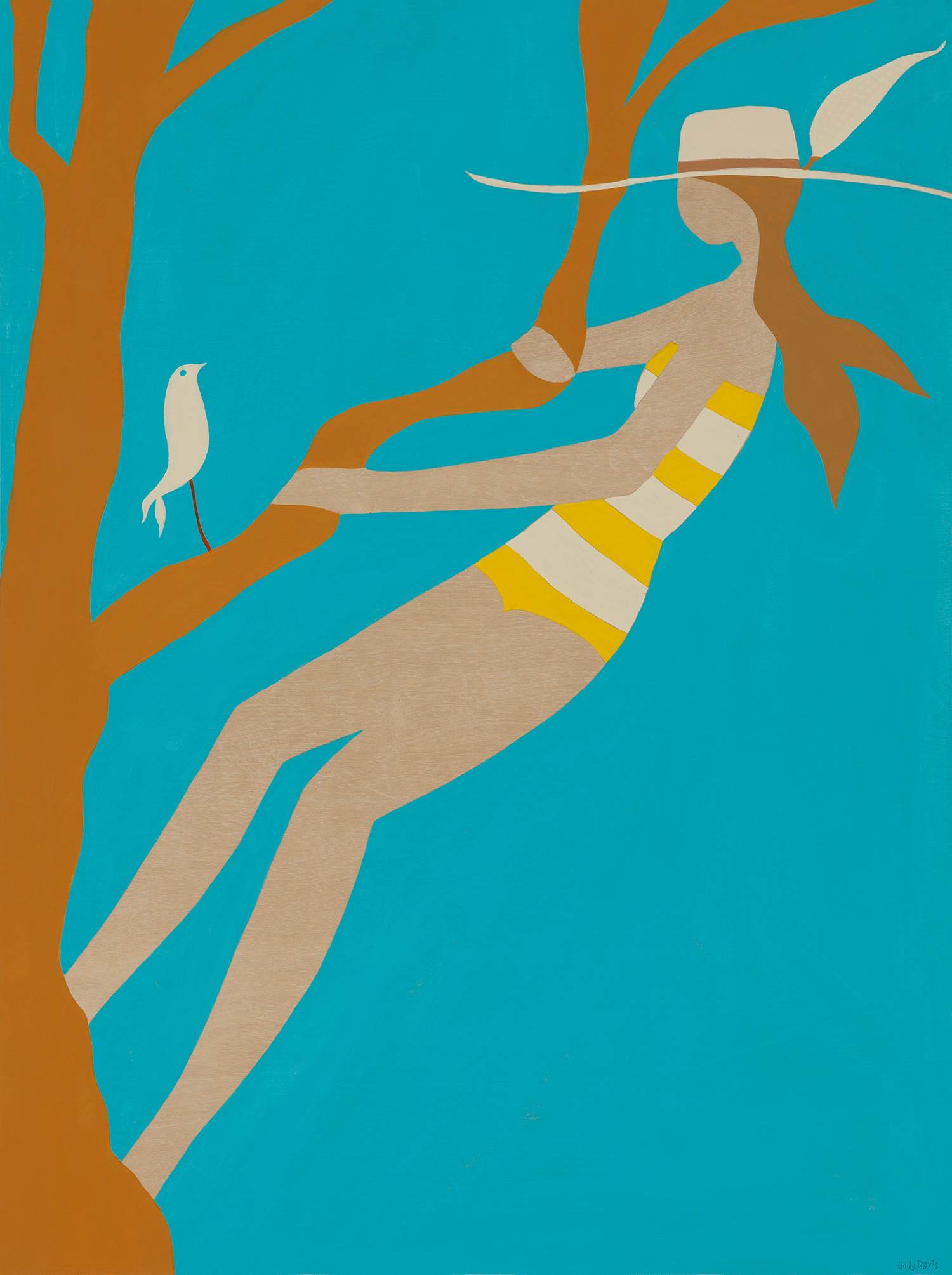
At first Davis thought he’d recycle old themes. Give the people what they want, classic Ando, easy enough to accomplish in that tight window. “But,” he said, “this little spark went off and I thought, this is a really neat opportunity to make all new work. So, I worked 12- to 14-hour days for three weeks. I didn’t have anybody in my ear. I wasn’t collaborating. I didn’t have anyone editing.”
What he produced in those three short weeks heralded a subtle but distinct departure. The pieces had all the hallmarks of Andy Davis—there’s no mistaking that style—but the happy hippy summer breeze on a board had shifted. Surfing was no longer the overt milieu.
“I wanted to strip the work down and simplify the idea of the emotion of what I like to do,” he said, “which is a lot of color and just having fun. I thought, what if I really push it farther? What if there isn’t going to be a wave, there isn’t going to be a board?”
A year later, he had another show, this time at Artists Republic Gallery in Laguna Beach, and for this he created work that focused on women, with even less surfing. “It was 1960s-inspired,” Davis said, “old Vogue magazine covers and my interpretation of those classic images of Brigitte Bardot and other muses of that time.” Floral, wild, and very femme, it felt as if Jean Shrimpton had dropped into Coachella, and in the hot summer of the 2016 U.S. presidential campaign, as the country seemed about to elect its first female president, the work felt hopeful, celebratory, post-feminist.
And then, well.
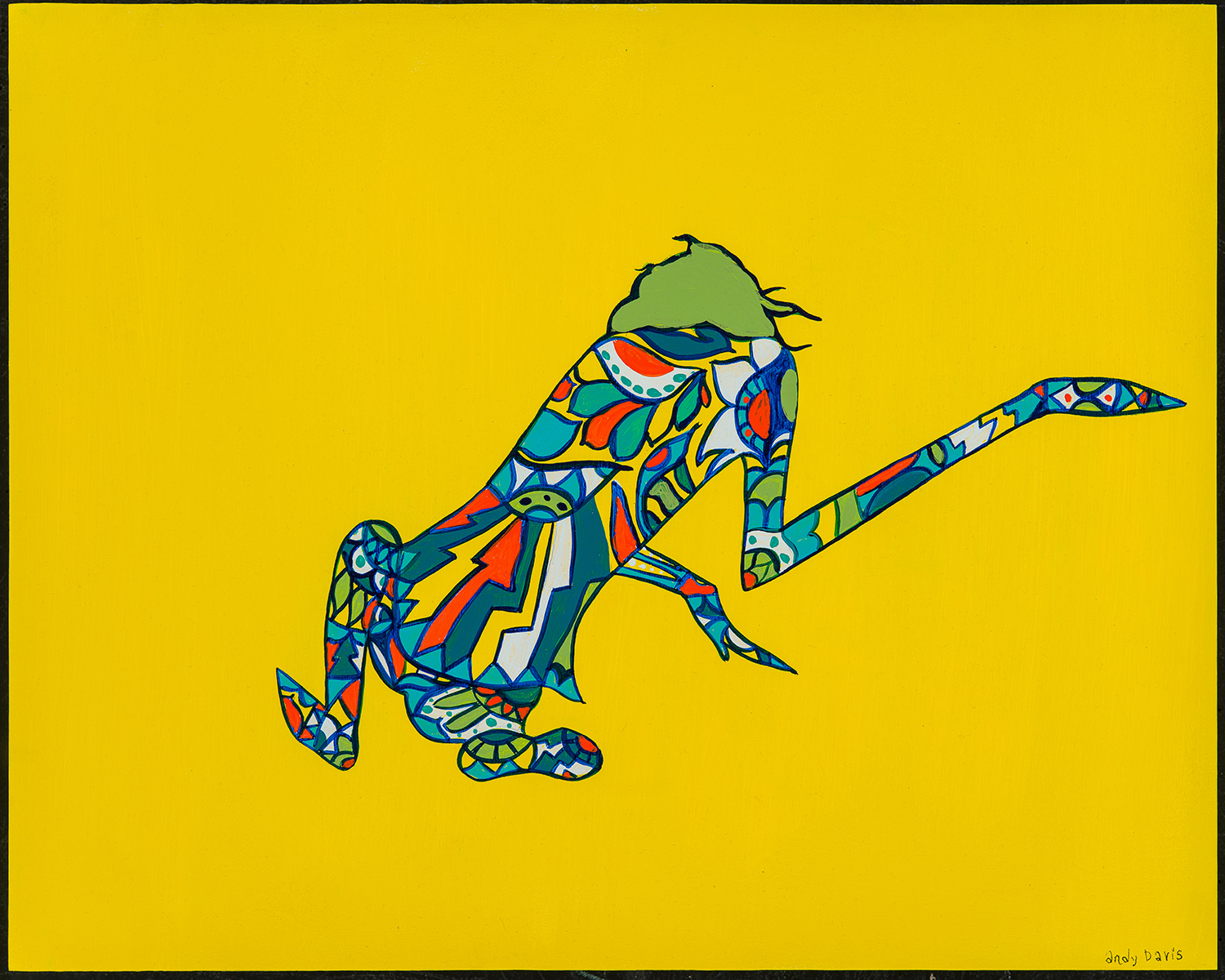
In the late spring and early summer of 2017, as Davis prepared for a new show called Eye Yi Yi, there was no escaping the post-inauguration mood, even on the sparkling sand of Southern California, even in the lineup at Swami’s or Trestles or T Street. Women marched in Laguna, and there were pussy hats in Malibu. He spent eight weeks hunkered down at his studio, playing music and painting, and while he didn’t think it was enough time to get completely dialed, what came out the other end was another step away from water and into emotion.
“It’s kind of an evolution of the last show I had,” he said. “For people that know my work, it’s a little bit different. There’s no surfing involved in it. It’s kind of all derivative of surfing, with movement and energy and flow but there’s no literal waves or boards. If you surf, you can totally see it. If you don’t, it may be interpretive of dancing.”
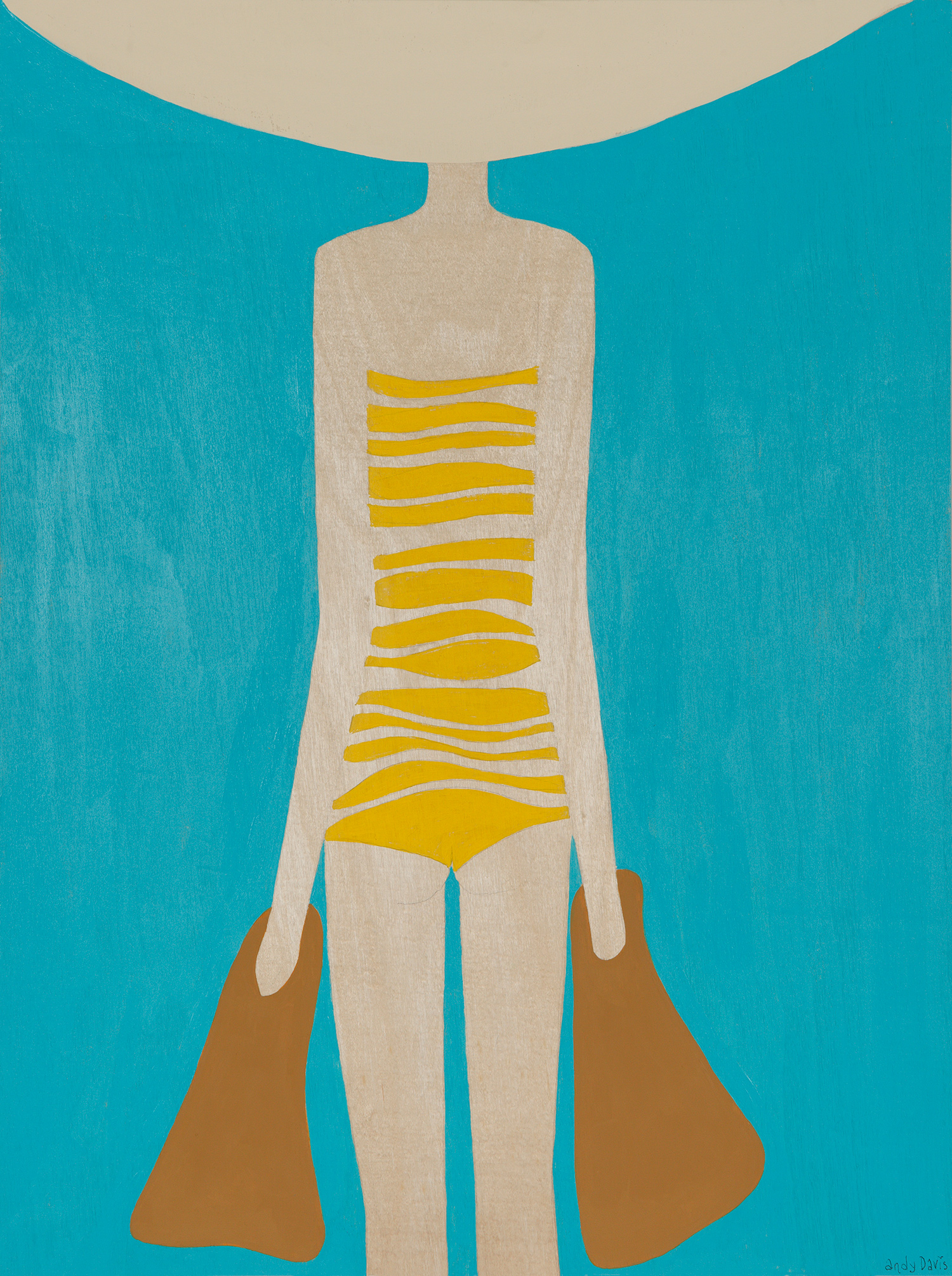
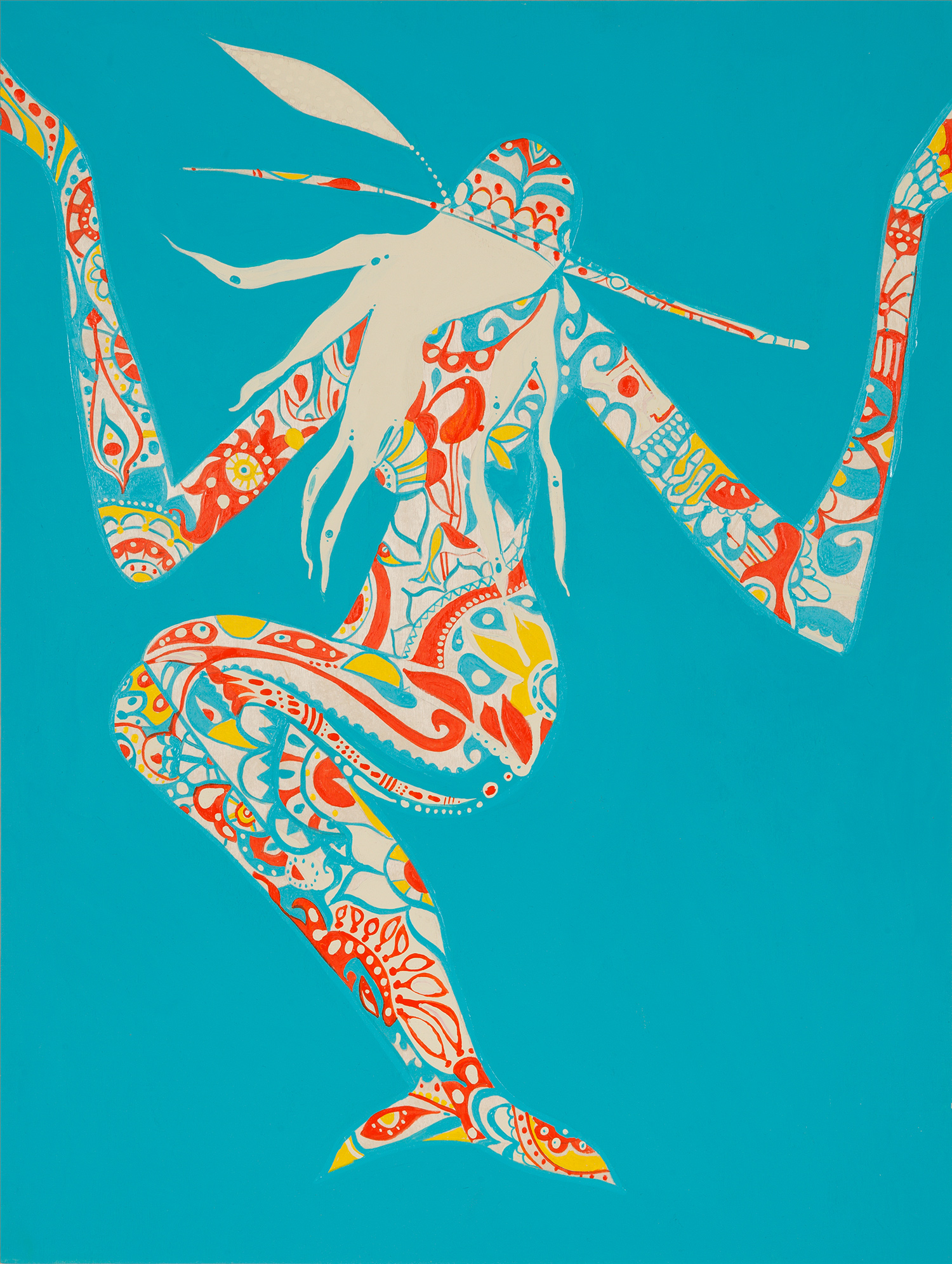
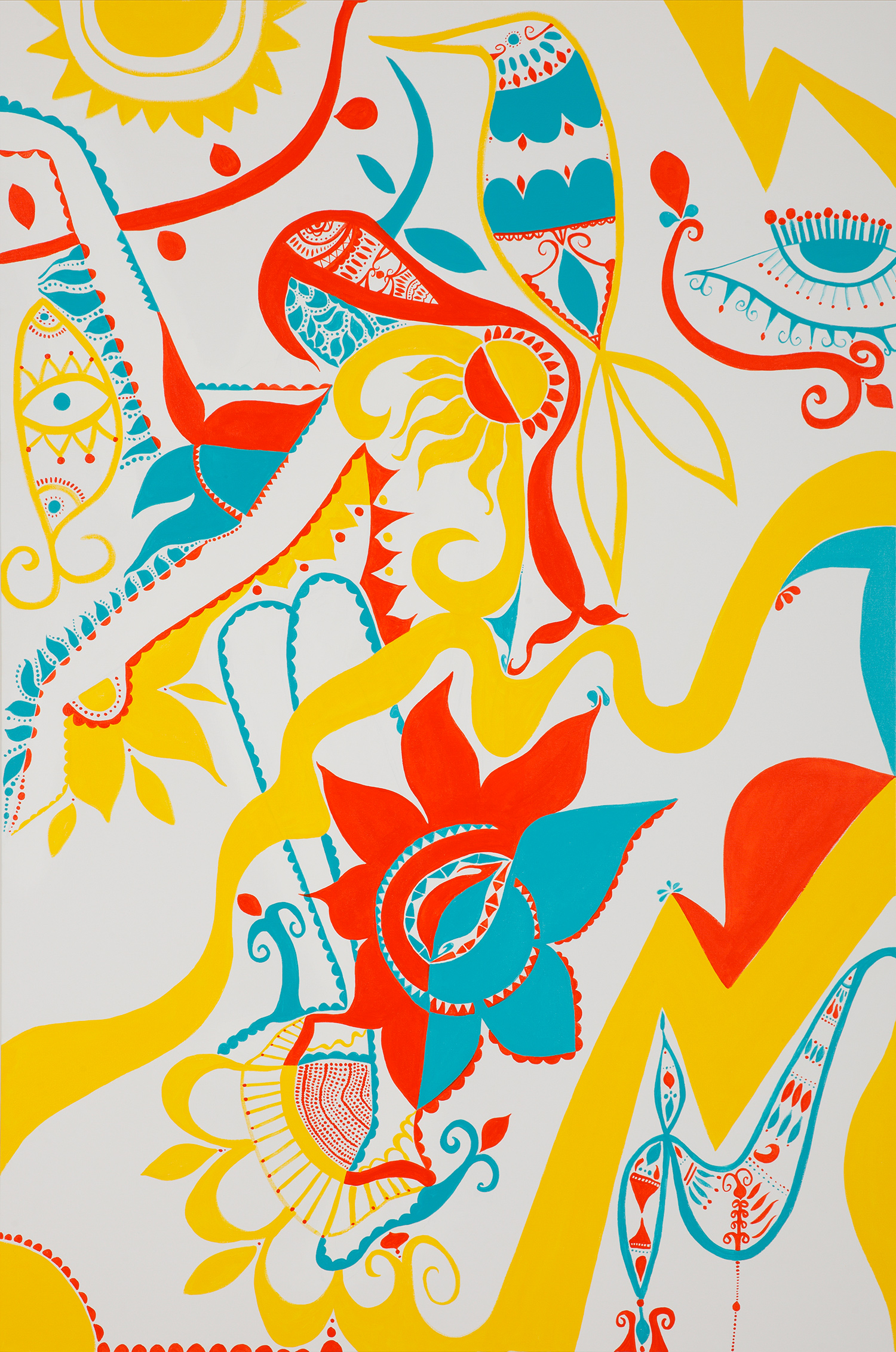
Yellows predominate, and the paintings have swirls of color and wild patterns that force you to pay attention, to engage and not just look. There are big flower child daisies, a girl flashing twin peace signs, hints of Picasso and Miró, and, hey, is that a partridge from the Partridge Family? The subjects are now all women—kinetic, sometimes frenetic—and unlike in past work, while the color is extravagant, the body language is ambiguous.
Davis sees these women as “kind of like alien warriors—they’re here to shed light on this world. They’re exotic, with unfamiliar shapes and forms, really bright and colorful and happy. My role is to evoke a smile and that good energy, tapping into the female energy of life and love. There’s something special about that.”
Writing about Eye Yi Yi, he elaborated, “A bright, shining colorfeast from a far off freakquincy channeling the positive powers of otherworldly feminine leaders of love and light. Their mission is a special yet simple one—to help, heal, and harmonize the insanity that our humanity has created. The message shall be sent through song, dance, and vibes of niceness that make us smile, laugh, sing and dance. Through their sharing and caring they shall lead us on a journey to a brighter today and tomorrow.”
And then, he concluded, “Aloha.”