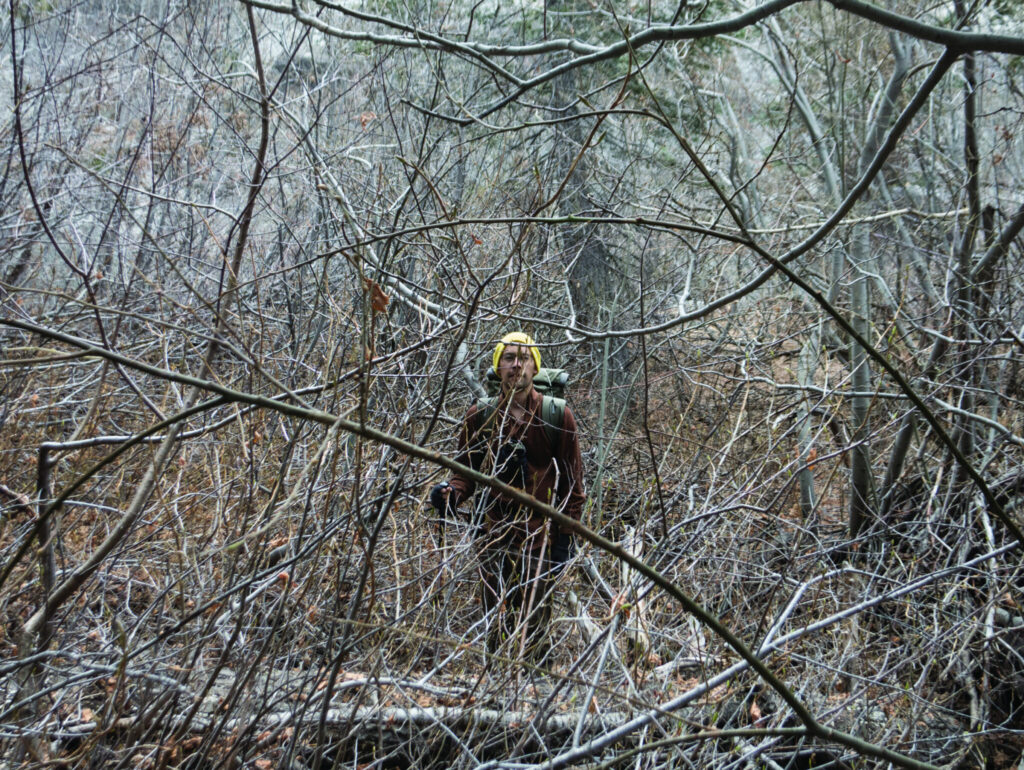
Matthew Rangel
A printmaker's stratified view of the Sierra Nevada opens the mind to new understanding
Dinuba, California, is a city of just six and a half square miles and a population of 24,000, located in the richly fertile Central Valley at an elevation of 345 feet. Eight of the top ten employers in the town grow, pack, process, or sell food. Yosemite National Park is 80 miles due north, and Mount Whitney, the highest point in the lower 48, is about 50 miles due east, but Dinuba is pretty much dead flat, the air is often hazy, and if you didn’t lift your eyes you might think there was nothing around but farms and dust and wind.
Matthew Rangel’s grandparents came from Texas and Mexico to Dinuba in the 1950s to work in the fields. His parents grew up in Dinuba and then he did, too, finding identity in skateboarding, in its physicality and self-expression. For a kid, the Central Valley seemed like a whole lot of not much, a good place for leaving—or at least it did until high school, when Rangel took a mechanical drafting class, and then community college, when he took an art class, and everything changed.
“I grew up in a house that was only three or four houses down from El Monte Way,” the main drag through town, he said. “The view up El Monte to the Sierra mountains is otherworldly. It’s insane. But I never noticed it. And one day I decided to take a drive in the foothills to practice my painting skills. My grandma let me use my grandpa’s Oldsmobile. It was a spring day. The air was very clear, which is a rare occasion in the Central Valley—its fog made the mountains more elusive when I was growing up.
“I looked up El Monte Way, straight up at the Sierra, and it was like the Swiss Alps. I was flabbergasted. That was there the whole time? I didn’t even know what I was looking at.”
That view was nothing short of a revelation. Rangel’s friend John Spivey, a furniture maker and author who grew up nearby, said, “It’s almost like the story of Paul the Apostle in the journey to Damascus. Suddenly he’s overcome with light and it’s a spiritual experience. You start wondering, ‘What else haven’t I been seeing?’”
Rangel, thirty-seven, is a printmaker. Also, an assistant professor of printmaking at the University of New Mexico in Albuquerque. But really, he’s a printmaker, working in lithography, in which he draws on slabs of limestone with a kind of greasy crayon. Pores in the stone accept the grease, and gum arabic, which is basically tree sap, is massaged into the rock. During printing, ink is rolled onto the limestone, the stone is dampened with water, and the paper is laid down. Ink is attracted to the grease and repelled by the water due to the gum arabic. “It’s a very natural process,” said his wife, Amie Rangel, who is also an artist, a printmaker, and a college art instructor. “It’s just rock, water, tree sap, and grease or fat.”
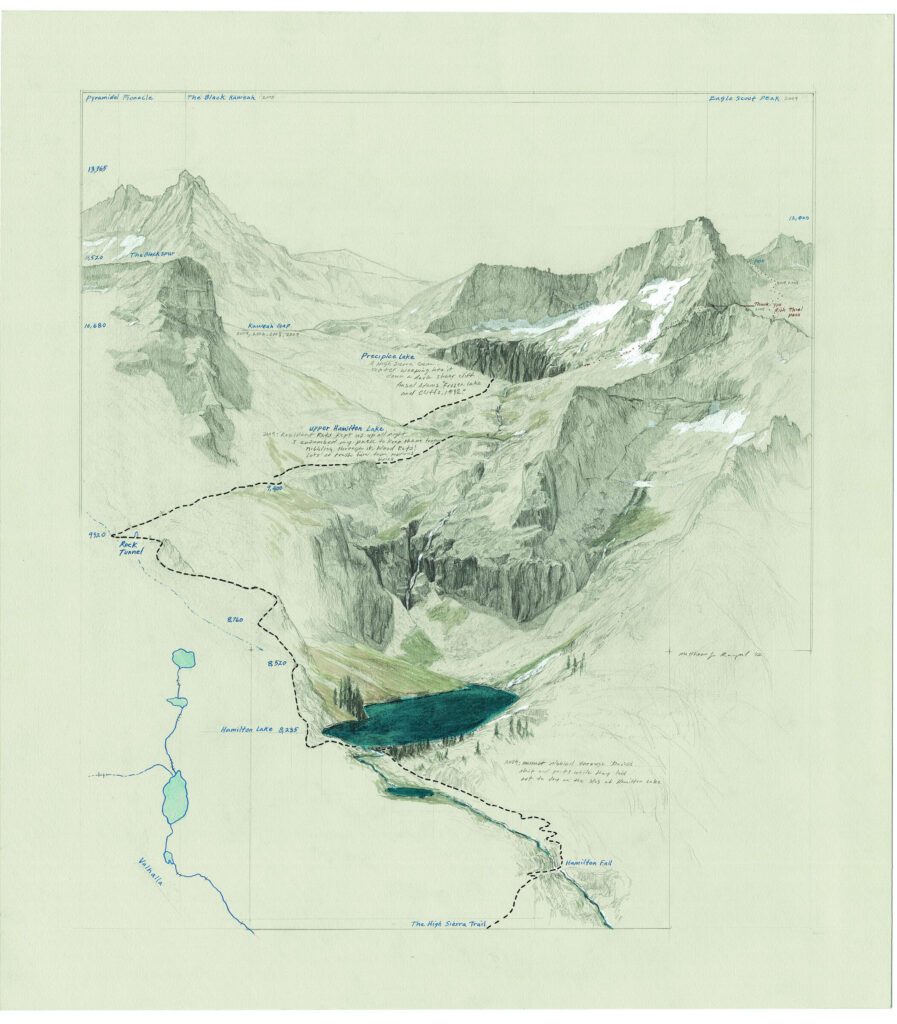
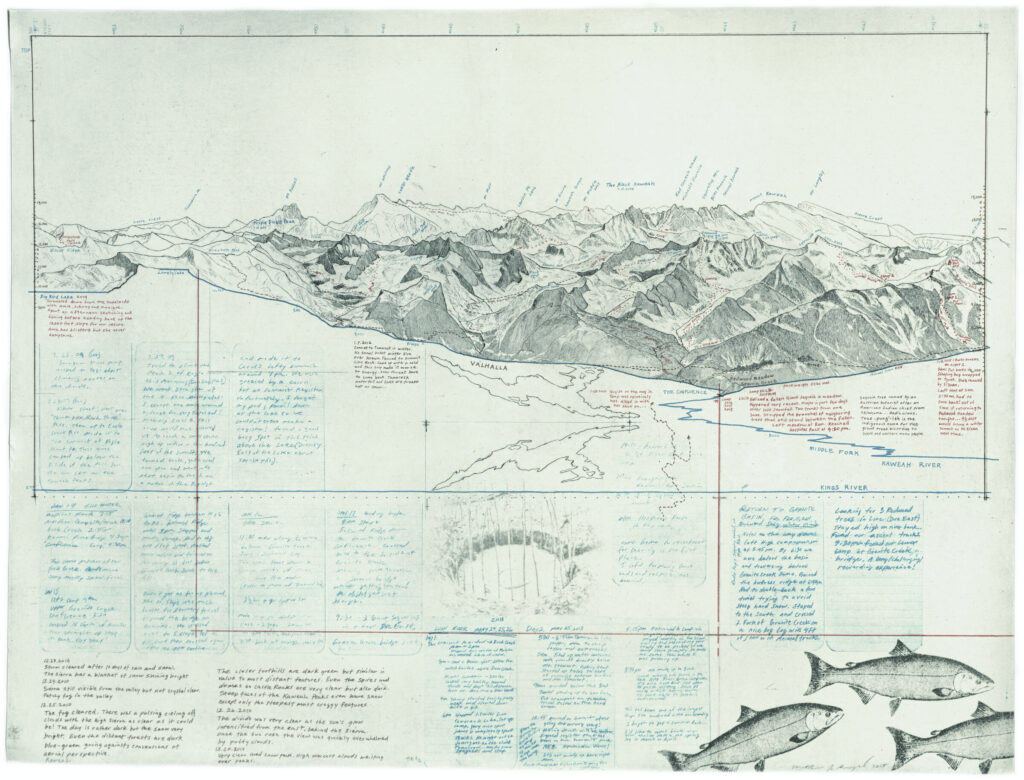
The limestone can be used again and again, allowing Rangel to build up a rich feast of line, image, text, and data. Even his earliest sketches of the Sierra Nevada featured notes, musings, and elevations, but as Rangel’s work has evolved it’s grown more complex, with more layers and more information, and his most recent studies of the Sierra resemble natural history guides collaged with land-use plats appended with trip reports, field notes, and anthropological ruminations.
“There’s an entry point in my artwork,” Rangel said. “It’s representational. It’s easy for people to see it’s a specific place, so it’s easy to approach. But when you start to look at the layers that are embedded, it becomes more expressive and meaningful and emotional and devotional. Then comes the question, why does this person care so much about this place?”
Well, a lot of people care about the Sierra Nevada, this famous range of light, and a lot of people have tried to express the awe they feel there, most famously John Muir, whose every word of gilded rhapsody seemed burnished by buttery sunbeams. But the challenge for anyone, especially someone working in pictorial representation, is how to say or show something new.
His approachability helps. Rangel’s mountains are recognizable as real summits. You might also recognize in Rangel a fellow outdoor enthusiast, who talks of blisters and hiking shirtless in the heat and hitting his turn-back time and forgetting to bring a notebook for a summit register. With its liberal use of topographical lines and USGS quads overlapping the shaggy horizons, Rangel’s work seems familiar, even comfortable, suggestive of not-yet coalesced memories from last weekend’s backpacking trip.
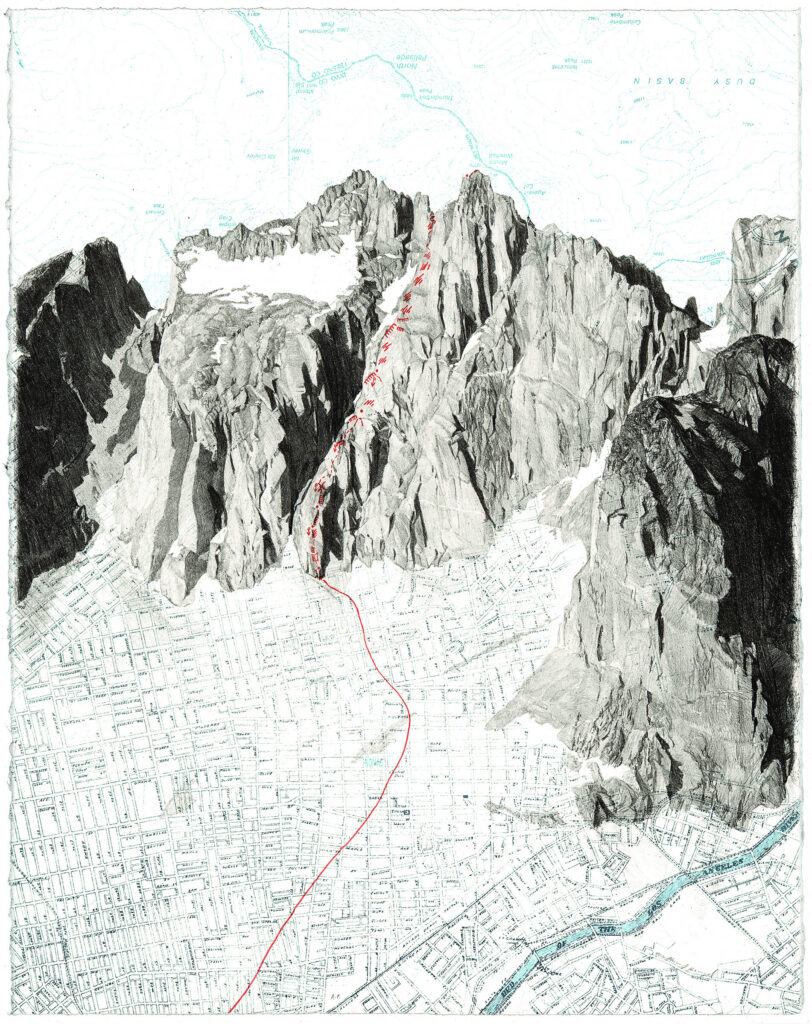
That’s no accident. Rangel met and fell for the girl who would become the woman who would become his wife when he was fifteen and she was thirteen. Amie’s family had the means and inclination to venture into Sequoia and Kings Canyon and Mineral King and other cathedrals just east of Dinuba, and while Rangel was still years away from becoming an artist, those early excursions with them led to familiarity with the corrugated valleys and whale-gray granite that would become his foundation for later adventures, when he began hiking and then backpacking and climbing.
Rangel got an associate’s degree in liberal arts at College of the Sequoias in 2002, then a BFA from Cal State Long Beach in drawing, painting, and printmaking in 2005. What came next was an explosion in productivity and creativity, as he raced to keep up with his inspiration and continued his education at the Herron School of Art & Design in Indianapolis. In 2006, he and Amie backpacked the Sierra from west to east (most do it the other way, as access is easier), and from that he created a series of prints called Across the Sierra. “This,” said Amie, “was the beginning of layering and his understanding that language of layers. A lot of the preliminary drawing that he did for the trip came when we were living in Indiana. He took what he’d learned in drafting, where you create an elevation of a house from the plans, and did the same thing with maps, making an elevation drawing of the landscape from the topo lines. I mean, he couldn’t show detail like chaparral, but he can create the structure of that form, of the mountain prior to actually being there, without actually seeing it. When he first started doing it, I was like what in the world are you doing?”
Wait—Matthew can look at a topographical map, study the contour lines, and then draw an accurate sketch of the mountain as if you were there?
“Yes.”
Cool.
Across the Sierra, then, was about ground-truthing, about being in instead of looking on. While there, Rangel would frequently wake up for an alpine start, scramble up a peak, and return to Amie in the tent at sunrise. He spent his time sketching while she wrote in a journal, so when he later compiled their experience in his prints using his drawings and her words, the perspectives were slightly different. They overlapped, but the layers were slightly off-register. It wasn’t just about his interpretation of the landscape, but hers, too, giving an embedded multi-view expression—more dimensional than a single perspective, and a lot more interesting, too. He was onto something.
Take El Monte Way toward the mountains and you cross an aqueduct and farm fields and eventually come up hard against a foothill. The Sierra might be rich with public lands, but the Central Valley is mostly private and much of the terrain is owned by conservatives and cowboys whose families have ranched there since the 1880s. The day when Rangel went exploring in the Olds, when the scales fell from his eyes, he didn’t actually get far before being stopped. (One of his prints, not coincidentally, is called Access Denied.)
“The road only went 12 miles,” Rangel said, “and I started walking. This guy came out and said, ‘Hey, what are you doing, this is a cattle ranch.’ So I got turned away. A few months later I came back and introduced myself. After I was granted permission, I went up there and took my binoculars to see those mountain forms really clearly and when I came back down from the mountain and started thinking about what was going on in the land, I started looking for a map. We went to the Kings Canyon National Park visitor center.
“A ranger showed me a really detailed topographic map called Triple Divide Peak, and Amie’s mother purchased it for me. I could see the Kaweah River system, how it looked like veins in the body, the way Leonardo had written. And after that I started paying attention to all the canals you cross when you’re driving around the Central Valley. Once I started going up in the mountains, I began to have this really internalized sense of how water moves in the landscape.”
Rangel was beginning to grasp the interconnectedness, and while his aesthetic curiosity and love of mountains led him to study the physical topography, his intellect led him to the human. Who were these people who owned the ranches? How did they use the land and feel about it? What about the people who came before them, the Yokut? What histories were layered there that he didn’t yet know?
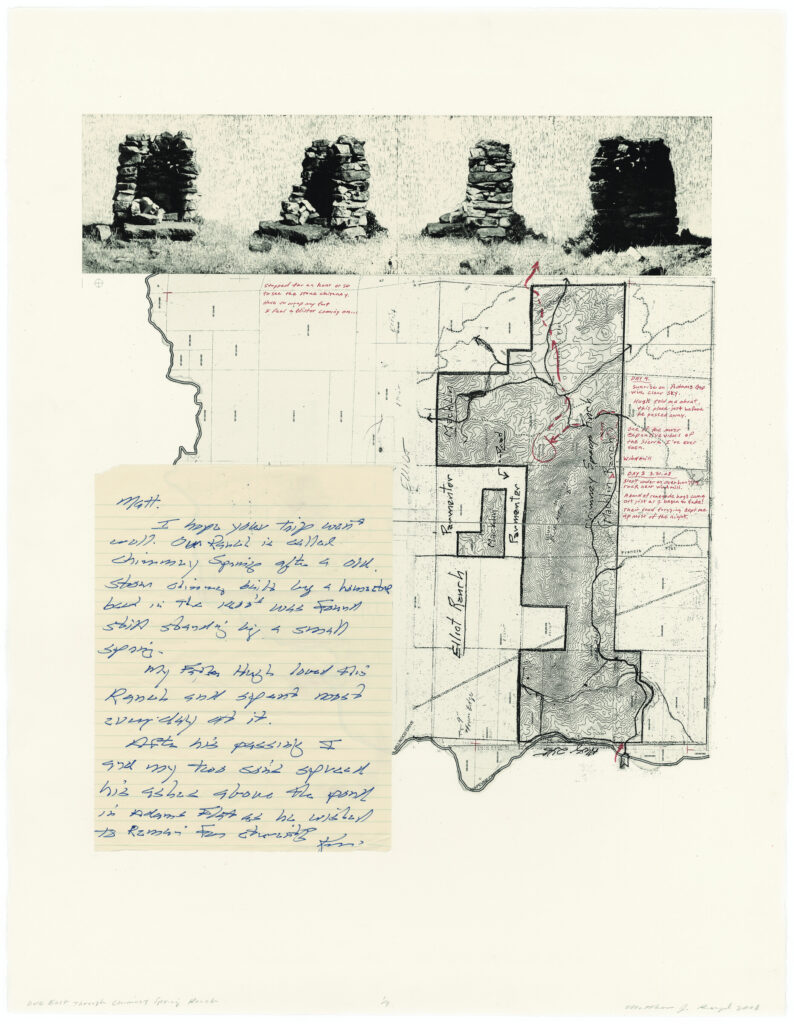
His next big project was A Transect—Due East, in which he walked 200 miles between Dinuba, the Great Western Divide, and the Owens Valley over the course of several trips in 2008. After Indiana, the Rangels had moved to Canada for graduate study in printmaking at the University of Alberta, where his advisors pushed him to define and defend his art.
“When you’re a contemporary artist who wants to be relevant, beyond being a Sunday painter, you have to deconstruct what you’re trying to see so when you reconstruct it, it has conceptual intent. So there’s more to it than just pretty pictures,” Rangel said.
“You have to understand philosophy and the issues that surround the content that you want to explore, so my professors were always challenging me. ‘You’re going to make an image of that mountain again. So what’s that about? What’s behind that? What’s the motivation and how are you going to make it so it’s not just a shallow thing, but it has depth and meaning?’”
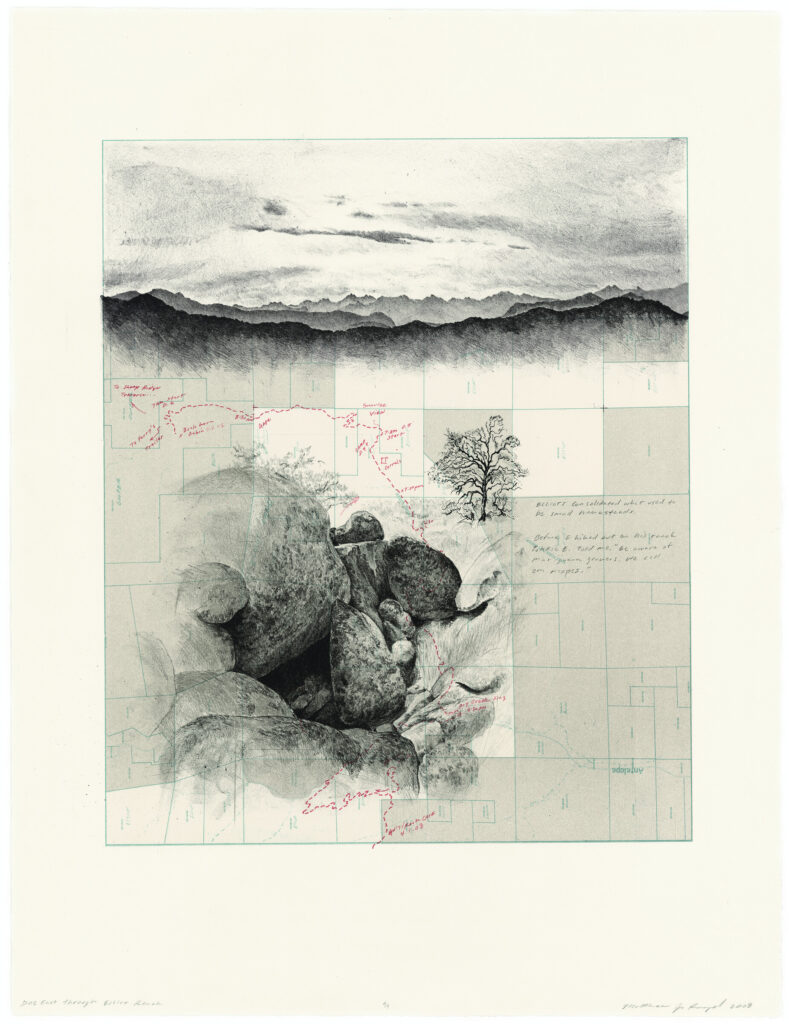
Amie said, “Canada was a transition between Across the Sierra and A Transect—Due East. It was pivotal. So much was happening through phone and email, so there was a lot of documentation. Every time we would go back to California, Matthew was meeting with landowners. It wasn’t just about getting permission from them, it was finding out what their stories were and how they felt connected to the land. As children, we never were exposed to the rich history of the area, but this opened him up to an understanding of the landscape from so many different perspectives.”
This manifested in the work, which still used his trip reports and personal experience as the foundation, but also increasingly featured animals, events that shaped the land, and the histories of others. This combination appears acutely in a piece called Due East over Shadequarter Mountain. It features a lookout tower, portions of the Kaweah River drainage, and snippets of a conversation Rangel had with ranchers Tim Loverrin and Forry Cooper while up on Shadequarter’s slopes:
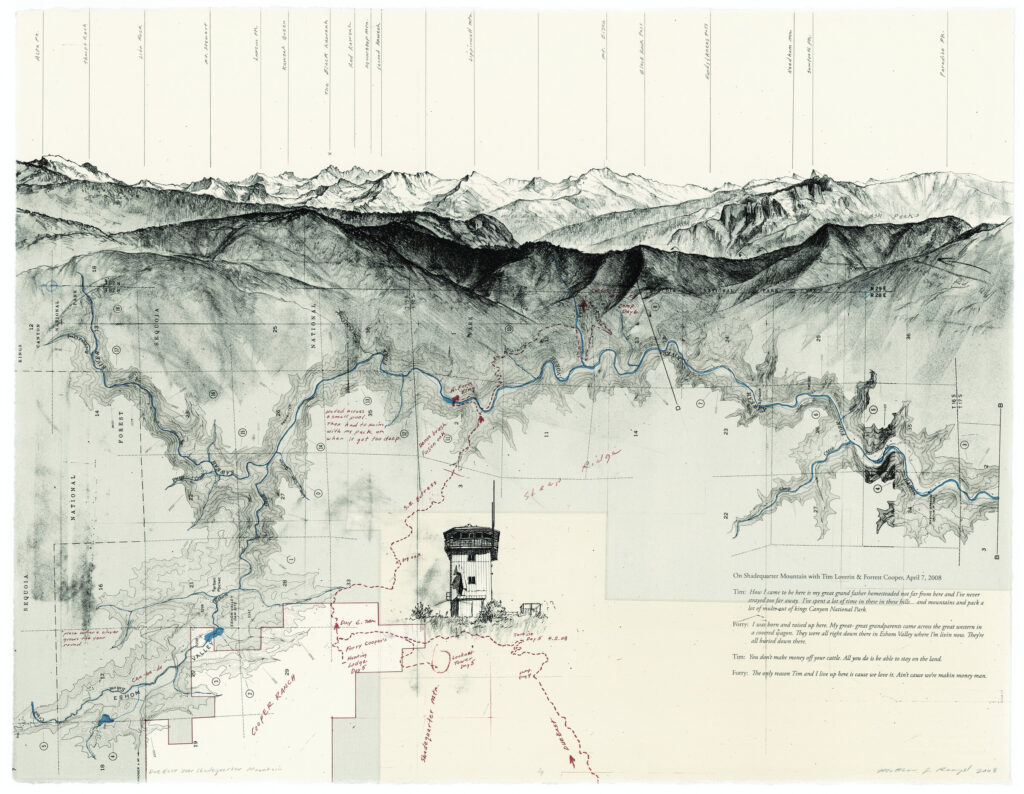
Tim: How I came to be here is my great-grandfather homesteaded not far from here and I’ve never strayed too far away. I’ve spent a lot of time in these in these hills…and mountains and pack a lot of mules out of Kings Canyon National Park.
Forry: I was born and raised up here. My great-great grandparents came cross the Great Western in a covered wagon. They were all right down there in Eshom Valley where I’m living now. They’re all buried down there.
Tim: You don’t make any money off your cattle. All you do is be able to stay on the land.
Forry: The only reason Tim and I live up here is because we love it. Ain’t cause we’re makin money man.
In early 2018, the Rangels were teaching printmaking and art and raising their toddler son, Leland, in Albuquerque. Matthew has proven so far to be immune to the desert charms of New Mexico ranges and instead continues to dream of the Sierra, and Dinuba, and to explore where the water goes when it runs out of the mountains. In 2016, he held an exhibition of work in the U.K. called Linear Referencing, in which the Sierra featured prominently but the hydroscape played a larger role, especially referencing dry Tulare Lake, once the largest freshwater lake west of the Mississippi, now drained and stolen by agricultural and development.
At its core, Rangel’s art reflects an effort to apprehend, distill, and understand his experiences, while simultaneously acknowledging the crosstalk and dissonance between action, place, and history. Linear Referencing has a piece that touches on these themes and points to where he’s heading next. Called Sierra Nevada Codex, Mineral King, it features the personal (“Hiked up at 11pm in sandals while shoegoo dried on my boots.”) as well as the historical and also the writings of his friend John Spivey. There’s a bear, and fragments of giant sequoias, and the story of a flood, and a cross section of a dam built in the 2000s, all set against the spine of the Sierra Nevada. It’s a lot to take in, and it brings to mind something Rangel said about that long ago day in the foothills, looking up at the mountains.
“I couldn’t completely comprehend what I was seeing,” he said, “but I knew it was in a new way.”