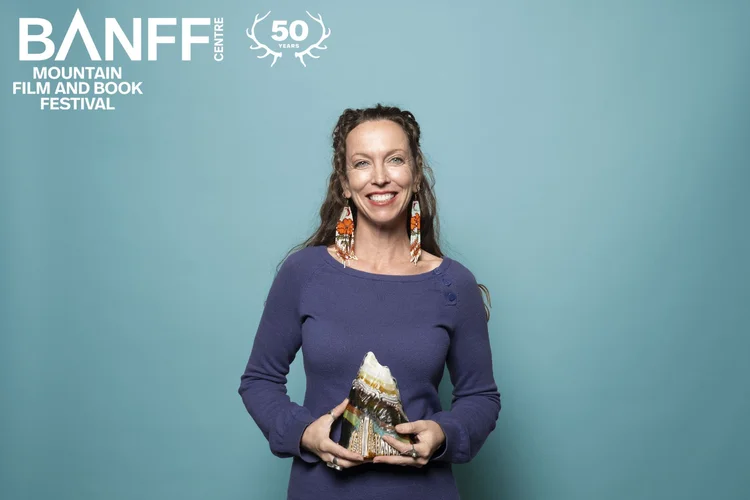
Cassidy Randall Climbs Back in Time
For the last decade or so, I have watched Cassidy Randall’s writing journey with great pleasure. Cassidy has written for the New York Times and for AJ, and her stories are always deeply heartfelt and wonderfully attuned to the human experience. So it’s really no surprise to me that her first book, Thirty Below, has done a masterful job of weaving the story of the first all-women’s expedition to summit Denali. They did it in 1970. They used siege style. They carried wooden snowshoes. And they faced a culture that was actively hostile to their being there at all. The book won the Grand Prize at Banff, which is an amazing feather in Cassidy’s cap — really not surprising to me. So I had a wonderful conversation with her. I hope you enjoy it. I think you’re going to love her, and I think you’ll love the book. My name is Stephen Casimiro. Let’s dive in.
I’m so excited to talk to you, and so excited to actually see you, because we’ve worked off and on for, I don’t know how many years. When was your first story for AJ? It’s been a while.
Yeah, when was that? I’d have to think about it. 2017, ’18?
Maybe. You did a piece — I can’t remember what we titled it — about coming home, about moving back to Montana. And then, of course, you did the honeymoon one, “If You Can Survive This, You Can Survive Anything.” And we’re going to get to your book, I promise. But I just found out your sister wrote a wonderful piece for us about sailing. Now that I’ve learned a little more about you and worked with your sister, I even more get the coming-home story. Can you talk about that a little? Because you moved around, and your radar was out about dating, and you were sort of talking about your journey — how it took you afield and then back. And now, in light of family, I get it even more than when you wrote it.
Yeah. So 2025 is my 20-year anniversary of moving to Montana. My sister and I grew up in Southern California, very far from any kind of real winter — to the point that, even though we lived at the base of the San Bernardino Mountains, where Snow Summit and Big Bear are, these great little mom-and-pop ski resorts, when I was probably in junior high, some friends were starting to learn to snowboard. And I cornered my dad once on our hot patio, surrounded by grapevines, and said, Dad, how come we never ski? My father is a Southern California surfer, an orange-grove guy. He looked at me and said, you can stand in a cold shower and rip up $20 bills for the same effect. And I never asked him again. So the fact that my sister and I both ended up in a northern climate is shocking.
I moved up here intending to spend just a winter. My sister was already here, going to graduate school at the University of Montana, and then planned to go back to Southern California. But, one, I learned how to ski, finally, at 25. And two, I took a class with a professor I wanted to get my degree with. And I never looked back. I spent, gosh, 10 years here, probably, just loving life, until it suddenly started to feel small, like dead ends. And so I was a total cliché. I quit my environmental activist job with just enough money in the bank to be gone for maybe a year, and moved to New Zealand to hitchhike and hike and ski. When I ran out of money, I came back, and it still didn’t feel right. And I finally ended up in Revelstoke, in British Columbia, which was my mecca for skiing and expanding all these physical limits. It’s where I really started writing. That town is full of creative people, fascinating folks — it just vibrates with energy.
One of the reasons I left Montana was that I’d had my stock-market-crash of a relationship here, and after that just could not find love again, and was convinced I never would. And then I ended up falling in love five years after moving to Revelstoke. I got permanent residency. I was never coming back to Montana — I was a Canadian. I fell in love with a man from Montana, convinced him to move up to Revelstoke, and I had it all for a little bit there. And then the pandemic hit and the borders closed, and I realized how often I came home to Montana, where all my very good friends were, where my sister was, and now my niece and nephew. And I felt it flip. It was this visceral shift. What had been so important to me was adventure, and who I was adventuring with — the fact that I had 20 people on a given day to say, hey, do you want to go for a mountain bike ride. It shifted to where I was like, no, I need these deep relationships, that’s what’s important to me. And it was a really long road to finally making it home and being at peace here. That was a long-winded answer.
No, that’s great. My head was spinning. I won’t go down a rabbit hole, but what town did you grow up in?
Yucaipa, off the 10 freeway between Los Angeles and Joshua Tree.
Oh, okay. I go past there all the time.
Yes, and it’s gorgeous, right? An amazing spot. It’s just very different than up here.
Very different. This thing about the adventures we chase — we did a reader poll every week before we launched AJ in print, and one of the questions was, could you have a life partner who wasn’t adventurous? And predictably, 90 percent of people were like, no, no, I couldn’t possibly. Some people come to this sooner than others, and it may be a function of age, but you can have adventures anywhere. You can’t necessarily have family anywhere. One of the reasons I’m still in Southern California almost 40 years after moving here from Vermont is that this is where my family is now. My wife grew up here, her dad’s here, now my mom’s here. My kids have moved away. As an only child, I was not close to my parents — it just wasn’t that important to me. Adventure was what was important. And there’s a dominant narrative within the hardcore adventure spaces that you chase the snow, you chase the waves, and the other stuff falls by the wayside. You’ll make your new family, but there’s just nothing like blood.
Yeah. And for me, a lot of the friends I made here in Missoula came at a very formative time — my late 20s, early 30s. I was going to graduate school, expanding in so many ways. It’s very hard to replace friends who know you on that level, no matter where you go.
So our main agenda today is to talk about — I heard you wrote a book.
I did?
I heard you wrote a book. I was at Coast, you were at Banff. Your book won the big book award, sort of like the Oscars of mountain books. Can you tell us — are you at a round table with other people waiting to hear? Did you know beforehand? It’s the biggest award you can win for outdoor books, and you just won it. So what was that like?
Oh my gosh, it was incredible. I still don’t have words. Banff is a place where creativity just crawls out of the walls. It’s this condensed gathering space for adventurers and writers. The book aspect of Banff is unlike any other festival I’ve been to. It’s well known as a film festival, but the book program is incredible. You get these authors from all over who have done incredible things and written beautiful things, getting their time to speak. And people come just for the book program.
I’d been going to Banff since 2017, since I moved to Revelstoke, and have really amazing connections there. I was invited to submit Thirty Below — this book on the first all-women’s ascent of Denali — to the book competition. Even being invited to submit is amazing. And then two weeks before the festival, they sent out a notification of who won their category. I remember being shocked, because I just assumed maybe Melissa Arnott would win. Melissa is already fairly famous, and her book was groundbreaking in so many ways. So that was wild.
You go up to Banff — I’d just come from a talk in Whitefish at a women’s leadership conference — and the book awards happen on Thursday night. Everybody is a little nervous, because you have to come on stage and accept your category award and talk for one to two minutes. I’ve spoken in front of audiences, and I was so nervous for some reason. I came out to accept my category award and just made a joke — front row, I’m sorry, if you can see the sweat stains in my armpits, all these buildings are so hot at Banff, and I’ve completely messed up my wardrobe, I’m wearing basically this giant blanket of a sweater dress. And everybody laughs. And I said something about what an honor it was to be in the category with Melissa, and that the mountaineering genre is not one women have written in very much at all, so to have two books in there is incredible — thanks to the women who’d come before us and talked about why women’s stories are important, and thanks to my parents, who’d driven up, and my husband.
Then you go backstage. Everybody accepts their category award, and the three jurors get up to talk about who won the Grand Prize. And I have convinced myself that the fiction book is going to win — it’s right up Banff’s alley. It was called An Abundance of Wild Roses, set in Nepal, with magical realism and cultural conflict and snow leopards. So I’m half-listening, and Kate Neville gets up and says, and the Grand Prize goes to Thirty Below. I remember my stomach dropping, my eyes getting wide, and I didn’t hear anything she said after that. Caroline ran up and gave me a hug, everybody else hugged me, and honestly, I cannot remember what Kate said. You’re standing backstage, and then they bring you out to accept your award, and I said — because I was so floored — you guys, I don’t have anything else to say, I didn’t expect to win. People ended up coming to my book talk the next day, and several said they came because I was so real on stage, by which I think they meant it was totally awkward.
That’s amazing. I’m surprised they didn’t have to bring you out on a gurney. You’d have to have a pretty big ego to think you were the shoo-in for the Grand Prize.
Yeah, definitely.
Can you imagine if you’d had two speeches written?
Right.
Let’s get to the story, because I could not put the book down. It’s an instant classic of mountain literature, of telling the story of a climb. But there are so many wrinkles — the misogyny and sexism, and, setting aside gender, just the personalities involved. So give me a little synopsis, and then we can walk through the scene-setting.
Yeah. I found this climb by way of my agent, who sent me an email one February morning in Montana a few years ago. She just said, is there a good story here? And it linked to an old — well, not that old, a couple-year-old — National Park Service blog post about the first all-women’s ascent of Denali. It was really short, maybe 500 words, commemorating the anniversary of the climb. And I thought, I had never heard of this. It seemed like quite a feat, because for context, we had sent men to the moon by 1970, and women still hadn’t stood on the highest points on Earth. There was this popular belief at the time that women were too weak to withstand high altitudes and savage elements, to carry heavy loads day after day without men’s help. So I thought, if this climb was such a big deal, we should know about it — the way, if you’re nerds like us, we know that Lynn Hill freed the Nose in the ’90s.
As I dove deeper, it became clear that not only was this the first all-women’s ascent of Denali, it was the first all-women’s ascent of any of the world’s high peaks. And not only that, it turned into this wild, improbable survival story. And yet somehow it had escaped widespread notice and more or less disappeared from our collective consciousness.
The story starts in 1967, three years before the climb, with the woman who ends up with this audacious idea to lead an all-women’s climb up Denali. I love starting it there, because it’s a snapshot of who this woman was — so determined, and very complicated, which I loved — and a snapshot of what the mountain could do to climbers. Denali, as a lot of people who know it — maybe even climbed it — are aware, is not the tallest mountain on Earth, not the most technical, but it is one of the biggest. And it’s famous for wildly fierce weather and savage conditions.
In 1967, Alaskan climber and doctor Grace Holman is on the mountain — she’s on two expeditions, the only woman on both, to the summit of Denali. On the first, she’s turned back midway up by the expedition leader because he thinks she’s suffering from altitude sickness, even though a nightmare storm had just broken over the top of the mountain. They knew seven climbers from another expedition above, the Wilcox Expedition, were trapped in it. And a doctor like Grace would probably have been really critical for those men. He turned her back. And it would turn out later that all seven of those men died in that storm. In that storm, the winds were estimated to be howling across the top of the mountain — and this is not a typo — at 300 miles an hour, which is insane. And it came out of nowhere.
The second expedition Grace is on is a humanitarian mission to figure out more about the decisions that led to those men’s deaths, to find their bodies and give them a proper burial. Her husband, Vin Holman, is leading that expedition. For some reason the bush plane drops them at 10,000 feet, which is 3,000 feet above the normal base camp, and they start climbing. Grace again starts to feel ill, and her husband leaves her on the mountain, turns her back, even though there’s no urgency this time — those men had already died. So I love starting there, with these stakes about who Grace was and why she wanted to do this.
Then the book ties together the other two who end up being main characters, just because the most surviving information was on them — Arlene Blum, and Margaret Clark, who’s a Kiwi. And it brings in three other women who were the climbers. The way these women came together were these fateful paths that almost read like fiction. There were all these obstacles to overcome before they even made it to the mountain — and some of them were these magical resolutions they were able to achieve to get over those things and make it to the side of Denali. And then what starts to happen on the mountain is just insane — these personal dynamics, the stakes, the pressures they were under as the only women to have ever attempted this and what that meant at the time. And when they land at the top of the mountain in this life-and-death situation, what they choose to do and how they choose to do it. The whole story was so intriguing that I ended up writing it really quickly, once I figured out what the actual story was.
So I’m wondering directionally — should we set the larger scene of sexism before we get into what happens? In particular, there’s a part about folk wisdom in 1967. Can you say that off the cuff, or do you want me to read it?
I think I can. It was Arlene watching the first woman run the marathon — that kind of folk wisdom about women undertaking arduous activity.
Yes.
That their legs would become unsightly large, they would grow mustaches, and their uteruses would fall right out of their bodies. This was 1970. That wasn’t that long ago.
No. On the other hand, we still have a history of men making laws about women’s bodies who don’t seem to understand the basic biology of them. So we haven’t really gotten that far. So tell me — almost all of these women faced horrific sexism, people who completely dismissed their dreams of climbing, even though they were already accomplished climbers. What was that climate like in the late ’60s, if you were female and you wanted to climb big peaks?
Yeah. They were coming off of 1959 — so that’s 11 years before Grace was on Denali in 1967. In 1959, another expedition that had billed itself as all-female, even though they had male guides and porters, was Claude Cogan’s expedition to the top of Cho Oyu, the sixth-highest peak in the world. When Cogan and a few of her expedition mates and one of the guides were swept away at high camp, before they could reach the summit, by an avalanche, this British reporter, Stephen Harper, called it more evidence that women were incapable of withstanding the white hell of an avalanche-torn mountain — that in the face of certain death, men go out and flaunt it, and women just accept it, or something along those lines.
And leading up to this — Margaret Clark, the New Zealander, was a geologist in training, an incredibly accomplished mountaineer who’d climbed all over the world. She wanted to be part of an expedition to Antarctica, where people with her experience were in high demand for keeping research expeditions safe on the ice. And she was denied because there were no women’s bathrooms on the plane from Christchurch down to Antarctica.
Arlene had wanted to climb Denali, and assumed her only opportunity was a guided trip. And that guided trip told her, no, women will not be admitted on the climb, but you can come stay in base camp if you want to cook for the rest of the expedition. She’d been told that women climbers either aren’t good climbers or they aren’t real women.
And Grace, in the third incident — terrible things come in threes — that spurred her to lead this all-women’s climb: she had been barred from an expedition to Dhaulagiri I in the Himalaya that Vin, her husband, was going on. Although she had climbed on several continents and had all these first ascents to her name, five of them solo, in Alaska, the leader of that expedition told Grace she had light experience and was suffering illusions of grandeur. She probably had more experience than half the men put forward for that team. And those are just a few of the things. I have a whole chapter about what women had to deal with at the time — infuriating and fun to write.
There was one incident, I think in the Himalaya, where a woman was there with her husband, and it was suggested that if she wanted to be there, she had to sleep with all the men.
Yes, that’s right. I forgot about that one. The most outrageous.
How can you forget? Who even thinks of that idea, let alone states it?
It was Irene Miller — again, an accomplished American climber. She went to Makalu with her husband, who was part of Sir Edmund Hillary’s expedition up that mountain. Hillary not only forbade her from joining, but one of the men on the expedition said that if she wanted to be part of it, she ought to be willing to sleep with all the men on the team, despite the fact that she’d gone with her husband.
If you’re going to ask, you might as well ask right in front of the husband. I’m just shaking my head. I don’t want to hijack this dramatic story with the tales of misogyny. But what you write about in Thirty Below, and what Melissa Arnott wrote about, has brought me face to face with realities of the bias women face — I know it conceptually, but not tangibly. It’s frankly stunning and disgusting. As if climbing big, high, very cold mountains isn’t hard enough, these women then, and to some extent still now, have had to face this kind of bias just based on gender.
This is a departure from our self-imposed itinerary, but I had a lot of tension when I was writing this, because I didn’t want to hit the gender lens over the head so much. My editor said, we need this backdrop, this is just what these women were dealing with at the time. And it was a huge motivation for several of them. But at the end of the day, I just wanted it to be this amazing story. We don’t read books like Into Thin Air and The Wager and Touching the Void because they’re male-focused stories — we read them because they’re good adventure stories. And that’s really what I wanted this to be, and I think it is, regardless of the gender lens. The gender part just has to be in there, because it shaped who these women were as climbers in a lot of ways.
But it’s also this idea I want to get away from. I got the honor of being on a panel with Cheryl Strayed at Mountainfilm, and a woman in the audience asked, what can we do to support women writers? We’d been talking about bias in publishing for writers like us. And Cheryl told this story she said was indicative of her entire book tour. Anybody who’s been living under a rock — she wrote Wild, this insanely successful memoir about hiking the Pacific Crest Trail and using it to heal her trauma. She gave this example, that she was on with a radio host, and before he hit the live button, he said, Cheryl, this book is amazing, you wrote all these things I needed to read, it really touched me. He hits the live button, on air, and introduces Cheryl Strayed, who’s written a great book for women. So Cheryl was saying there still is this bias that books about women, and written by women, are only for women. And going back to Into Thin Air and Touching the Void, it’s not only men reading those. I love those books. So there are a few different things I want to overcome with this book that are not small things — one, that it’s not just a book for women, and two, that it’s a great adventure story.
It is a great adventure story. A great addition to the canon of high-alpine climbing. The personalities are complicated and incredible, and the drama and the weather and everything they face is incredible. And I think we should move on from this, but it’s critical, because it’s the context within which the climb occurs. These humans faced extraordinary challenges because of their gender. You can’t get away from it. It’s a critical part of their experience, even if we’d kind of like to move on and just get to the climbing part. The climbing doesn’t happen outside that context.
Yeah, it’s a catch-22.
Let’s talk about some of these people. One thing that impressed me — there are six women on the climb, plus some ancillary characters. That’s a lot of personalities to balance while telling a story without getting lost in the weeds. And they all had critical roles to play. It really comes down to primarily two of them, and a couple others worth mentioning. A lot of your narrative was based on the materials you had access to, and primary there was Arlene Blum’s memoir, right? So when you came upon these characters and started looking into this, how did they present themselves to you?
The first thing writers do to see if there’s enough for a book, especially with historical narratives, is to see what still exists. Side note — can you imagine somebody trying to write a historical narrative 50 years from now? Are they going to look through our text messages?
Probably. ChatGPT has them, so they’ll have easy access.
I guess that’s a good point. What I found first was Grace Holman’s archive. Grace and her husband Vin were both incredibly well-known Alaskan climbers, and Vin was putting together a guidebook about Alaskan climbs, so he’d amassed so much material and correspondence. Their archive is housed at the University of Anchorage, where they both lived. And it wasn’t even their climbing exploits that got me — it was this tragic love story between the two of them. I didn’t even want to give it away, because it’s so formative to who Grace is and what leads her to try to lead this climb. She finds the love of her life at a much older age — he was younger than her by 10 years — and loses him in this mountain tragedy where she was not allowed on the expedition. And she ends up with this heavy survivor’s guilt, this wild and heartbreaking grief. That was so gripping to me, to set up what ends up happening later on the mountain.
Then she finds Arlene Blum. The way these women came together almost reads like fiction. When Grace finally convinces herself to go through Vin’s correspondence after he died, she finds a letter where Arlene had asked for Vin’s support — at the time, you needed the support of the Alaskan rescue group and other expeditions on the mountain. The park would only approve you if you said you had support. So Arlene had been asking Vin, via letters, who could support them.
For Denali, correct?
Yeah, on Denali. Grace knew nothing about this correspondence. Arlene had been part of a three-person group, looking for a fourth, but she’d started to put all the wheels in motion, and the group fell apart — Arlene was the only woman. She sends this letter to Vin, like, it looks like I won’t be making it to Denali. Grace finds it, and the two of them start corresponding. Grace has this idea — I want to lead this climb, the all-women’s climb, would you be interested?
And what’s also amazing is that I had access to everything in Arlene’s archive. Arlene is still alive, which is very helpful when you’re doing a historical narrative. There are two surviving members of the climb, Arlene Blum and Margaret Clark, the Kiwi, who lives in Christchurch. She must be 89 now. I want to be Margaret when I’m old. She’s just starting to lose her mobility and is so pissed off about it. She refuses to use a walker, and has a hiking pole in every room instead, which is amazing.
That’s so cool. Wait, I’m going to hijack you. Margaret got hurt right before this, right? Some of the challenges these women faced to get on this climb — do a little sidebar on what happened to Margaret. It’s incredible.
Yes. And to make it really confusing, there are two Margarets on this climb. Margaret Clark, the Kiwi, in the six months leading up to the climb was diagnosed with multiple sclerosis. All she wanted was to climb mountains — she became a geologist basically so she could get paid to go abroad and climb and do studies. And she gets this diagnosis that she has very limited time before she’ll be relegated to a wheelchair, and she’s never been on a big expedition. So those are her stakes.
The other Margaret, Margaret Young, is maybe the most fascinating member of this entire expedition. She was a renegade member of the Forbes family — astronomically wealthy, but you’d never know it. Arlene has this amazing memory of going to Margaret Young’s house for the first time. They both lived in the Bay Area and would climb together, and Arlene was unsure if maybe she’d entered through the garage and not the front door. Margaret was a physicist and a small-plane pilot, and she became a mechanic to figure out how to fix her plane. She was quite possibly a genius, and I think because of that, her brain and her social skills worked very differently than anyone else’s. Arlene walks in and sees stacks and stacks of projects in progress, basically science experiments. She can see through to the kitchen, and it doesn’t look like a kitchen, it looks like a science lab — the surface of the wooden table written all over with the calculations Margaret makes when she’s on the phone getting weather to fly.
And she has these super dark eyebrows.
She does.
In a handful of photos I’ve seen of her, she has this laser-like, super-intense gaze that says, who are you, and I don’t give a — these kind of Frida Kahlo eyebrows. There’s this smoldering intensity you see in some of the photos of Frida Kahlo herself. This is a person you don’t want to mess with. A powerhouse.
I think it’s maybe even more intriguing that so little exists on her now. She’s the one member of the expedition who doesn’t appear in any of the correspondence. She sent no letters that were saved — and I’d guess she didn’t send any. She didn’t keep a journal that was preserved, and I would not be surprised if she didn’t keep one. She liked photography, so her photos are what we have of her experience of the climb. But she was this black sheep. The memories people have of her that I could find are that she used to floss her teeth with her hair, the weird things she used to wear, the fact that she had skis installed on the bottom of her Cessna to be able to fly into glaciers to do first ascents. But with her partners, if a partner told her what to do, she’d do the opposite. And she narrowly escaped death several times. Leading up to the climb, she’s on this first winter ascent of Mount Tyndall, falls 900 feet down the side of the mountain, and miraculously — other than some internal injuries, probably — is unscathed. I don’t understand how that happens.
There was another intriguing woman where there was just nothing on her. Faye Kerr was an Australian, and I think she hated talking about herself. When I was in New Zealand with Margaret Clark, I met a bunch of old climbers. Margaret and Faye were very close, and even Margaret didn’t know much about Faye’s background, because Faye just didn’t like to talk about herself. She just wanted to experience the mountains and be happy. Because she was so enigmatic, we met up with four old male climbers to chat about what they remembered about Faye. And over the course of this two-hour conversation, every one of them, in one way or another, said, you know, I think I was a little in love with her. Which I love.
But it’s interesting when you’re writing a book like this — the main characters are the ones you have the most evidence of. What I got really lucky with — one, these women. It was 1969, 1970 when they were planning this climb. We had telephones, obviously, but I swear these women never used a telephone. So you can watch their relationships developing, becoming good friends, over the course of their correspondence. They don’t all meet until they’re actually in Alaska. And then, when they’re on the mountain, the journals these women kept — most mountaineering journals from that time, and maybe even now, are weather and stats and equipment we brought. These women were on full journeys in their heads, and they put it on paper, which is incredible. So a fourth character — Arlene, Margaret, and Grace make up the bulk of the first part of the book, and then this woman Dana Smith walks onto the page once they’re on the mountain, and she and Grace end up having this really intense social tension. The social dynamics start crumbling, which is always really fascinating in expedition scenarios. How do you keep up your social dynamics? It’s a really big piece that I don’t think gets enough attention.
I wonder if that’s changing at all as people put together expeditions now, because it’s such a critical part. So set the stage with the route. They were doing the West Buttress, correct?
Yes.
Give us an overview of the route, and then let’s get onto the climb and start to reveal how these personalities interact.
It’s interesting. By 1970, a fair amount of routes had been opened on Denali. The West Buttress was maybe five or six years old by then. It had been climbed enough, and it’s known today as the easy route on the mountain. The women chose it even though they were all really good mountaineers and a few of them wanted a bigger challenge — they chose it because they knew they couldn’t fail. They were carrying so much pressure up the mountain as the first women to ever do anything like this.
But let’s be clear — the way people climbed mountains then, alpine style was not a thing. Nothing about the West Buttress was easy. They had photographs of their gear that are just amazing — these three-foot-long wooden snowshoes, so clunky and heavy, these heavy frame packs. And they were climbing the mountain siege style, which was the thing then: you carried successive loads, hundreds of pounds of food and gear, to leave at camps. By the time you actually summited Denali, if you were so lucky, you’d basically climbed the mountain two or three times, just trying to get all the gear up there. And there are crevasses and avalanches, and Denali is famous for really intense weather and cold and thin air. Even though it’s not as high as Everest, it’s a high polar mountain. At the time, because of how they were climbing and how much elevation Denali gains — Denali from its base gains 6,000 more feet than Everest gains from its base to its summit — you’re on the mountain for so long. It’s 30 days that you’re expected to have all your food. Some expeditions carried more. So you’re with these people, none of whom have ever all been together at once — six women who’d never spent time together — and then you’re in this really intense environment where the only time you’re alone is if you’re 25 feet behind somebody, tied onto a rope, or trying to use the loo. And the higher you get, the more the elevation is messing with you.
That’s a critical part of it — Grace was the leader, but she was also the organizer, did all the paperwork. So it was obvious she was going to be the leader. Did the group vote, or agree on how they’d do this? Or did she do all the work, so when they got to the mountain she was the loudest voice? How did that shape things?
What’s interesting in terms of dynamics — Grace was the oldest of them, 48 at the time of this climb, which is amazing when you think about ageism in climbing now. She was the most experienced, she lived in Alaska, had been on the mountain — the only one who had been on the mountain at all — and had the motivation to put it all together. So it was very clear she was the leader. She invited Arlene, who was only 23 at the time, to be the deputy leader. And Arlene and Grace brought these women together as a team. You can see their friendship and respect developing over the course of their letters. It was never a question that Grace was in charge, and Arlene would be in charge in case Grace was incapacitated. And there wasn’t a hierarchy, really, after that.
What’s really interesting is all these women were complicated, and a few were really strong personalities. To add to that, Grace has these stakes — by the time she’s on the mountain in 1970, she’s tried to climb it twice and been turned back twice, probably from altitude sickness, which she won’t even admit to herself, because that’s admitting weakness in a culture where you could not admit weakness. That’s a very new thing in outdoor sports, that we’re allowed to be vulnerable. So she starts suffering from altitude sickness. And then you have other women with very different stakes and reasons for wanting to climb, who want to push faster or want to be sure. Arlene was very much a peacemaker, and as heads start butting between Grace and specifically Dana, she feels intense pressure not to let cat fights break down the team, because it’s been accused that that’s exactly what would happen. The other thing is that Arlene is so young, and she does have a lot of experience by this point, but she’s not confident in her ability to lead. So as things start going wrong, the story becomes — thanks to these journals — this wild ride inside the heads of people who all had different stakes for doing this. It’s almost a domino effect of decisions made or not made, and that’s what led to this being a survival story, this crisis at the top of Denali. If you collapsed at the top of Denali in 1970, you died there — nobody was coming for you. So these women find themselves in this life-and-death situation.
And what really intrigued me about writing this story was Grace. When I first found her, I thought she was amazing, heroic in so many ways. And by the end of the story, you just want to throttle her. But what was so interesting is that I got to portray her as a real person. She made some of these decisions because she was still carrying so much grief. She needed to prove herself so badly — her friends in Anchorage thought she had a death wish, to join her lost love. What a cool opportunity, to get to write about real people in this three-dimensional way.
So how do she and the other woman butt heads? What was their conflict over?
Dana is also newly in love. Dana was a very interesting woman of the time. She was divorced. Three of these women were mothers — wildly nontraditional ones, in an era when a mother being engaged in high-risk pursuits was just way off the map. Dana has just fallen in love again, just gotten married, and basically wants to bag this peak, get off the mountain, and get home to her newlywed husband. She’s also so incredibly physically strong that she can do that — to the end of her life she’d leave fellow climbers in her dust, she was so fast and strong. Grace, because internally she knows she suffers from altitude sickness, wants to go so much slower. And Grace also — this is a really interesting piece of what forms her — when she was in her early 20s, she chose to go to Berlin in the middle of World War II to become a doctor, to go to university there. She wanted to be a surgeon at a time when less than 4 percent of women were doctors. That was maybe one of the only universities still operating, and it probably had all the best doctors and researchers and professors. There’s nothing to indicate Grace was ever part of the Nazi Party, but if she wanted to be a doctor, she had to brave Nazi Germany to do it. And because of that experience, the way she led was not as authoritative as it could have been.
What do you mean?
There’s this line — well, I’m curious what you think.
I was just thinking — okay, if you’re coming up through the hierarchy in Nazi Germany, and Germans, I have German blood, have a certain reputation for occasionally being blunt — I’m wondering if we fall into cultural stereotypes, thinking of Grace as a tough cookie, really direct. That’s where I was going.
Oh, that’s interesting. Grace is actually Dutch. There’s this great letter she writes to somebody, that she’s often been thought of as unfriendly because the Dutch are so stiff and formal — so, speaking of cultural stereotypes. But there’s this line in Grace’s journal after she and Dana have one of their first blowout arguments, because Grace wants to stay in this camp, doesn’t want to take the time to climb to the next camp. She’s like, we just need to rest. And Dana chews her out, and they go back to separate tents. And Grace writes in her journal that since Hitler, I’m afraid of leadership where it’s not needed. Just that one line is so interesting to think about, and how it all plays out in the end.
How do you think that informed what she did or didn’t do on the hill?
I think there are these points where things are really escalating — there’s this group meeting above high camp on Denali Pass, where there’s a lenticular cloud over the summit, and Grace is thinking they should go back, and she’s the only one thinking they should go back, and she gives in to the rest of the group. And disaster just unspools from there. Maybe she felt like she couldn’t be listened to. But her experience in Nazi Germany was layered with all these other things that made her who she was. She was really determined, even if she wasn’t going to be as forceful a leader as maybe she should have been — or she was forceful in ways she should not have been. Her leadership style was not one I’d want to follow. But then you also have this deputy leader in Arlene, who’s not ready to step up and lead either. So everything just starts to crumble.
We’re dancing around what really happens on the hill. You can find out pretty easily, but I recommend you don’t — read Cassidy’s book, let it unfold in real time, and don’t think too far ahead. I don’t think it’s giving too much away to say there’s a health emergency on the hill, very high altitude, and these personalities, with all kinds of different agendas, have to come together — or not — and deal with it. Is that fair, without giving away too much?
Yes, absolutely.
They have a crisis, way high on the peak, and that’s when you start to see who people really are, revealed by the choices made there. Going in, you knew the story, but when you got to the crux of what’s happening on the hill, were you surprised at how people acted? Did people act within character of what you’d seen, or did some of them surprise you?
I think I was even surprised by Margaret Young’s reaction. You see Dana and Margaret Young kind of leave the group behind to get to the top, which shouldn’t have been surprising by then. But then, in the middle of this survival situation where decisions have to be made, Margaret Young just turns and walks away down the mountain without a word. It’s really interesting. But it also gets at our cultural narratives — I wrote about this at the end of the book — about how we want heroes, and we want them to be more or less uncomplicated. We want them to follow this traditional hero’s journey, because that’s what we know and expect and are comfortable with. We expect our heroes to have figured out everything we still struggle with — not to make selfish decisions, not to be a total asshole or bitch on the mountain. We expect people to be good to each other, and that’s just not real life. So something surprised me, but it’s only because maybe we haven’t had enough exposure to heroes who are selfish and ambitious and totally annoying at times, and can still be noble.
And still be heroes.
Yeah.
That’s one of the things you’ve done so well with this book — to convey the humanity of these people. They’re not reduced to caricatures. You talked about what we want from our heroes. We also want our stories to be relatively simple — easier to grasp, to follow a linear narrative. And these are all complicated people, in complicated relationships, all six coming together in a very stressful environment under incredible pressure. Then you start to see these cracks, and these pressures lead to real-world decisions, some of them very destructive, some baffling. From a human-drama standpoint, this story has everything you could want.
Exactly. A little secret is that I’m a nonfiction writer who hates reading nonfiction, for the most part — I hate dry nonfiction. This story was so fun to write because it had all the elements of fiction. So much suspense, and, for lack of a better word, character development, even though they’re real people. You got to see them develop, and there were places where you could put all these great cliffhangers. The whole climax lasts for several chapters, to the point my editor was like, okay, you need to not put a cliffhanger here, people need to be able to go to bed and shut the book, can we feel some relief? But to be handed a narrative like that as a writer is so fun.
I hope you bought a nice something for your agent, who brought you the idea, and your editor, who shepherded it along. I hope they’re right at the top of your acknowledgments, because it sounds like they were amazing partners.
Oh my gosh, they absolutely were. I’m really lucky.
So why do you think the story was overlooked for so long?
This takes us back to the gender lens, but there’s a story in that that’s so fascinating you can’t avoid it. At the time, the popular narrative was that women couldn’t do this, and even in 1970 it persisted in some pockets of the climbing world that any route or peak a woman had done without men’s help wasn’t worth doing. And this was Denali. So maybe that played a part. The other thing I’ve thought about a lot is that, as a culture, we prefer stories that prop up our popular narratives. It’s hard to change our minds.
What really illustrates this to me is that two years after this Denali climb, Arlene opens up the Los Angeles Times, and there’s a three-paragraph story about what was billed as the first all-women’s expedition to attempt Denali — two years after Grace and Arlene led their expedition. And it’s chronicling the fact that three women on this Japanese team died at 15,000 feet. I had to do all this research to find out that those women had summited Denali. There were two survivors. That article didn’t mention it — it was only covering the fact that the women died trying. And yet you have this incredible feat that happened two years earlier that got no recognition, really, other than some very local newspapers. So I think there’s something to that too.
I don’t think climbing was as great a fascination then as it is now, but it still is a loss that more people didn’t know about this Denali climb. Part of the service of the book is bringing these stories to light. Given the paucity of attention, did any lessons come out of this? Did anything change because of it, in the broader culture?
I think change was much slower in the broader culture, but I do know that in the communities those women hailed from and continued to climb in, they were incredible inspirations for the next generation of male and female climbers, and would end up driving change to some degree. Margaret Clark actually mentored Lydia Bradey, who became the first woman to climb Everest without oxygen, in 1988. Margaret was instrumental in getting the local climbing club in New Zealand, which used to be men only, to admit Lydia, so she could find other mentors — and then she becomes the first woman to do that on Everest, which is incredible. Margaret Young mentored Annie Whitehouse, who was one of the first women on Everest. So change definitely happened, even if it wasn’t immediate. There’s this great line in the American Alpine Club write-up on the climb — the doors are not kicked open, but at least we’ve proven this is possible. It’s wild to think these women blew the roof off what people thought was possible, and had more people known about it, change might have been faster. It’s hard to say.
I’m curious as a writer — this is your first book, correct?
It is. I sort of co-wrote another book with a Paralympian, but this is my first with only my name on it.
It’s a heavy lift. What was it like for you?
I’m a self-taught writer. I didn’t go to journalism school. I have no training in creative writing or creative nonfiction. I was thinking back to when we were talking earlier about pieces I’ve written for Adventure Journal. Years ago I sent you this essay, and it was a terrible essay. Because I was self-taught, I was probably —
What did I say?
You actually gave me some advice on how to put an essay together. It wasn’t very much — a two-paragraph email. But I ended up workshopping that over another year or so, and I ended up being able to publish it in the New York Times. It was because you’d given me this advice to start down this road. It’s so interesting that not that long ago, in my mind, I was not a fully formed writer. I used to think I couldn’t put more than 2,000 words together, that I couldn’t write a real essay. I love that this journey involves Adventure Journal and you, as a mentor to probably so many writers over the course of your career, who may never reach out. I remember reaching out to tell you that, and you were like, nobody ever tells me that. I don’t think editors get told that. Going back to my editor — probably still not getting enough credit for this book. I don’t think editors get enough credit for shaping writers and shaping what stories turn out to be. So thanks to AJ for being part of my journey to this book.
Thank you. I was probably mansplaining, so I’m sorry.
You were not, in fact.
I don’t know what your draft was like, and I don’t know what your editor did, but you and they together really produced a beautiful, very compelling recitation. You’ve done justice to an incredible story. So the book is Thirty Below, available now. Anything you want anybody to know about it as we wrap up?
Yeah — that it’s not just for women. It’s a great adventure yarn. And if you’re a reader who doesn’t usually like nonfiction, who likes fiction, maybe give it a read, because it might have all those elements you like in fiction.
And if you need more — it just won the Grand Prize at Banff, for crying out loud. It’s a great book, Thirty Below. And I’m excited to have more of your writing in AJ in coming issues, so keep an eye out for that. Thank you so much for your work on this, Cassidy, and thank you so much for the time.
Thank you. I so appreciate it.