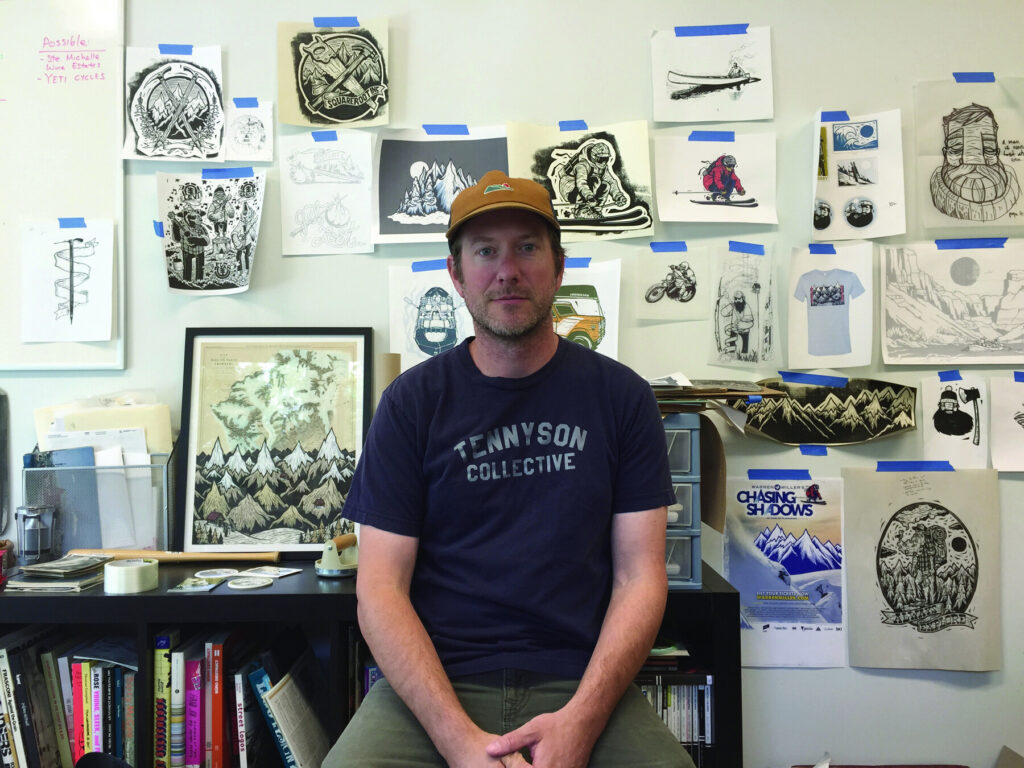
John Fellows and the Land of Mountain Folk
John Fellows’ art carves the alpine fun-hog culture into high relief
Art pretty much blew John Fellows’ ski bum career. He was on the right track, totally on the right track. Grew up in a big East Coast city, Philadelphia. Traveled around Europe and fell under the mountains’ spell. Took I-70 straight to Colorado’s Summit County and almost immediately got work at Keystone Resort as a “yellow jacket” telling skiers and snowboarder to slow down. He bumped chairs in the summer season. Put the pieces in place to become a patroller and got accepted to join the Keystone squad, following his girl there. “I thought I’d found my calling,” he says.
But then, dang it, art. Fellows worked for five years in the Keystone sign shop. He got busier and busier. Made tees and hats and the like in the warm months. For two seasons, he delayed joining the patrol. “Stuff kept happening. There was this job and then that job and then oh yeah graphic design and then a tee shirt and then…”
And then he was moving to Denver to make a living as an artist.
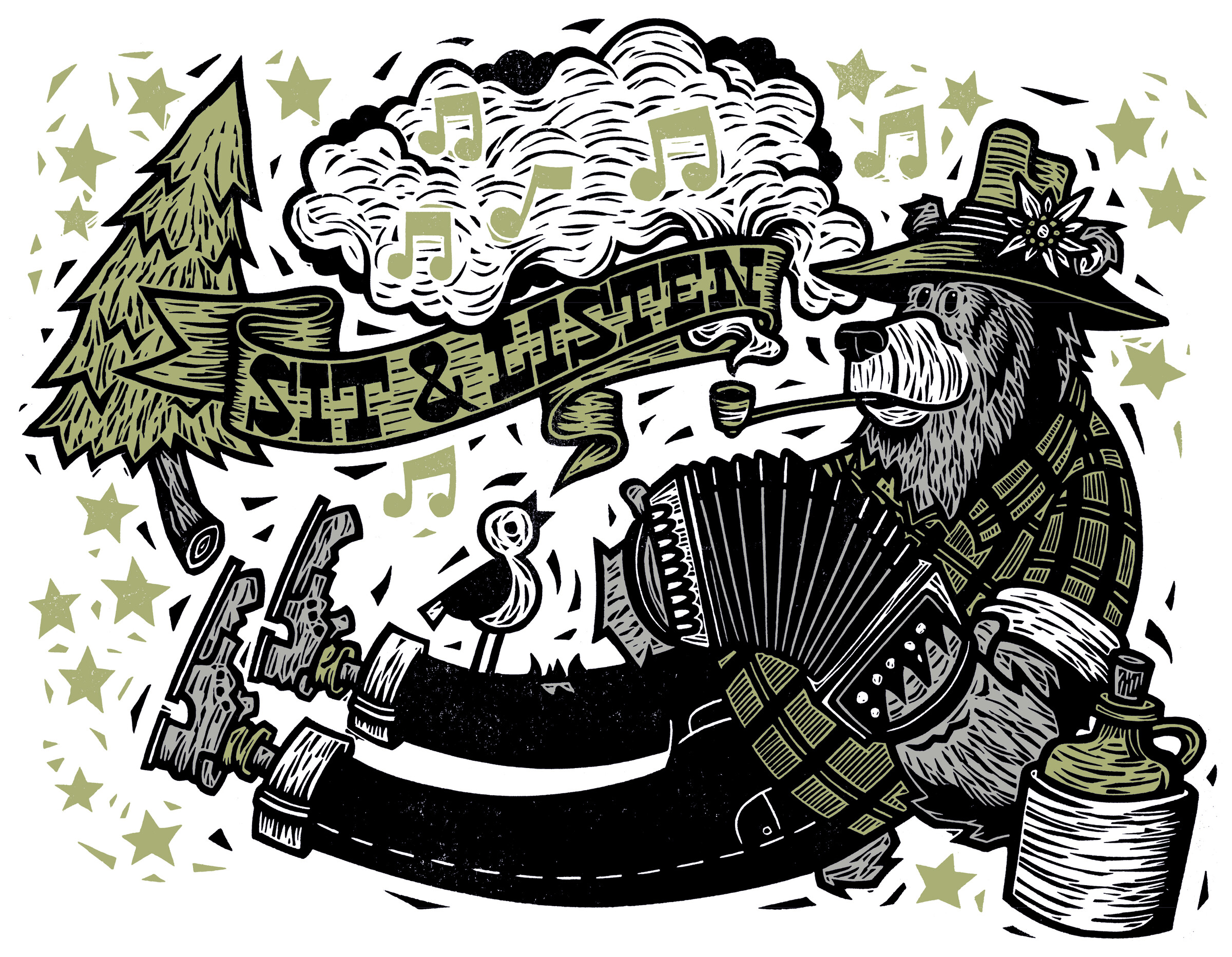
It’s almost enough to make a Summit County ski bum shed a tear. Except that Fellows is now by any rights a successful fine artist, whose work singularly defines what might be called contemporary mountain folk, whose clients include the likes of Pearl Jam, whose art has been displayed in Australia, Japan, the Netherlands, New Zealand, and the States. So, yeah, the ski bum thing didn’t really work out for the long haul. But the art, that’s going pretty good.
“West Point goes back eight generations in my family,” says Fellows, who as an Army brat moved every three years growing up. “When it came time to go to school, art was never an option. It was, What kind of career can you get when you graduate? How are you getting your 401(k)?
“I settled on graphic design because it’s kind of like art. Drexel University in Philly has a big co-op program. By the time you graduate you have nine to 18 months’ experience. Little did I know that would teach me I never wanted a full-time job. After school, I worked just enough to afford plane tickets, and graphic design jobs would always let me come back. It definitely wasn’t the career path my dad was hoping for.”
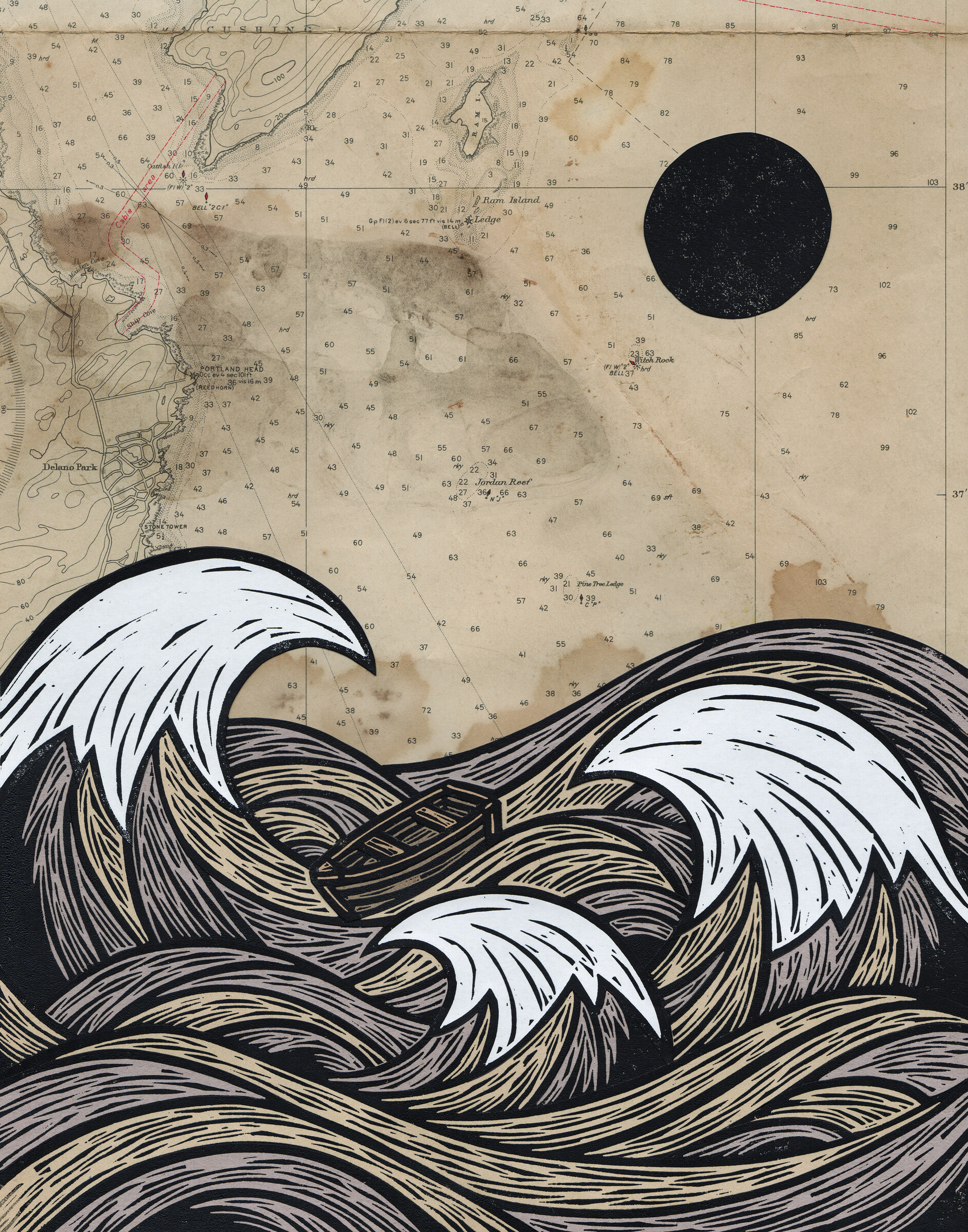
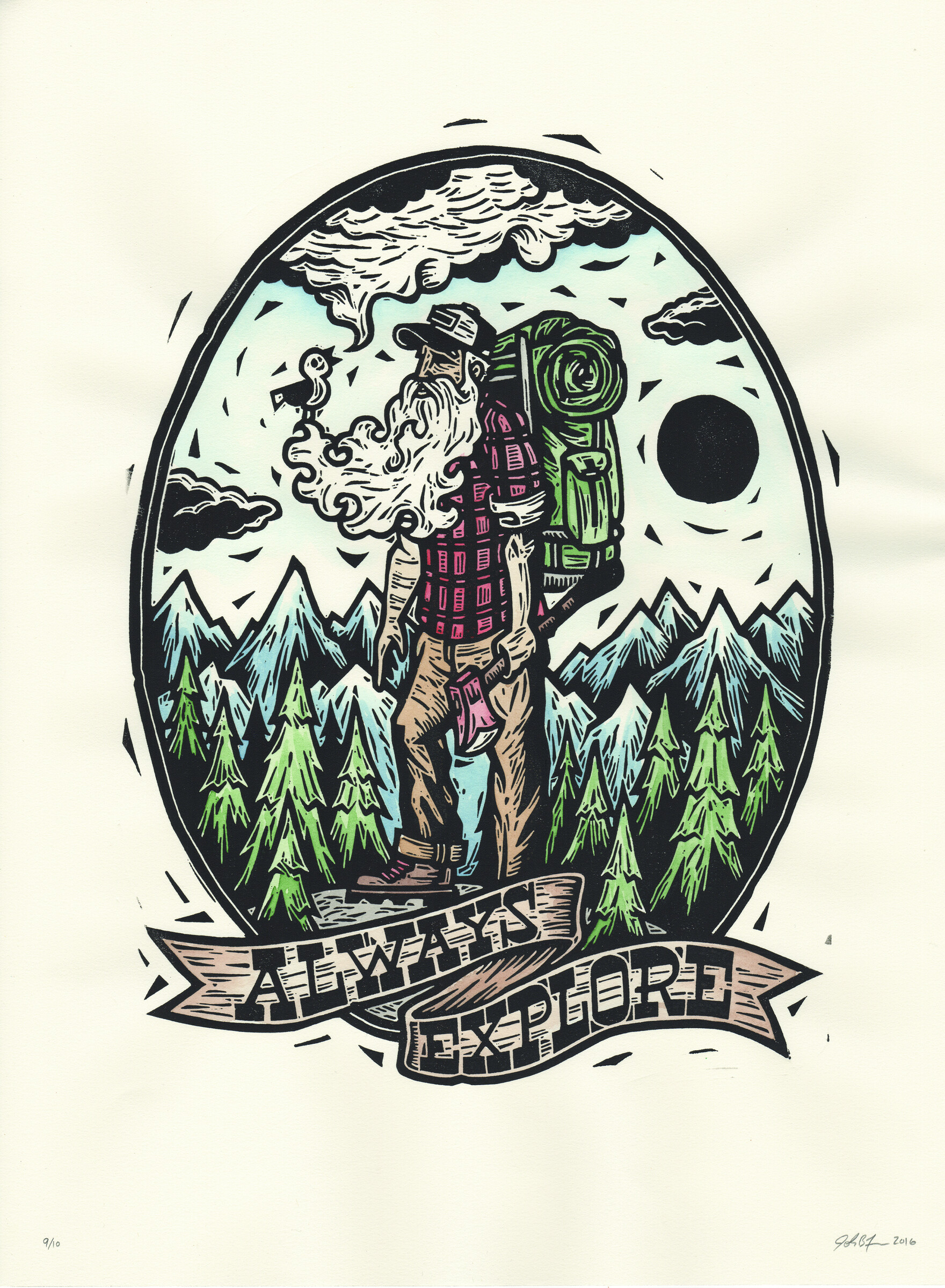
But it led to successive summers in Gimmelwald, Switzerland, where he reinvigorated his creativity by making linoleum block prints for post cards he’d send home, and there in the Alps he met the Colorado girl who would become his wife. Linoleum cut printing mirrors the erosive hand of nature. Beginning with a chunk of linoleum, a friendlier medium than wood, the artist carves away the surface—a composite of linseed oil, rosin, cork dust, and wood flour—to create a blockscape of peaks and valleys. Ink sticks to the ridges, which are called the relief, and that determines the color you see when it’s printed on paper. Everything not inked is the negative space—the paper itself. If you want more than one color, typically you’d make a second block and try to get the paper lined up just right on the next pass.
The block cut process is among the most basic of printmaking techniques, taught in elementary schools around the world, but it’s used at the highest levels of art, too. Henry Matisse made monochrome linoleum prints of zaftig women with gamin hair, and Picasso dabbled with linocut in his late 70s, creating the spectacular Buste de Femme au Chapeau, whose five colors were added by carving away a little more of the original block for each additional hue.
Fellows first learned block printing as a kid, but came back to it because he was disgusted with how poor his drawings were. “I’m a control freak when I draw. It’s like I’m choking the pen or pencil. I’d get so mad if it didn’t look like I wanted. The linoleum carving freed me of that. You have to think differently, you can’t shade things, there aren’t gradations. I had to learn to reduce things to their simplest. If I was making a portrait, I’d try to make it extremely graphic. And slowly that worked into my style.”
His break came in 2006 when a friend with a shop in Denver put his prints on display. The response to them was positive, and he found the Denver art community encouraging, open hearted, even nurturing. Tired of ski area politics, and with his wife ready to switch from patrolling to nursing, they moved down the hill to the city.
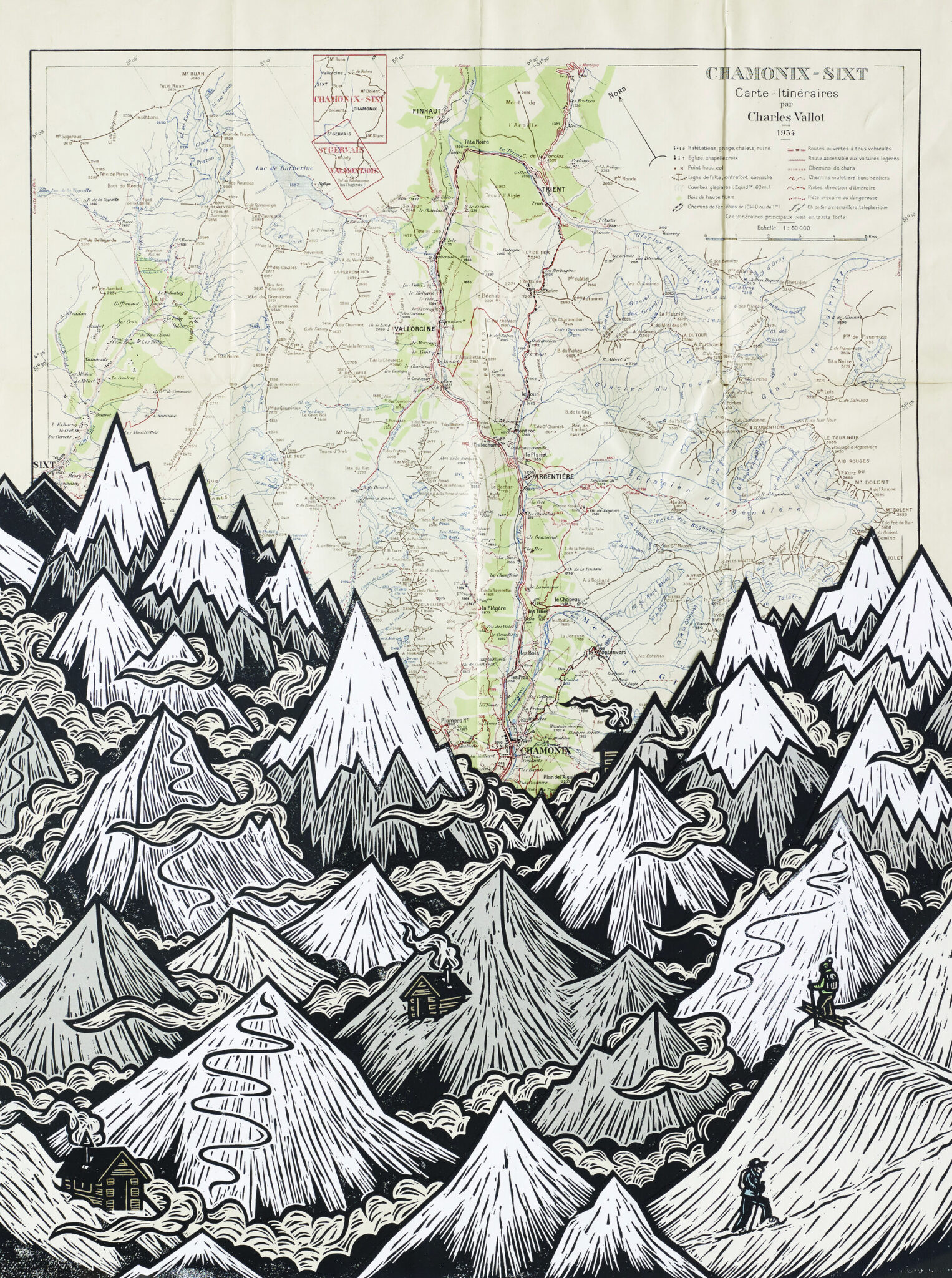
Over the next decade, his work became steadily more confident and, though not necessarily apparent to the eye, more woven with the personal. Beards feature significantly in his prints, long swirling tangled beards, but these are not the lumbersexuals that stride Pearl Street in Boulder—these are the old men he met in Gimmelwald, the farmers and craftsman and laborers whose lives in the high peaks were etched on their faces. The maps upon which he prints many of his blocks are found through careful connection to place, like the 1850s rendering of the Mer de Glace he found in Chamonix, or a family connection, like the New England marine charts his sailing father handed down to him.
If not maps, Fellows might print on old envelopes or books. A new body of work for an exhibition at the 2018 Banff Mountain Film and Book Festival was focused mostly on books, as connection to the literary side of the festival. “I keep buying more and more books,” he says, “and my wife is, like, what are you doing? A lot of people in younger generations, they don’t care about paper maps or books. There’s no sentimentality around paper. But for the groups who do like to hold something physical, the prints can hold a special place in their hearts.
“I use the title page of a lot of books, and people can project their own stories onto my pieces. They’ll first be drawn to the art and then they’ll see the layers and maybe the title of the book in the artwork will resonate with them about something they’ve done or something they’ve read. It’s all a narrative, a loose narrative.”
In summer 2018, Fellows and his wife Lara and their two young kids moved back into the mountains, this time to Crested Butte, a bit south and west of Summit County. She has family there, and their kids will grow up around auntie and grandma. Lara drove to her nursing job in Denver two days a week, while John held down the fort as a stay-home dad and working artist. They were unpacking slowly, still trying to remember what was where, and John was making prints in the garage while looking for studio space in town, as winter comes early there and the garage will only work for so long. Just below their red-stained deck, a creek ran clear and cold, and on the skyline stood Mt. Crested Butte, its sharp, rocky shoulder looking an awful lot like a John Fellows print. It looked an awful lot, too, like the kind of view a young ski bum might hope for his family, should he let himself dream that far ahead.