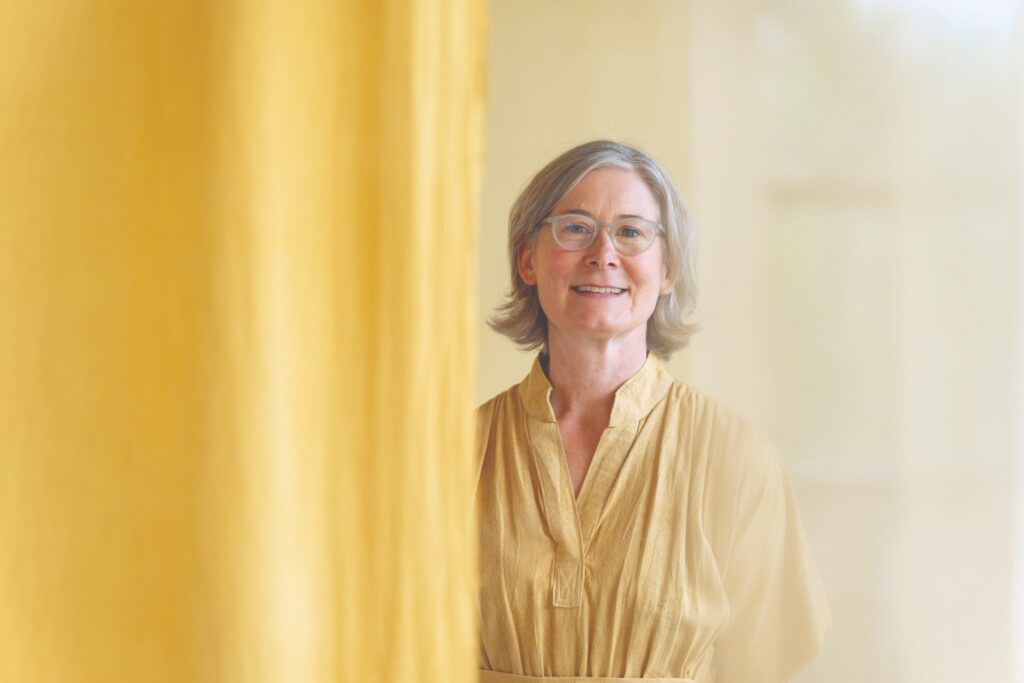
Julie Beeler Turns Mushrooms Into Rainbows
I caught Julie Beeler on one of those weeks. She was teaching indigo to the first-graders at her local school — the annual Mother’s Day tea-towel project, seedlings in cups, science and plants and color all at once — while prepping two webinars (one for the New York Botanical Garden, one for the Minneapolis College of Art and Design), and packing for two weeks in London at the Royal Botanic Gardens at Kew, where she’d spend a week inside the Fungarium, the largest in the world.
You sound busy.
I am. I was teaching. I’m giving two webinars this week and teaching two classes, so it kind of piled up on me. And then every year I teach indigo to the first graders — this week’s the big Mother’s Day tea towel. They’re learning about science and plants, it’s spring, they’ve all got their little seedlings in cups, and then I teach them about art and color. It’s a fun time.
Then I’m off to London in two weeks. I’m going to do a week of research at Kew, at the Fungarium — they have something like 1.3 million specimens in their collection. They’re also doing an ethnomycology symposium I’m part of. Then I’ll teach for a day at the Slade, at UCL, and go over to University of the Arts London, which has great people working on biomaterials and biocolorants.
And the timing — I’m so excited — overlaps with a festival of ideas, the kind usually run out of NYU, and they’ve never held it in London before. They announced it right as I was finalizing everything with Kew, and it overlapped. So Merlin Sheldrake will be there. Robert Macfarlane. Suzanne Simard. And Cosmo Sheldrake is doing a concert, and I finally get to go — he came to Portland but I’d just had knee surgery and couldn’t get anyone to drag me there. There’s also Tarun Nayar — Modern Biology, on Instagram, who makes music by wiring into fungi and plants. We’ve been trying to meet up for years, and he’ll be over there too.
What a trip.
I know. And then Brad and I are going to meet in Copenhagen for three or four days — I’ve never been — and then out to the Faroe Islands.
The Faroes are a bucket-list trip. When I was in Copenhagen, the one thing I’d say is go out to the Louisiana Museum.
Yes — my friend who was born in Copenhagen told me the same thing. She said it’s an easy hour on the train, that I’ll want to spend more time there but could do it in three-quarters of a day and still have the evening back in town.
It’s an extraordinary museum. Robert Longo had a big show when I was there — I’d never seen his work in person.
She said I’ll love everything about it — the building coming out of the sea, the bakeries. I need to look at what’s on, but I think we’ll go regardless.
So how did you get into mushrooms in the first place?
I grew up in the Northwest, and as a little kid the mushrooms were just popping up — I didn’t even know what they were, I picked them like they were a flower. I’d come home with these little mushrooms. So I’d always been curious, and never understood them at all.
Then I moved down to Berkeley and fell in with a whole group of friends — designers, artists, food people, chefs — who foraged fungi for the kitchen. They kept inviting me, and I kept saying I was too busy. I’d already forged this pathway with quilting and textiles. Someday, someday, someday.
And then in 2012, when our design studio was acquired and I was about to start working part-time, I thought: okay, what have I always wanted to learn? Now I have the time. So it was fungi and mushrooms. I immediately signed up for the local mycological society, started taking all the identification courses, going on the field trips and forays, getting involved.
At the same time I wanted to push the textile path I’d been on since I was little — my grandmother had a fabric and yarn shop. When I was in Berkeley I’d joined the East Bay Heritage Quilters Guild, where a group of women were making what we call art quilts, and that’s what I dove into. Originally I thought I’d do graphic design and work with my hands — cut Rubylith, all of it — but the desktop revolution took off, and I was in that first generation of designers working on the computer. I wasn’t sure I loved that, so I decided my hobby would be working with my hands.
The other thing I wanted to do was pivot my textile work toward natural colorants — making my own patterns, not relying on an industry that, I was coming to learn, isn’t the kindest to the planet. So I thought: I want to do this, and I want to learn mycology. I wonder if mushrooms make color. A little Google search, and sure enough — Miriam Rice. She’d started working with mushrooms for color in the late ’60s and early ’70s and published a book in the ’80s that had just been republished. I got a copy and taught myself. That’s how those worlds came together.
Walk me through it. How do you actually get color out of a mushroom?
What I discovered was just that surprise of life — you’re kidding me. This tiny little thing that looks brown: if I put it in water, which is the typical extraction, an aqueous extraction, and heat it just like I’m making a cup of tea, I get these colors. And if I’ve treated my fiber properly, that color will bond to it.
Working with natural materials for color goes back thousands of years — they found indigo in an archaeological site in Georgia dating back 34,000 years. So this is old knowledge. But for me, finding these little mushrooms — which took me a long time to even identify — and bringing them in, it was mind-blowing. Mushrooms are so much more complex than, say, a flower or a berry. They’re these chemical wizards, with so many pigment compounds. And then if I tinker with the pH — getting in there with acids and bases — I can shift the colors and get a whole range out of one little mushroom. That blew my mind.
What are the acids and bases — also natural materials?
Things like vinegar for your acid, or soda ash and baking soda for your base. Just adjusting the pH enough that the mushroom responds. All of a sudden a mushroom that was making a mellow color, if you put an acid in, gives you this incredibly rich, glorious orange. A base, and you start getting more of a brown-red. You expand the palette.
Is the response consistent, or is every mushroom different?
Flowers, berries, roots — they don’t respond much to acids and bases, because a flower really only has one or two pigment compounds. But a mushroom — this one little Cortinarius, I’ll send you a picture so you see how tiny it is — we’re learning has up to 13 different pigment compounds. So you’re trying to isolate them from one another.
Generally, with fungi, if you add acid you’ll get more yellows and oranges; add a base and you’ll get more greens and blues. But there’s always an exception. That little red Cortinarius? To get the red out you actually have to add a base. So it’s a rule of thumb to help people down the path, but funga always has an exception.
Where do mushrooms sit relative to other natural dye sources — is there a deep history?
It’s lesser-known and lesser-used than plants, but there’s a long history. There’s a French textile archaeologist, Dominique Cardon, who’s traced it through the manuscripts. That crimson red we all associate with the Italian Renaissance? That came into being through a companionship between a flower and a mushroom. We know the European dye studios — in Paris, in the Netherlands — used mushrooms at scale, dyeing yardage and yardage. And Indigenous peoples along the Northwest coast used a fungus they called the paint fungus as a symbolic body paint.
Here’s the super-cool one. Just last July, an Indian entomologist was studying the lac insect — the one used to make shellac, and also a beautiful red. It’s highly revered in India, culturally and economically; they farm it. He decided to map its genome, and he found that the red color isn’t coming from the insect at all. It’s a fungus making it — a symbiotic fungus. The scientists were saying it’s a fungus that paints the town red, not the insect. So all those master paintings that used that red — that red is from a fungus.
Has cochineal been studied the same way?
Exactly — when I read about the lac insect I said the same thing. In my heart I know that when they map the genomes of cochineal and kermes, they’re going to find it’s a fungus making that color too. I’m waiting for the day, because no one’s taken on that work. And I think it’ll be true of the mollusks that made Tyrian purple — you’d basically milk these mollusks for little drops of purple, and of course the species was nearly wiped out, a big ecological tragedy. There are a few remaining, and in Oaxaca the Indigenous dyers still have the rights to work with those sea snails. I’m sure we’ll find a fungal symbiont in there too.
Why are purples and blues so hard to get from nature? I read that birds don’t even have blue pigment — it’s structural, the way the feather scatters light.
That’s right — it’s iridescence. With blue, the famous one is indigo, and there are many species of it. The only two plants in the natural world that make blue are indigo and woad. So blue is rare. And purple in the natural world — when you try to get it from beets or cabbage, from flowers like scabiosa or hollyhock, those have a pigment compound called betalains. In an aqueous extraction the liquid looks gorgeously rich — cook purple cabbage and you’ll get this purple water — but betalains don’t like to bond. The color shifts and falls away. So purple is very hard to capture.
In fact, purple is the reason we have synthetic dyes at all. William Perkin, in 1856, was tinkering in his lab and accidentally created mauve out of coal tar. That revolutionized everything — suddenly you could make color chemically, from petroleum — and within a couple of decades the natural colorants were gone, replaced by petroleum-based dyes, which led to all the pollution and the problems with clean water around the globe. So in the end it was the color purple that pushed all that forward.
Let’s talk about the Mushroom Color Atlas. How did you get from your own experiments to this thing that’s become a reference for the whole field?
I was still teaching, in higher ed, working with students on natural colorants, and I was in a weekly study group — we’d meet in the fiber lab and each take turns bringing something in to test. I was always bringing fungi. And through all of that I realized there was a real gap. The books that existed just wrote the colors down — “this mushroom should produce a red-beige” — but you had no idea what that red-beige actually looked like.
So I thought: how do I make an accessible educational resource? I’d had a whole career in interactive media design, building websites, so I could publish on the web. And it let me tap my inner library-archives-museum nerd — I’d spent twenty years in archives and collections, and this was the perfect bridge between my former life and now.
The mushrooms had to be illustrated, and they had to be black and white — no color except the color that comes from the mushroom. So I worked with an illustrator, Yuli; Brad helped me with the visual design, typography, the logo; and my friend Danny Rosenberg, a programmer, set me up a real database so I could keep adding to it. I launched it in October 2021, and it just got picked up. People started seeing it. A wonderful magazine over in the UK called The Mushroom — gone now — wrote it up. And over and over I heard the same thing I’d felt: you’re kidding me, I had no idea mushrooms make color.
I add to it every year. It’s a living, breathing thing — it’s got something like 825 colors now, from around 400 mushrooms, and I’ve got another 20 mushrooms waiting.
Less than three dozen mushrooms shown on the palette, and you get 800-plus colors out of it?
Yeah — and that’s just what I’ve done. There’s so much more out there. People send me mushrooms from all over now, they experiment, they tag me, they email. It’s a great community. And it crosses into so many worlds — MycoWorks, who make mycelium leather, asked me to run a series of dye tests on it; the Forbes Pigment Collection said they needed fungal pigments and asked me to curate a subset. It’s a nice overlap of a lot of different interests.
Do you feel like you’ve become a nexus for this?
No — I think it’s just a way for people to get in. Miriam Rice did this with her book in the ’80s and spawned a whole contemporary movement that I’m part of. This is just today’s version, the way to get people engaged. It happens that fungi are at the forefront right now — they’re in the lexicon, people are even considering them in conservation, which they never would have a few years ago. You’d think to protect an animal or a tree, but fungi? Merlin’s a big part of that shift. So people get pulled in.
Do you feel like we’re on the edge of a new era of understanding what fungi can do?
Absolutely. There’s so much we don’t know — it’s genuinely mind-blowing when you sit with these scientists and realize how little we do. They estimate there are multiple millions of species, and maybe we’ve identified ten percent. Maybe. With the citizen-science work, with iNaturalist, with DNA technology getting more accessible, thousands of new species are documented every year. And fungi evolve and adapt so much faster than, say, mammals — in one lifetime we’ve watched them learn to decompose plastic. There’s a fungus in Chernobyl doing remarkable things with radiation.
But the reality of using any of it is a whole other set of issues. If we picked up a plastic-eating fungus from China and brought it to the Pacific Northwest, it could go invasive and choke out everything else. It’s like the carp they brought in to solve one problem, and now the carp are the problem. A real example: the yellow oyster mushroom. People started cultivating it because it’s beautiful — yellow, pink, blue, and people buy color — and now the science shows it’s extremely invasive, escaping cultivation and decimating native forest fungi. That happened in the last decade. So we’re learning all of this, and we have to be very cautious about bringing it into being.
Tell me about Bloom & Dye.
That’s my flower farm. We live on an 18-acre farm in Trout Lake, and I carved off a chunk for it. I grow natural-dye plants — indigo, madder, cosmos, coreopsis — and specialty cut flowers, and I do weekly bouquet deliveries, like a CSA but for flowers. It’s also my studio, where I teach. I retired from higher ed at the end of 2020 because I didn’t want to be in it any longer, and started doing workshops and community-based work instead.
Was that whole period — selling the studio — your big pivot?
That was it. We’d had the studio twenty years, and it was ready for its next iteration — but we weren’t the ones to carry it into the future. Time to pass the torch. Brad and I founded it together, and he was ready to move on, pretty burned out. I didn’t want to keep it going alone, and he agreed. But I wasn’t burned out, and I didn’t want to retire. So I had to create something for myself. That’s what I did.
We always run a label for people. What do you prefer — mycologist, artist?
Not mycologist — I’m a mycophile. I’ve never studied this formally; it’s not my degree or my background. Mycologists are the actual scientists. Call me an artist, or a designer.
Or a desert dirtbag.
Yeah — exactly.
Last thing. I was looking at your CV and it’s about 18,000 pages long.
Live long and prosper — that’s what happens. I keep thinking I should edit it down, take some things off.
Or just leave it. Let it accrete like a coral reef.
Beeler’s work, and the living Mushroom Color Atlas, are at juliebeeler.com.