
Love in the Borderlands
Ruta del Jefe is more than a bike festival. It's an attempt to improve the world, one pedal stroke at a time.
Seen from Mexico, and at a distance, the American border wall across Arizona is surprisingly beautiful. The rusted steel bollards take on the color of wild buckwheat in the fall, a deep and lustrous burgundy red, and it’s only when you get close that a chemical orange tinge reveals itself. From this distance, and on this side, the wall looks like land art, a dark wine-colored line sketched across the horizon, rising and falling with the topography like kelp in a gentle ocean swell and fitting in among the tans and ochres as if made for it. Of course, it wasn’t created to be beautiful, or thoughtful, or nice. It was made to keep people out, and to intimidate. The post-apocalyptic steampunk vibe was intentional, and it’s easy to see each bollard as a certain former president’s middle finger aimed south.
In reality, though, the wall could never be just one thing. It is beautiful and horrific—and so much more. Such is the nature of the border zone, where the tides tug in all directions, and life is complex, contradictory, nuanced, and rarely depicted with the fullness of the people who animate it.
All of which might seem a strange way to begin a story about one of the most fun bike festivals I’ve ever attended, the Ruta del Jefe, held in March 2024 in a northern Sonora ecological preserve, because the wall is definitively not fun. But in this part of Mexico, it is impossible to escape its shadow. Indeed, the wall’s impact on people, wildlife, and ecosystems was one of RDJ’s primary themes. Aside from riding bikes across rolling former ranchlands, it offered workshops and speakers on biology, birding, art, chocolate, immigration, sotol, and more. It describes itself as “celebrating adventure, education, community, and advocacy.” Yes, but in a dispatch on her website, artist Beija Flor put it more lyrically: “Unlike any bike event or really many events for that matter, Ruta del Jefe felt like a serendipitous reunion, a blissed-out hallucination of summer, a portal to witnessing and listening to a space we can only ever experience if we are welcomed into it.”
I drove through Sonora with an open mind and no small amount of excitement, but, not being a fan of crowds or big group rides, even before I arrived I was planning my departure for sunrise on Sunday, after scheduled activities were complete. That shows what expectations will get you: By the time Sunday rolled around, I was so blissed out they practically had to ask me to leave.
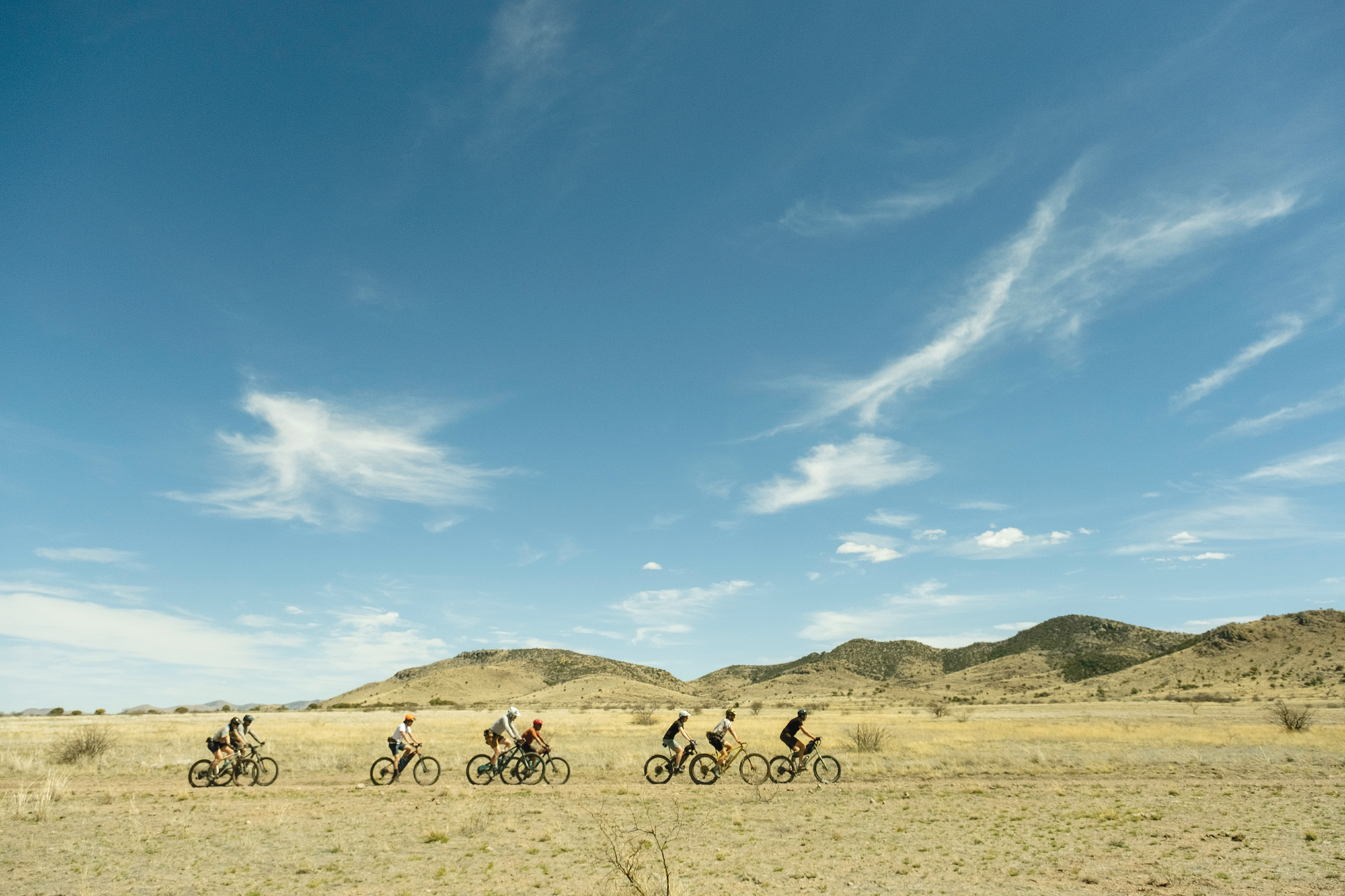
Ruta del Jefe is the brainchild of Sarah Swallow, an adventure cycling evangelist originally from Ohio but now living (mostly) in Durango, Colorado, and Tucson, Arizona. She’s a thoroughly modern professional cyclist—a brand ambassador, route developer, event organizer, and former shop owner, who rides in huge races like the two-thousand-five-hundred-mile Tour Divide not to compete but to have fun. “I use the bicycle as a tool for well-being, community connection, and relating to the natural landscapes I travel through,” she says. The inaugural Ruta was held in Arizona’s Santa Rita Mountains, where she’d mapped a series of bikepacking routes called the Sky Islands Odyssey; this fourth iteration was significantly more ambitious. It was located at Cuenca Los Ojos, one hundred twenty thousand acres of protected land assembled piece by piece from ranchers willing to sell. It was Swallow’s first event south of the border and it was Cuenca Los Ojos’s first public event ever.
The region is a hotbed of biodiversity. Here, the Rocky Mountains meet the Sierra Madres and the Sonoran and Chihuahuan deserts abut each other. Cuenca Los Ojos means “watershed of the springs,” and the perennial Cajón Bonito is one of the area’s most important freshwater streams; during the Mexican Revolution, troops routinely traveled its banks because of the reliability of running water.
On Friday’s get-to-know-you spin, in a group of dozens of riders on just about every kind of rig imaginable, from rigid single-speeds to dropbarred and knobbied mile-eaters, we got to see a little of the topography. The ride was led by Dr. Rodrigo Sierra, a biologist who’d spent more than twenty years working and researching on Cuenca lands. With sweeping gestures, he pointed to the mountains where he’d lived in a cabin for months at a time, toward the hills where he’d tracked bears and mountain lions, to the valley where Cuenca founder Valer Clark had her ranch, and in the direction of the doubletrack that would take us back to the Ruta del Jefe base at a spot called Rancho Nuevo. Only from the highest point of the ride, in Valle de las Ánimas, could we get a glimpse of the two-lane pavement we’d all come in on; everywhere else we looked, it was a sea of dun-colored grass, hardy junipers, ridge after ridge of mountains, and not a sign of civilization.
The riding was all on dirt roads, but that doesn’t mean it was easy. Swallow recommended a mountain bike and suspension, and it was good advice for the descent back to Rancho Nuevo alone, where I encountered loose gardens of babyhead cobbles and any temptation to uncork it was tempered by big dropoffs beside the switchbacks. “This stunning landscape is not to be underestimated; it’s steep, rugged, rocky, sandy, and remote, with many water crossings,” she wrote prior to the weekend. “The terrain will have riders dreaming of extra climbing gears, wider tires, and suspension. Distance means nothing out here. The challenge level is measured by the technical terrain and the number of feet gained per mile. The average completion time for the forty-mile route is seven to eight hours. This is not a gravel ride!”
She spoke the truth. But we took it casually, riding sixteen miles in two and a half hours, stopping regularly to hear about the land, and returned to Rancho Nuevo fresh and ready for an evening of speakers under a giant open tent. Notably, right before we passed a bump called Cerro La Tinaja and dropped deeper into the Cajón Bonito watershed, two tumbleweeds whirled past in a spinning vortex. I don’t know if it was an omen, but it sure was delightful.
Cuenca Los Ojos exists because Valer Clark moved from Manhattan to southeastern Arizona with her husband Josiah Austin in the 1980s, when they bought the nineteen-hundred-acre El Coronado ranch. Looking across the overgrazed, degraded lands, she asked Josiah, “What do the cows eat, rocks?” After the first monsoon, she was dismayed at the depth of erosion. They built a handful of small rock dams, known as trincheras, in the gullies, and the results were thrilling: The trincheras slowed the flow of water, allowed silt to deposit, and collected seeds that germinated, which further slowed the water. They hired people from a village in Central Mexico, who were known for their expertise in trincheras, to teach them the intricacies of naturally inspired dam building. What happened next was a revolution.
Over two decades, Clark and Austin built twenty thousand trincheras and transformed El Coronado from a near-wasteland to a verdant experiment in low-tech, highly efficient restoration. “I watched that landscape change from rockland habitat to robin and frog and turtle habitat,” said Walt Anderson, a biologist. “They showed it right there that you could convert what looks to be arid landscapes into lush landscapes.”
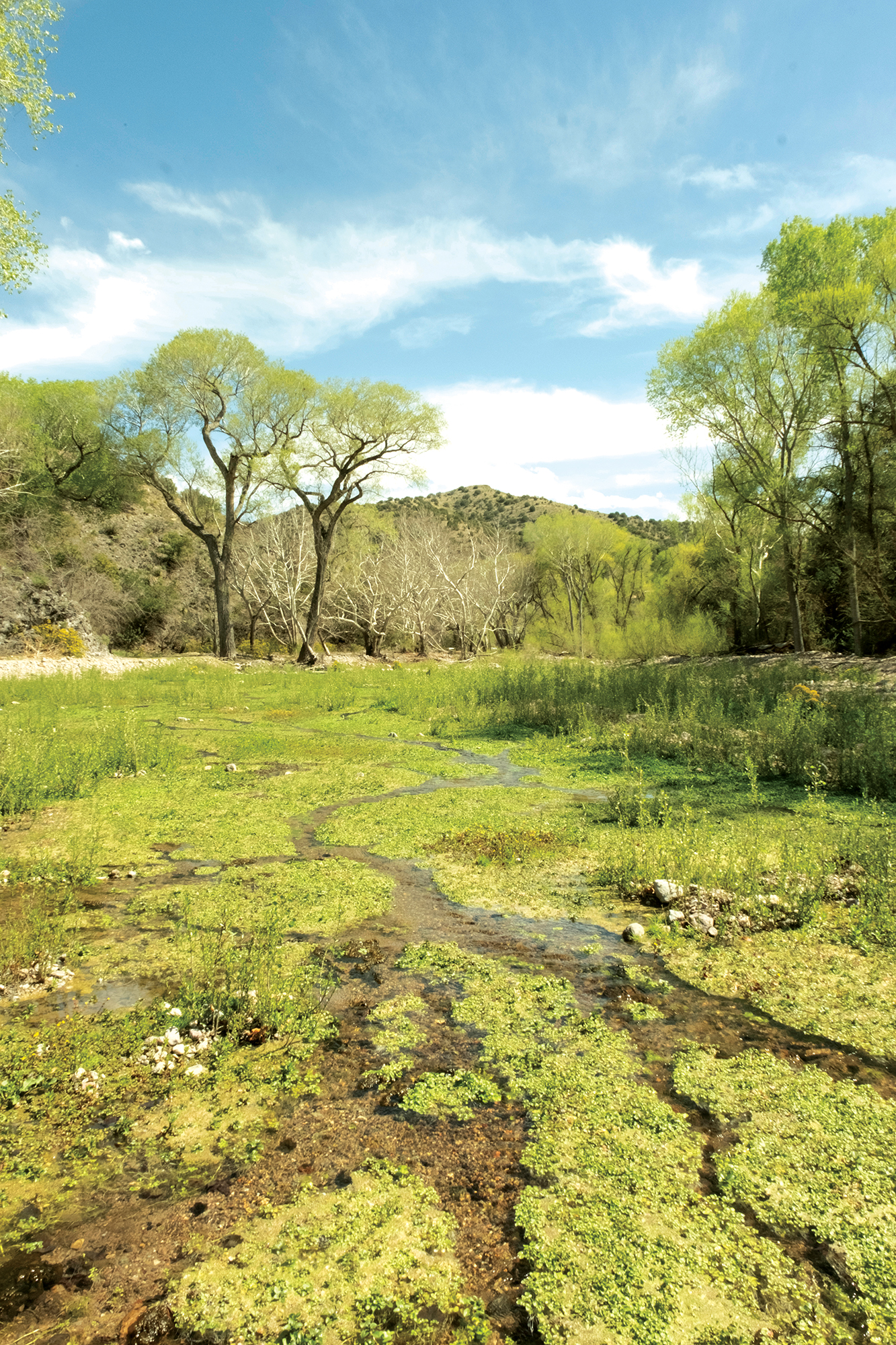
At the recommendation of desert fish expert W.L. Minckley, Clark turned her attention south, to the area around Cajón Bonito, and began purchasing vast parcels from Sonoran ranchers. She hired a foreman and workers and put the lessons of El Coronado into play. Now known as Cuenca Los Ojos and protected by sister NGOs in the U.S. and Mexico, her transformation of these lands has been remarkable. Over nearly four decades, the CLO crew built forty thousand trincheras, a thousand water-guiding berms, and eighty large rock dams called gabions. Today, the water table is higher and six miles of bone-dry river have water all year. The area’s largest ciénega, or wetland, has grown by seventy percent. In addition to the natural growth of vegetation from the influx of water, Cuenca Los Ojo planted sixteen thousand saplings.
Critters followed the water. There are bears and bunnies, javelinas and ocelots, and, most excitingly, jaguars. These big cats are the charismatic rock stars of the area and symbols of power and mystique dating back centuries. Indeed, Ruta del Jefe is named for a celebrity jaguar who showed up on Arizona wildlife cams in 2011—the only jaguar verified living north of the border. Biologist and National Geographic Explorer Ganesh Marin has recorded four of the cats on Cuenca property using his network of hundreds of camera traps, part of his PhD dissertation tracking the impact of the border wall on animal migration (spoiler: it’s not good). He and his fellow researchers named the two young males they spotted Valerio and El Bonito.
At his presentation after dinner on Friday evening, Marin showed video of what appeared to be Valerio rubbing his cheek on a downed tree. “He’s marking the territory. That was in Cajón Bonito. They just leave their scent to tell the other ones, I am here, I am home.”
But there was more to the story. “Sound please,” said Marin, and from the jaguar came a series of deep grunts. “Since 1996 in this area, they have only detected males because males are the ones to disperse. But seeing that behavior in Valerio, I was, like, what’s he doing, because that’s typical from an adult telling the other ones, this is my territory. And then we saw…can you play it again? That deep sound and the absence of testicles…if someone sees testicles…but I don’t see anything tricky. Check it again.” The video plays the grunts again. “Yeah, that’s the sound of a female asking for a mate. And that happened just one mile from here, one mile to the borderlands. Without doubt, it’s a female.”
There was a sharp intake of breath from many and more than a few whoas. A female? This close to the border? “That’s fantastic,” said Marin, “because that means the populations of jaguars are really close to being back in the United States. That video was in February. The next one was in March. They found each other, they found love in the borderlands. Who knows where they are now? I keep imagining every time that I am here jaguars are seeing me. At some point, we are mammals, we are required to move. We empathize with the stories of those who have been moving to have a better life. Just moving to find love, to find a home.”
Over thirty days of recon in fall 2023, Swallow and her team mapped more than one hundred fifty miles of potential routes, though many of the Cuenca roads had been hammered by the seasonal monsoon, leaving the CLO team with plenty of work to do before the event. They settled on three loops, each named after big cats: Valerio was eleven miles and had twelve hundred feet of climbing, El Bonito was twenty-seven miles and had three thousand three hundred feet of climbing, and El Jefe clocked thirty-eight miles and forty-two hundred feet of gain. All three started from Rancho Nuevo and traveled up Cajón Bonito, with more than a dozen water crossings before hitting a long, steep climb out of the valley.
After breakfast on Saturday, cyclists gathered for the main event and made last-minute adjustments to their gear, filled water bottles, chatted with friends. Swallow called for attention and reminded everyone to check in at each aid station, to check in when they returned, to be aware, to remember they were on their own and there was no sag wagon, and then she told us we could go. But nobody moved. Scores of people sat on their bikes in the pale sun. Nobody wanted to be first or to put themselves ahead of anyone else. The moment felt like Ruta del Jefe in a nutshell. Eventually, after a long minute, one guy shifted his body in the direction of the trail and that broke the spell. One by one, the whole crew saddled up and started pedaling.
It was a big group, but people spread quickly into clusters and singles, some hesitating at the first water crossing, others diving right in to get their feet wet and be done with it. By the time I arrived at the first aid station eight miles in, where bacon was sizzling on a stove under an Ombraz sunglasses banner, there were stretches with no cyclists in sight.
It was a beautiful spring day, cool and cloudy, and wonderful to ride without consideration of pace or a clock. Spontaneous conversions occurred as I caught up with people or they caught up with me. I rode with Cat, a science journalist whose grandparents moved to Aspen in the 1940s to grow potatoes. I rode with Carl, my neighbor in the campfield and the nicest guy, who improbably had BADBOY tattooed inside his bottom lip, and I rode with John, whose yellow custom Sklar hardtail I couldn’t help but envy, and with Spencer, Eva, Rodrigo, Nick, Hannah, Lindsay with an “A,” and a bunch of others whose names I didn’t catch. I didn’t remember often enough, but when I did, I asked people to summarize their Ruta experience in one word. One person said rad and one said fun. Six said magic.
On the now-familiar descent to the ranch, the babyheads were still loose, the drop still steep, and I was in no hurry, riding slow enough to marvel at the shocking brilliant green of life along the creek below. I rolled into camp with gas in the tank, but dusty, sweaty, and ready for a nap and coffee, in that order. I’d ridden twenty-seven miles in five hours, half of it spent in the saddle, half of it spent snarfing snacks at aid stations, taking pictures, and stopping to soak in the views—a golden ratio if you ask me. Later, in line to get dinner, I waited behind a couple of guys who’d ridden the biggest loop. They stood silently holding their plates and utensils. Finally, one of them spoke. “That was a hard thirty-eight.” There was a long pause from his buddy. “Yep.” An hour later, a single cyclist pedaled past the dinner tent, his light bouncing in the dark. Swallow announced this was the last of the day’s riders, finishing the El Jefe route. A huge cheer went up into the night.
Sunday morning felt like the morning after. Sunday morning was the morning after. Saturday night closed with a DJ and riotous dancing that could only be described as ecstatic; it felt like shaking your body was the only way to process the richness of new amigos, new knowledge, great riding, amazing food—a wave of wonder crashing under a moonlit sky. So, yeah, all was quiet the next morning. People’s movements around the ranch were subdued, and the camping grounds were half empty. Despite my initial plan to be up and out at dawn, I lingered at breakfast, over coffee, and while hunting for microtrash to pick up and throw away. I helped fold chairs and stack tables and dragged out my departure as long as I could, until word spread that a blustery spring storm would soon hit, threatening to turn the road into a quagmire of peanut butter mud.
I reconnoitered with Marin, who was taking me to see the wall up close, and I pulled in behind his white 4Runner to join the slow-moving line of trucks and cars heading seven miles back to the highway. At Mexico 2, we turned left, west, and a few miles later turned right, back to the north, and bounced down a series of dirt roads to park at a ranch house.
And there it was, thirty feet tall and rusting, rain-streaked and smeared with bird shit, a giant latticed screen upon which you could project almost anything: fear, anger, frustration, disgust. The two of us picked our way back and forth along the wall, Marin mostly silent, me ranting at the waste of energy and money, at the scar gouged by American bulldozers and explosives, at the political theater that had built the thing. After a weekend of empathy and positive vibes and so many folks working to make the world a friendlier place, it felt especially insulting, and shameful.
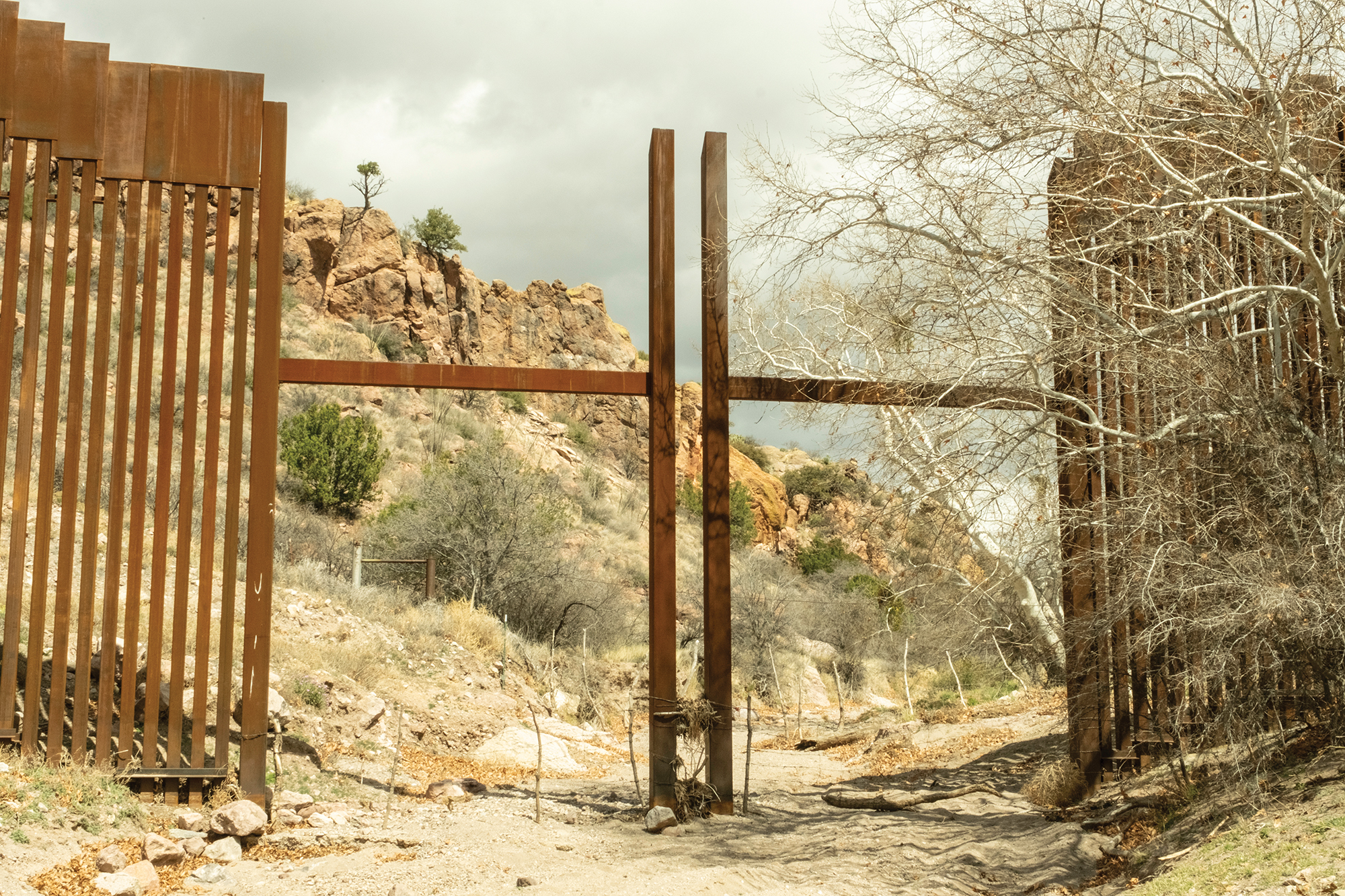
And even more because the wall stops nothing except confused animals. In a wash called Arroyo El Cacharron, where one of Marin’s wildlife cams kept disappearing, probably at the hands of people smugglers, there were voids in the wall big enough to drive through a Ford Superduty pickup. A hundred yards up a hill, in the middle of another large gap in the wall, there was a white concrete monument to binationalism, with plenty of room on either side to pass, a few limp strands of ineffective barbed wire hanging from a stick. I stepped from one country to the other, over and over, and shook my head at the absurdity. Well, no wall lasts forever, and where there are people like Sarah Swallow and Valer Clark, there is reason for hope. And optimism. And action.
A gust of wind swept down the wash, buffeted our jackets, and carried a litter of last year’s sycamore leaves through the gaps in the wall as if it wasn’t there. They settled on the American side, same as the Mexican side. Wordlessly, we turned and walked away, back to our trucks, and back to our bikes, too.