Maybe It’s No Surprise Shackleton’s Ship Sank
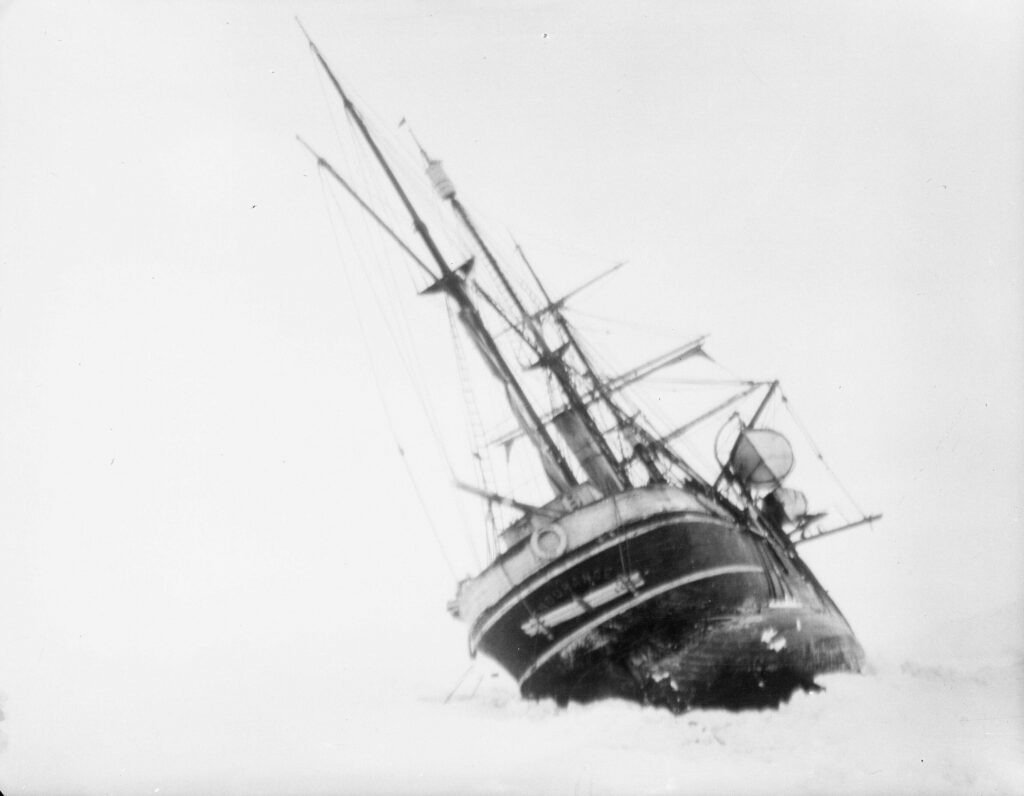
Most everyone knows the story of Ernest Shackleton and his crew: How their ship the Endurance was crushed by Antarctic ice in October 1915 and Shackleton kept up morale and all souls made it home alive. General sentiment was the sinking was plain bad luck, a product of the keel being torn off, but a study released Monday, October 6, says the Endurance was poorly designed for polar exploration and navigating ice. What’s more, Shackleton knew very well it wasn’t the best ship for the task but sailed south into the cold nevertheless.
By 1914, the Imperial Trans-Antarctic Expedition was conceived as the last great polar challenge of the Heroic Age—the first overland crossing of the Antarctic continent, a goal Shackleton had long pursued. The major prizes had fallen to others: Amundsen had reached the South Pole in December 1911, and Scott’s team had died there in January 1912, their bodies found months later. When news of Amundsen’s success reached him, Shackleton immediately pivoted, declaring that the “transcontinental journey from sea to sea, crossing the Pole” would be the next work of Antarctic exploration. He was now 40 years old and running against the clock.
The expedition, however, faced headwinds from the start. Of the nearly £80,000 Shackleton needed to fund the venture, the British government contributed only £10,000; he had to raise the rest privately. Key sponsors included Frank Dudley Docker, a prominent industrialist, who gave £10,000 without conditions to set the fundraising in motion, and Scottish jute manufacturer James Caird, whose personal cheque for £24,000 proved vital. Shackleton’s own finances were always uncertain, and his brother Frank had faced public disgrace when jailed for fraud. By early 1914, the window for departure was narrowing, and the window for glory—for being the first to accomplish the crossing—was closing even faster.
In January 1914, Shackleton purchased a Norwegian-built wooden ship originally named Polaris, which had been designed for operating in pack ice but had never sailed the Arctic as intended. The vessel was launched in December 1912 as the Polaris, designed to take wealthy tourists to the Arctic ice edge for hunting polar bears and walruses, but the First World War discouraged such recreational activity and the ship was never used for that purpose. Shackleton renamed her Endurance, in recognition of his family motto, Fortitudine Vincimus—Through Endurance We Conquer.
Finnish researcher and naval architect Jukka Tuhkuri was part of the team that found the sunken ship in 2022, and he pieced together its back story by studying journals and letters and analyzing its design relative to other ships. Endurance was supposed to be the most ice-worthy vessel of its time, which turns out to be myth, marketing spin, or a lie. “Since its launch, it has been repeated many times that Endurance was maybe the strongest wooden ship of its time, with very few questioning comments,” wrote Tuhkuri. It wasn’t.
The ship was built to withstand collisions with ice floes at the ice’s edge, where polar bears could be found hunting, but Shackleton took it into pack ice that puts compressive loads on the hull—a fundamentally different type of loading that requires different structural details in the hull, and those were not present. “Endurance was not designed for compressive conditions in the Antarctic pack ice, but for easier conditions at the ice edge in the Arctic. The weakest part of its hull was the engine room area, which was not only larger than in other early Antarctic ships but also lacked beams to give strength against compression by ice.”
Tuhkuri’s technical analysis shows multiple structural issues: the ship’s deck beams and frames were weaker than those of other early Antarctic vessels, and its too-long machine compartment weakened the overall hull, which itself lacked strengthening diagonal beams. The danger of moving ice and compressive loads—and how to design a ship for such conditions—was well understood before the ship sailed south. As evidence, Endurance was originally named Polaris and was created for Arctic tourism before Shackleton bought it for polar exploration, but other expeditions of the era, including contemporary German polar ventures, were using reinforced designs specifically engineered for Antarctic pack ice.
Shackleton knew this firsthand. When he departed in November 1914 to hear the worst ice conditions ever reported in the Weddell Sea, he had already resolved the decision: “for Shackleton it was now or never.” Comparing the ship to his earlier 1908 Antarctic vessel, he wrote to his wife, “…this ship is not as strong as the Nimrod constructionally this I have seen from her way of behaving when in a gale pressing against the dock wall here though there is nothing to be scared of as I think she will go through ice all right only I would exchange her for the old Nimrod any day now except for comfort.”
Indeed, Shackleton had assisted a German polar explorer on reinforcing his ship Deutschland with beams, and that vessel survived eight months stuck in polar ice. Deutschland was built by the same shipyard that made Endurance, and Shackleton had originally wanted to purchase it outright, but financial constraints pushed him toward the cheaper Polaris instead. In choosing Endurance over Deutschland or even over staying with the proven Nimrod design, Shackleton was choosing risk—calculated, perhaps, but risk nonetheless.
Tuhkuri doesn’t draw any conclusions about why Shackleton sailed with the inferior Endurance, but the context is clear. The expedition was facing mounting financial pressure, competing against time and the closing window of the Heroic Age itself, and determined to claim the last great unclaimed prize of Antarctic exploration. “Shackleton was well aware of the risks related to the strength of Endurance, but chose to use it anyway.” The margins between desperation and ambition, between prudent caution and explorer’s nerve, had narrowed considerably by the autumn of 1914.